Best AI voice over tools in 2026

Growth in the AI voice generator market doesn’t come from novelty features; it comes from teams treating TTS as a core dependency.
Growth in the AI voice generator market doesn’t come from novelty features; it comes from teams treating TTS as a core dependency. Choose the wrong vendor and you pay for it in latency, surprise bills, or a painful migration six months later.
This comparison looks at six tools: Smallest.ai, ElevenLabs, Deepgram, AssemblyAI, OpenAI TTS, and Cartesia. It’s written for developers, product teams, and enterprise buyers who have to ship, monitor, and scale a real system, not just impress someone with a sandbox demo. This comparison focuses on operational tradeoffs and deployment considerations.
How We Evaluated These AI Voice Over Tools
Each tool was scored on five criteria that show up in production, not in marketing decks. Voice Quality and Naturalness is about how the output holds up in real listening: prosody, emotional control, intelligibility, and artifacts. Streaming Latency is non-negotiable for voice agents and live support, where delays turn into awkward turn-taking. Language and Voice Coverage decides whether you can ship globally or end up building an English-only product by accident. API Scalability and Deployment Overhead focuses on what you pay at volume, not the free tier headline. Developer Experience covers docs, SDKs, and the time it takes to go from API key to something stable in production.
The gap between adopting voice technology and being satisfied with it is where vendor choice starts to matter. The wrong model or API shows up as drop-offs, escalations, and brittle workflows. Use-case clarity helps too; the differences between voice-over, dubbing, and narration change what “good” sounds like, and which platform you should anchor on.
Smallest.ai: Built for Speed Without Sacrificing Quality
Smallest.ai is built around a simple production claim: you shouldn’t have to trade voice quality for responsiveness. Its flagship, Lightning, is a text-to-speech API tuned for ultra-low-latency streaming. That makes it a direct fit for real-time voice agents, IVR, and conversational interfaces where even small delays compound into a worse experience.
In addition to its TTS product, Smallest.ai provides a broader speech platform. Pulse covers speech-to-text, Hydra handles speech-to-speech transformation, and Atoms provides a voice-and-text agent platform for teams building end-to-end conversational products. The Waves API acts as the single entry point across that stack, which matters if you’re trying to avoid stitching together multiple vendors and contracts. Voice cloning is available through the TTS and API layer, enabling custom voices for brand-consistent production deployments.
Smallest.ai combines TTS, STT, speech-to-speech, and an agent platform through its unified Waves API. With this approach, developers integrate once and get access to the whole speech pipeline, which cuts engineering overhead and lowers vendor risk. And if you’re scanning the broader field of best AI voice generator platforms, Smallest.ai provides a robust option for latency-first workloads.
ElevenLabs: Expressive Voice Cloning Focus
ElevenLabs is primarily positioned around media-oriented voice generation workflows, such as audiobooks and media dubbing. It now offers Scribe Speech-to-Text with both batch and realtime APIs supporting 90+ languages.
For teams scaling to high-throughput workloads, consider modelling API costs carefully. While ElevenLabs supports realtime streaming TTS and STT APIs, some teams have reported that its streaming latency may be a factor in live interactions compared to platforms built primarily for low-latency voice agents. If you’re optimizing for studio-style output (expressiveness first), ElevenLabs is primarily positioned around studio-style voice workflows. If you’re weighing options, the ElevenLabs vs. Smallest.ai breakdown lays out the practical differences.
ElevenLabs at a glance:
Strength: Expressive voice generation for content workflows
Strength: Multilingual voice library with cloning support
Limitation: Teams should model API costs carefully at scale for high-throughput workloads
Consideration: For certain real-time voice agent deployments, evaluate streaming latency against your response targets
Deepgram: STT-first platform expanding into Voice AI
Deepgram has evolved from a speech recognition platform into a broader Voice AI platform offering speech-to-text, text-to-speech, and Voice Agent APIs. While speech recognition remains a core strength, teams evaluating production deployments should assess its TTS, voice agent capabilities, latency, and deployment model against their own application requirements.
AssemblyAI: Intelligence Layered on Top of Speech
AssemblyAI isn’t a voice generation product, and it’s better to be explicit about that up front. Its strength is what it adds on top of transcription: sentiment analysis, topic detection, auto-chapters, and speaker diarization delivered as part of the API rather than as a patchwork of add-ons.
For podcast platforms, meeting intelligence products, and compliance-heavy transcription workflows, AssemblyAI includes LeMUR for transcript-level reasoning workflows. If your problem is understanding what was said, not generating new speech, AssemblyAI is designed primarily for transcription intelligence workflows. Just don’t evaluate it as a TTS option; that’s not what it’s built to do.
OpenAI TTS: Familiar but Constrained
OpenAI’s TTS is good at the job it has chosen: a straightforward voice generation API with preset voices, clean output, and minimal setup for teams already using GPT or Whisper. OpenAI integrates naturally for teams already using its ecosystem.
The limits are part of the design. There’s no voice cloning, customization is narrow, and for high-volume production workloads, some users have noted that rate limits can become a constraint. OpenAI TTS is commonly used in lightweight ecosystem-native deployments. For real-time voice agents, it is advisable to plan for potential scaling requirements rather than treating it like a full TTS platform.
Cartesia: Low-Latency Contender Worth Watching
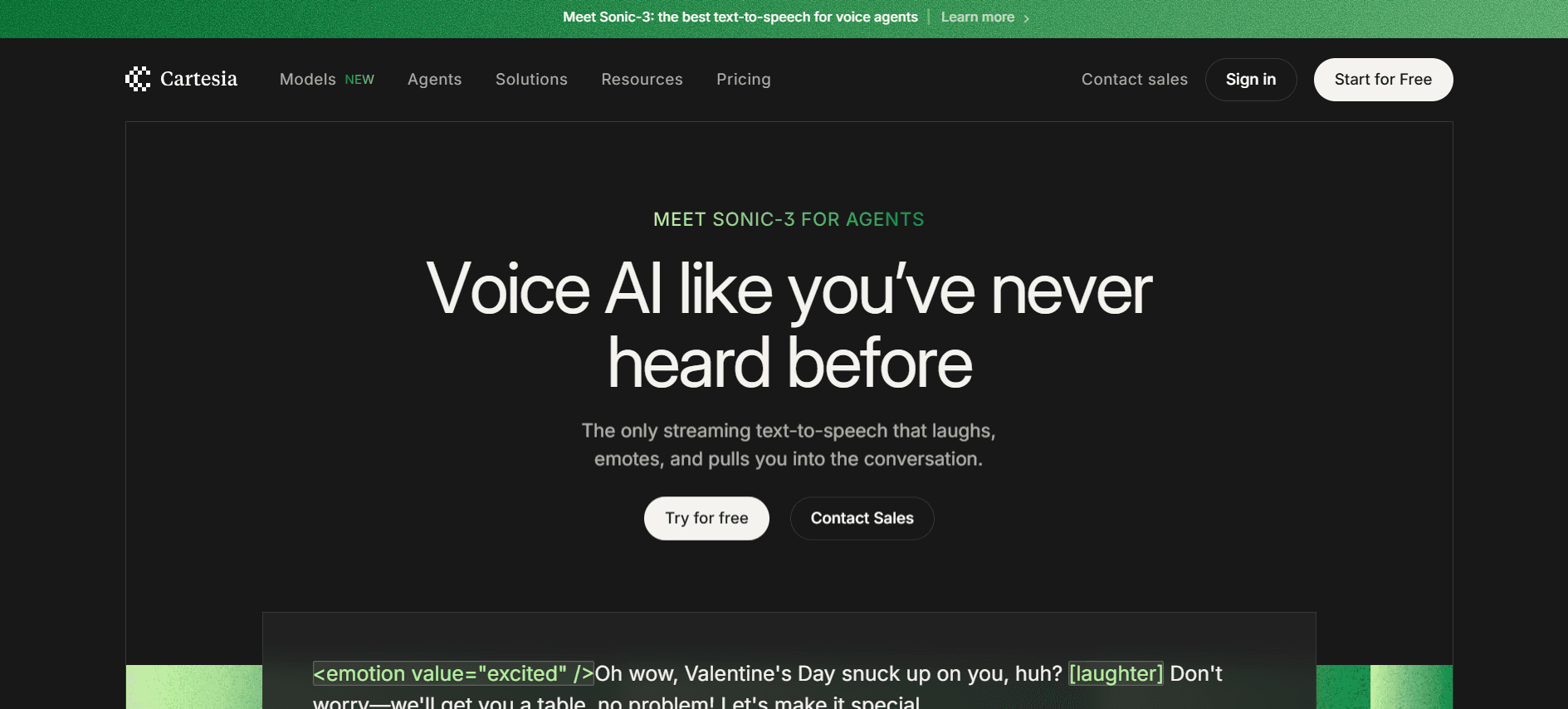
Cartesia is positioned around streaming-focused TTS use cases. Its underlying technology is aimed at real-time streaming and reducing latency. It now offers both batch and streaming Speech-to-Text APIs and supports voice cloning.
For some users, the voice library may feel smaller and language coverage narrower as enterprise support continues to evolve. Teams with broad language needs or heavy compliance requirements should evaluate these factors. Cartesia continues expanding its emerging ecosystem, but organizations with broader deployment or compliance requirements should evaluate whether its operational tooling meets their needs.
Head-to-Head: AI Voice Over Tools Compared
Tool | Voice Quality | Latency Model | STT Support | Voice Cloning | Operational Tradeoff | Deployment Context |
|---|---|---|---|---|---|---|
Smallest.ai | High quality with natural prosody | Ultra-low (tuned for real time) | Yes (Pulse STT) | Yes (via Lightning/Waves API) | Unified stack with integrated speech infrastructure | Real-time voice apps, full-stack speech |
ElevenLabs | Expressive voice generation focus | Streaming latency depends on configuration/setup | Yes (Scribe STT: 90+ languages) | Yes | Evaluate latency for live real-time workloads | Content creation, audiobooks, media |
Deepgram | Good (TTS is secondary) | Fast for STT; TTS latency moderate | Yes (core product, Nova-3) | No | Unified Voice AI platform with STT, TTS, and Voice Agent APIs. | Transcription at scale |
AssemblyAI | N/A (STT only) | N/A for TTS | Yes (plus audio intelligence) | No | Not designed for voice generation | Meeting intelligence, podcast tools |
OpenAI TTS | Preset-voice TTS with limited customization | Moderate; rate limits at scale | Yes (Whisper, separate product) | No | Limited customization and cloning | Prototyping, low-volume OpenAI-native apps |
Cartesia | Yes, STT available (batch + streaming) | Streaming-focused latency optimization | Yes (STT support included) | Available (check feature tier) | Emerging ecosystem; evaluate language coverage for your specific deployment. | Latency-sensitive real-time prototypes |
The Real Cost of Getting This Wrong
The failure mode is familiar: a vendor wins on a slick demo, staging looks fine, and production exposes the edges. Latency spikes under load. The pricing tier that looked harmless at 10,000 requests turns ugly at 10 million. A missing language or cloning capability blocks a launch. At that point, switching providers isn’t a toggle, it’s reworking the pipeline, retraining internal teams, and eating the delay.
This isn’t theoretical. The drive to adopt conversational AI in contact centers is significant, which puts voice infrastructure in the “material business impact” bucket, not the “developer preference” bucket. Plenty of text-to-speech tools can sound great in a demo and still fall apart when you hit real traffic, real concurrency, and real operational constraints.
Smallest.ai’s Lightning API is designed for production deployments where latency, streaming performance, and operational simplicity matter. Combined with the Waves platform, it provides access to text-to-speech, speech-to-text, and voice agent capabilities through a unified API, helping teams reduce integration complexity as production workloads grow.
Verdict: Which AI Voice Over Tool Should You Actually Use?
The right AI voice platform depends on your deployment requirements. Some vendors specialize in individual parts of the speech pipeline, while others provide broader Voice AI platforms that combine multiple capabilities through a single API. The best fit depends on your latency requirements, deployment model, and operational priorities. A fragmented approach forces teams to stitch together separate TTS, STT, and orchestration vendors, leading to brittle infrastructure and inconsistent performance. The key decision is not which point solution is best for a single task, but which platform provides a stable, unified foundation. For teams building production systems, the advantage shifts to integrated platforms that manage the full speech pipeline. Smallest.ai is built on this principle, combining its low-latency TTS with STT and an agent platform behind a single, unified API.
If you’re building production voice applications, evaluate each platform against your own latency targets, deployment model, integration requirements, and long-term operational needs rather than relying solely on feature lists. For teams looking to consolidate text-to-speech, speech-to-text, and voice agent capabilities behind a unified API, Smallest.ai provides a production-focused approach designed for real-time deployments. Book a demo to see how it fits your application’s requirements.
Frequently asked questions
What is the best AI voice over tool for real-time applications in 2026?
Can AI voice over tools clone my voice, and how accurate is voice cloning?
What should developers evaluate in an AI voice over API before committing?
Are there AI voice over tools that include both speech-to-text and text-to-speech?
How much do AI voice over tools cost, and what drives pricing?