Best AI Voice Generator Text-to-Speech Platforms in 2026

Compare the best AI voice generator text to speech platforms in 2026: Smallest.ai, ElevenLabs, Deepgram, OpenAI TTS, and Cartesia. Find the right fit for you.
The market for AI voice generator text to speech has crossed a threshold most people did not expect this soon. The convergence of market growth and perceptual realism is why platform selection carries more weight now than it did eighteen months ago.
This comparison covers six platforms: Smallest.ai, ElevenLabs, Deepgram, OpenAI TTS, and Cartesia, evaluated across voice quality and naturalness, latency and real-time capability, pricing, API and developer experience, language and voice variety, and use-case fit. The goal is a direct, honest assessment so you can match the right tool to your actual workload.
How We Evaluated Each Platform
Criterion | Why It Matters | Key Signal |
|---|---|---|
Voice Quality | Naturalness, prosody, and emotional range determine listener retention | MOS scores, blind listening tests |
Latency | Critical for real-time apps, voice agents, and live customer interactions | Time-to-first-audio in ms |
Pricing | Total cost at scale separates viable from expensive options | Per-character or per-minute rates |
API / Dev Experience | Determines how quickly teams can ship and maintain integrations | SDK quality, docs, streaming support |
Voice & Language Range | Breadth of personas and locales affects global deployment | Voice count, language count |
Use-Case Fit | Some tools excel at one workload and underperform at others | Stated positioning and real-world reports |
Smallest.ai
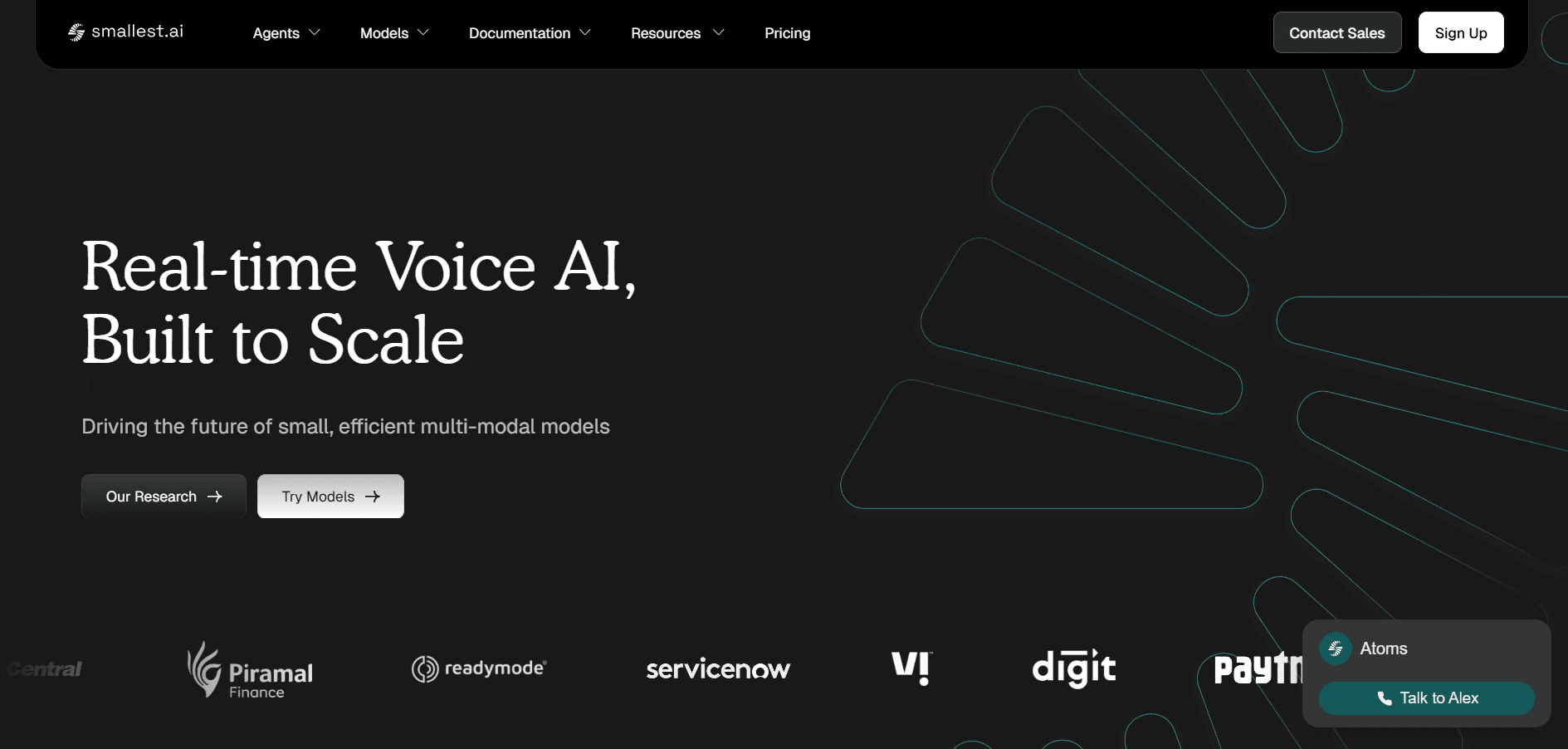
Smallest.ai's Lightning model is designed to achieve sub-100ms first-audio latency, making it viable for real-time voice agents.
Smallest.ai earns its place at the top of this list by solving the problem most TTS platforms treat as an afterthought: latency. The Lightning model is designed to achieve sub-100ms time-to-first-audio in real-time scenarios, a spec that matters enormously for voice agents, IVR systems, and any live customer-facing product. Below that threshold, conversation feels natural. Above it, something feels off and users notice. For a detailed look at how this compares perceptually, the most realistic text-to-speech AI comparison on the Smallest.ai blog covers the quality gap across providers.
The platform also supports voice cloning capabilities from short audio samples, multilingual support, and a streaming API built with developer experience in mind. Pricing is usage-based and transparent, structured to stay cost-effective as volume grows rather than punish success. Smallest.ai is clearly aimed at teams building voice AI products, not one-off audio assets. Developers wanting raw performance benchmarks across providers will find the fastest text-to-speech APIs breakdown a useful reference.
The one honest limitation is voice library size. Teams that need hundreds of pre-built personas out of the box may find the selection narrower than they expect compared to older, larger platforms. In practice, the cloning capability largely offsets this for any team with specific brand voice requirements. Try Smallest.ai's TTS API to test latency and voice quality on your own content.
ElevenLabs
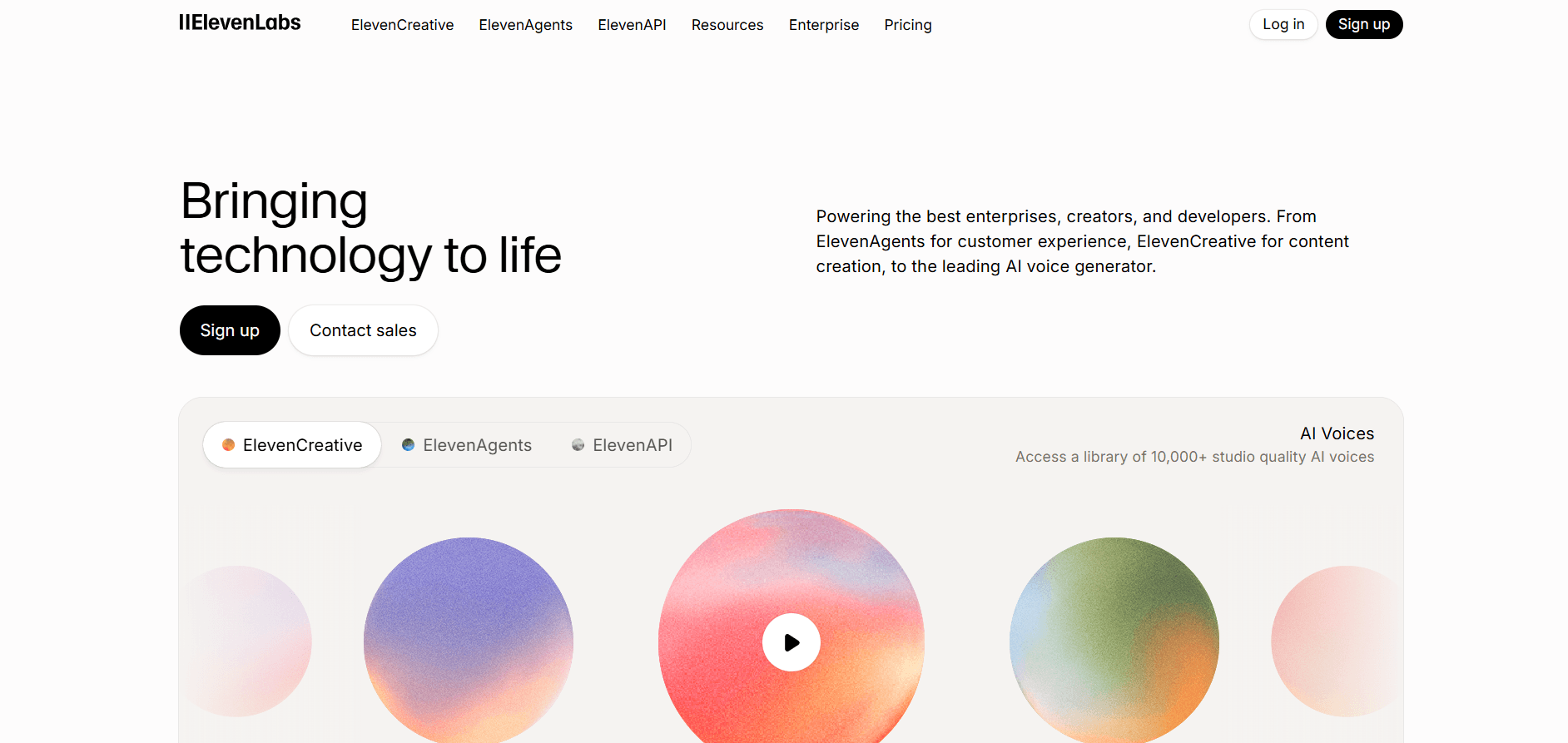
ElevenLabs is a popular AI voice generator known for a large library of voices and language options.
ElevenLabs is the platform most people cite when the conversation turns to high-quality AI voice. Its library includes a large number of voices across many languages, emotional range is broad, and cloning quality is consistently ranked among the best available. For content creators producing audiobooks, podcasts, or video narration, it is a natural first choice.
While the platform offers a Conversational AI product for real-time agents, its standard synthesis models are primarily designed for high-quality audio generation where latency is less critical. The company's pricing page shows tiers from a free plan through enterprise, but teams running millions of characters per month through a live product should model the cost carefully before committing. A detailed breakdown of the platform's plans and credit system is available in the Smallest.ai guide to ElevenLabs pricing.
Deepgram
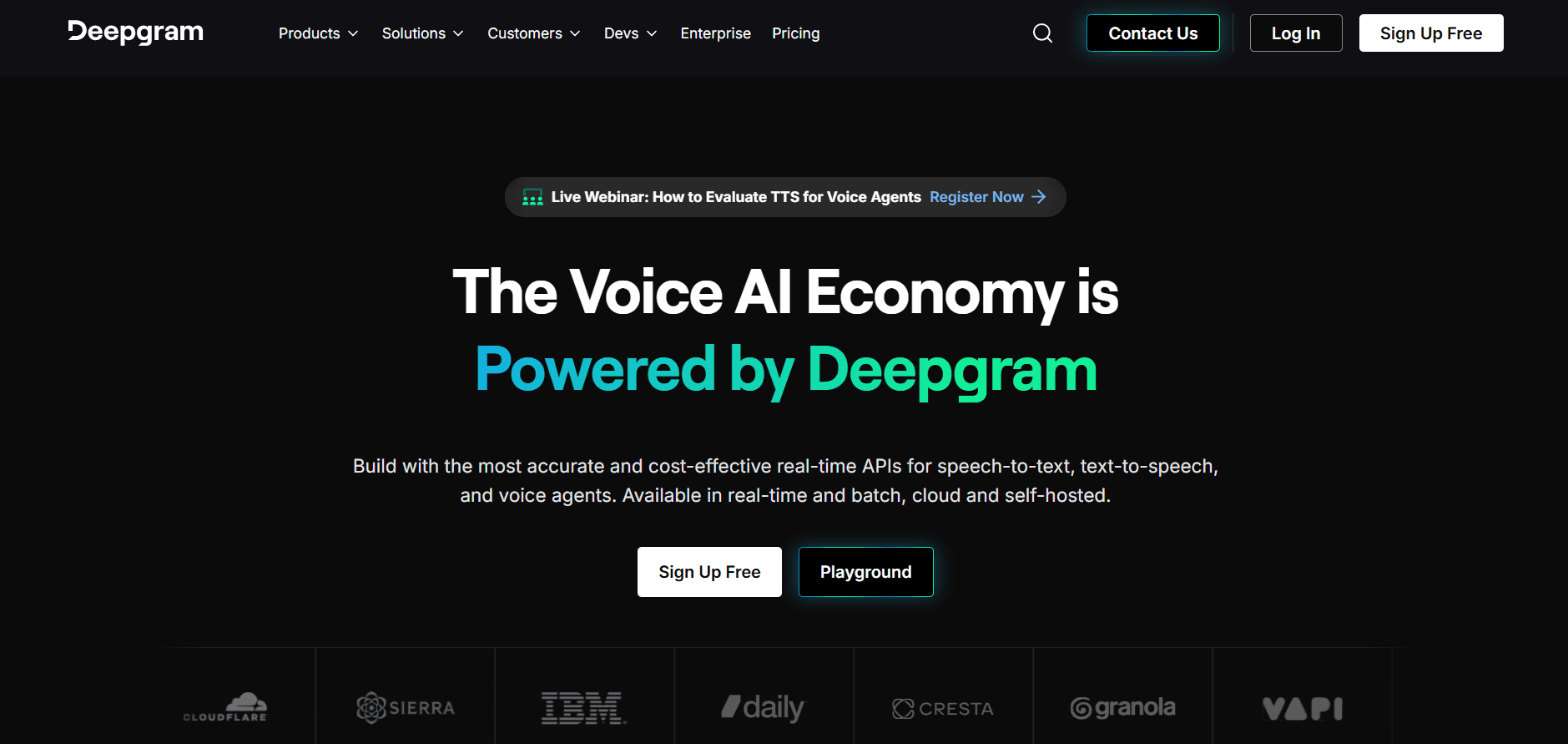
Deepgram's strength is its end-to-end audio pipeline, combining transcription and synthesis in one platform.
Deepgram is primarily a speech-to-text platform, but its Aura TTS model makes it a genuine option for teams that need both transcription and synthesis under one roof. If your architecture already uses Deepgram for STT, adding TTS through the same API reduces vendor complexity and keeps latency predictable. Aura produces clean, natural speech and supports streaming, which matters for conversational AI.
The trade-off is straightforward: voice selection is more limited than dedicated TTS platforms, and emotional expressiveness does not match ElevenLabs or Smallest.ai in nuanced delivery. Think of Deepgram as a strong all-in-one audio platform rather than a TTS specialist. Pricing is usage-based; the company's pricing page breaks down both STT and TTS rates, which are competitive for combined workloads.
OpenAI TTS
OpenAI TTS is easy to integrate for teams already using the OpenAI API ecosystem.
OpenAI TTS is not trying to be the best standalone voice product. It is trying to be the most convenient option for developers already inside the OpenAI ecosystem, and on that measure it succeeds. The available voices (including Alloy, Echo, Fable, Onyx, Nova, and Shimmer) cover a reasonable tonal range, quality is genuinely good for most content use cases, and if your team is already paying for GPT-4 or Whisper, the incremental cost to add TTS is low.
The ceiling is visible, though. The selection of built-in voices is narrow for any product requiring persona variety. Latency is adequate but not optimized for real-time applications, and there is no voice cloning without special access. For internal tools, prototypes, or content pipelines where convenience outweighs customization, OpenAI TTS is a reasonable default. For anything customer-facing at scale, most teams eventually look elsewhere.
Cartesia
Cartesia's Sonic model uses a state-space architecture designed to minimize latency for real-time voice applications.
Cartesia has built its identity around low-latency synthesis using a state-space model architecture (Sonic). It is a credible option for real-time voice agents and regularly appears alongside Smallest.ai in latency-focused comparisons. The Cartesia AI review on the Smallest.ai blog covers its features and positioning in detail, and the company's pricing page shows a tiered structure with a free tier for development and paid tiers for production.
Voice library size is still growing, and emotional range is functional rather than expressive. Cartesia suits developers who prioritize low latency and a clean API over a large catalog of pre-built personas. As a newer platform, enterprise support and SLA guarantees may vary compared to more established providers, though enterprise plans with custom SLAs are available.
Head-to-Head: All Six Platforms Compared
Platform | Voice Quality | Latency (Real-Time) | Voice & Language Range | Voice Cloning | Best For | Pricing Model |
|---|---|---|---|---|---|---|
Smallest.ai | High, natural prosody | Optimized for real-time | Multilingual, growing library | Yes | Real-time voice agents, dev teams | Usage-based, transparent tiers |
ElevenLabs | High, expressive | Higher latency | Large library, wide language support | Yes | Content creation, media production | Tiered plans available |
Deepgram | Good, clean | Streaming-capable | Limited voice range | No | Combined STT+TTS pipelines | Usage-based, API-first |
OpenAI TTS | Good, consistent | Moderate | Limited built-in voices | No | OpenAI ecosystem, prototypes | Per-character, bundled with API |
Cartesia | Good, functional | Low-latency focused | Moderate range, growing | Limited | Real-time agents, dev-first teams | Tiered, free dev tier |
Other options | Varies | Varies | Varies | Some | Niche or legacy use cases | Varies |
Verdict: Which Platform Should You Actually Use?
Choosing the right AI voice generator text to speech platform depends on your project's specific needs, as different tools excel in different areas. Some platforms are engineered for low-latency, real-time voice applications, making them suitable for interactive agents. Smallest.ai focuses on balancing speed with high-quality voice cloning and clear developer APIs. Other providers, like ElevenLabs, are well-regarded for content creation, offering expressive narration and extensive voice libraries ideal for media and audiobooks. For teams needing to simplify their technical architecture, vendors such as Deepgram provide combined speech-to-text and synthesis solutions. Meanwhile, platforms like OpenAI's TTS offer a practical and low-friction way for developers already in that ecosystem to add voice capabilities to their applications.
Growth in the AI voice generator market is being driven by exactly the use cases these platforms are competing for: voice agents, accessibility tools, content automation, and real-time customer interaction. If you are evaluating free AI text-to-speech generators before committing to a paid plan, that resource covers the no-cost options worth testing. For developers specifically, the free text-to-speech API guide is a practical starting point for understanding what is available without upfront spend.
If voice realism and emotional nuance are the primary concern, the guide to human-like AI voices explains the technical factors behind what makes synthesized speech feel natural, which helps set realistic expectations before you commit to any platform.
The Problem Most Teams Discover Too Late
Most teams pick a TTS platform based on a demo. The demo sounds great. Then they build a product, hit production traffic, and find that latency spikes under load, pricing becomes unsustainable at volume, or the voice that is impressed in isolation sounds flat inside a real conversation flow. These are not edge cases. They are the standard experience for teams that skipped testing against their actual workload before committing.
Smallest.ai's Lightning model addresses the latency problem at the infrastructure level, not as a patch applied after the fact. Voice cloning means you are not locked into a generic catalog. The pricing structure is built to stay viable as usage grows. For teams where the voice layer is load-bearing rather than decorative, Smallest.ai's Atoms TTS model is the logical starting point. The architecture is built for the problem.
Frequently asked questions
What is the best AI voice generator for real-time applications in 2026?
How accurate is AI voice cloning in 2026?
Is there a free AI text-to-speech option worth using for production?
What should developers look for in a text-to-speech API?
How is the AI voice generator market expected to grow?