ElevenLabs Pricing Explained: Plans, Limits, Hidden Costs & Calculator

A complete guide to ElevenLabs pricing for 2026. Every plan explained, credit system decoded, hidden costs uncovered, and a quick calculator to estimate your.
At first glance, ElevenLabs pricing seems straightforward: a free tier, a few paid plans, and an enterprise option. But once you start building with it, the credit system, overage charges, and commercial licensing rules add layers that are not obvious from the pricing page. This guide breaks down every plan, what you actually get, where costs can accumulate, and how to estimate your real monthly bill before you commit.
Whether you are a solo developer testing voice features, a startup scaling a voice product, or an enterprise team evaluating total cost of ownership, this is the reference you need. By the end, you will know exactly what each plan covers, what it does not, and how to calculate your costs accurately. The AI voice generator market was valued at $2.48 billion in 2025 and is projected to reach $2.97 billion in 2026 (Research and Markets, 2026), which means pricing decisions in this space carry real strategic weight.
How ElevenLabs Pricing Actually Works: The Credit System
Before comparing plans, you need to understand the billing unit: credits. ElevenLabs does not bill by audio minutes or API calls directly. It bills by characters processed. Standard TTS models consume one credit per character, while faster Flash models can cost between 0.5 and 1 credit per character depending on your plan (ElevenLabs, 2026). That distinction matters more than it sounds.
A 500-word script is roughly 3,000 characters. On a standard model, that is 3,000 credits. On a Flash model (where available), it could be as low as 1,500 credits. If you are generating high volumes of short-form audio, like IVR prompts or notification messages, the Flash model's efficiency compounds quickly. If you are generating long-form narration, the per-character rate stays flat regardless of audio duration, which is favorable compared to per-minute billing.
Understanding this model is the foundation for everything else. API call pricing structures like this one, where usage is metered against a prepaid credit pool, are common in AI infrastructure (Stripe, 2026). The risk is that credit pools feel abstract until you run out mid-month.
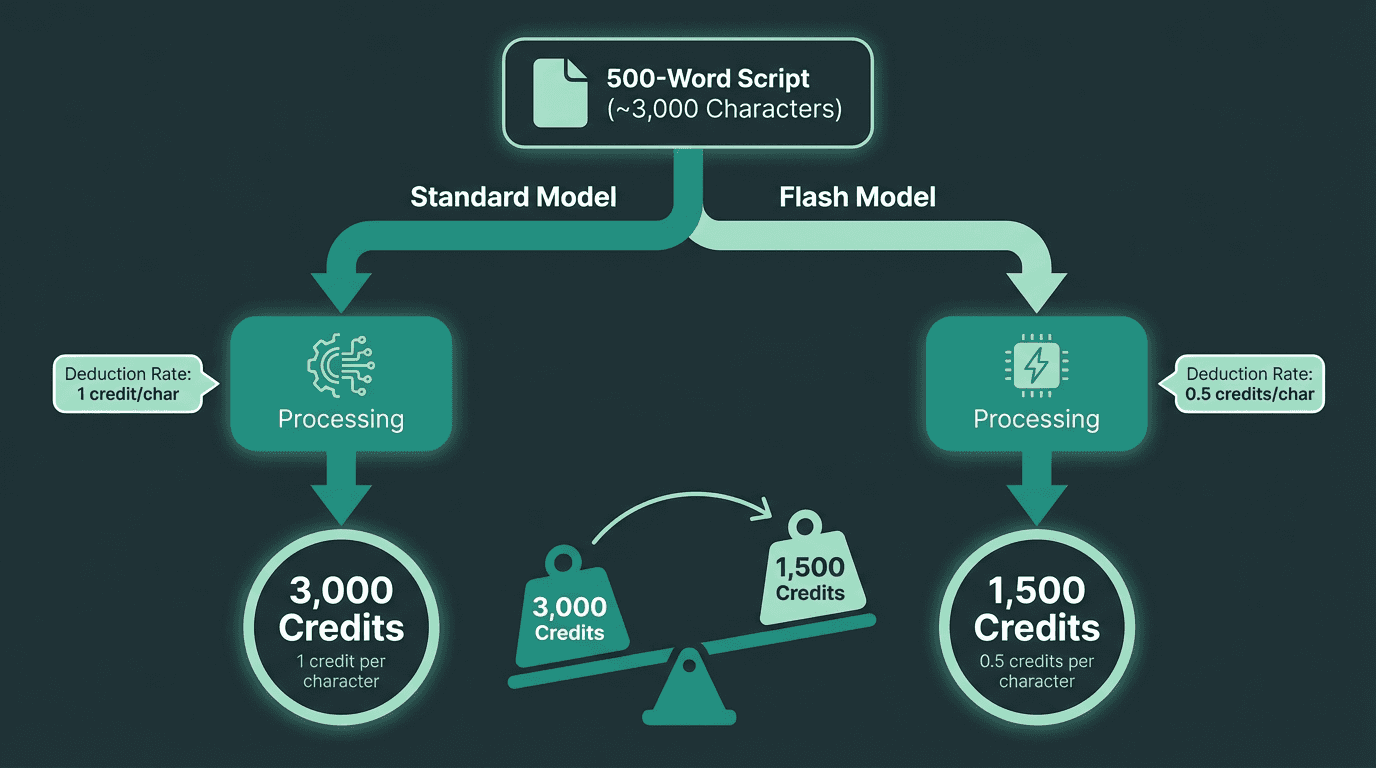
How ElevenLabs converts characters into credits differs by model type, which directly affects your monthly consumption.
Every ElevenLabs Plan, Broken Down
ElevenLabs offers a range of plans from a free tier with 10,000 credits per month up to a Business plan at $990/month and custom Enterprise solutions (ElevenLabs, 2026). Here is what each tier actually delivers:
Plan | Monthly Price | Included Credits | License Type | Key Features | Limitations / Overage Policy | Best For |
Free | $0 | 10,000 | Non-commercial use only | Access to shared voices | No Instant Voice Cloning | Personal experimentation and testing |
Starter | $5 | 30,000 | Commercial use included | Instant Voice Cloning, Dubbing Studio | 128 kbps audio output; no overage billing, generation stops at limit | Small projects and new content creators |
Creator | $22 | 100,000 | Full commercial use | 192 kbps audio quality, Professional Voice Cloning, API access | Overage billed at about $0.30/min (Multilingual) or $0.15/min (Flash) | Professional content creators and developers |
Pro | $99 | 500,000 | Full commercial use | 192 kbps high-quality audio output via Studio and API | Overage billed at about $0.24/min | Production workloads needing high-quality audio |
Scale | $330 | 2,000,000 | Full commercial use | All Pro features with higher throughput | Overage billed at about $0.18/min (Multilingual) or $0.09/min (Flash) | Teams with sustained, high-volume generation needs |
Business | $1,320 | 11,000,000 | Full commercial use | Low-latency TTS as low as $0.05/min, 3 Professional Voice Clones, 5 workspace seats | Requires significant volume to be cost-effective | Production voice agent deployments at scale |
Enterprise | Custom | Custom monthly volume | Negotiated terms | Custom SLAs, dedicated infrastructure, custom model development, data residency | Requires direct negotiation with sales | Organizations with unique security, compliance, or performance requirements |
One thing worth flagging: the free plan does not include a commercial license for generated content. Users must upgrade to at least the Starter plan to gain commercial rights (ElevenLabs, 2026). This detail is in the terms rather than prominently displayed on the pricing page, which can catch developers off guard when they try to ship a product built on free-tier testing. For a detailed look at how licensing intersects with plan selection, the guide on commercial use and licensing covers the key checkpoints.
Curious how Smallest.ai's pricing compares? See transparent, usage-based plans built for developers.
The Hidden Costs Most People Miss
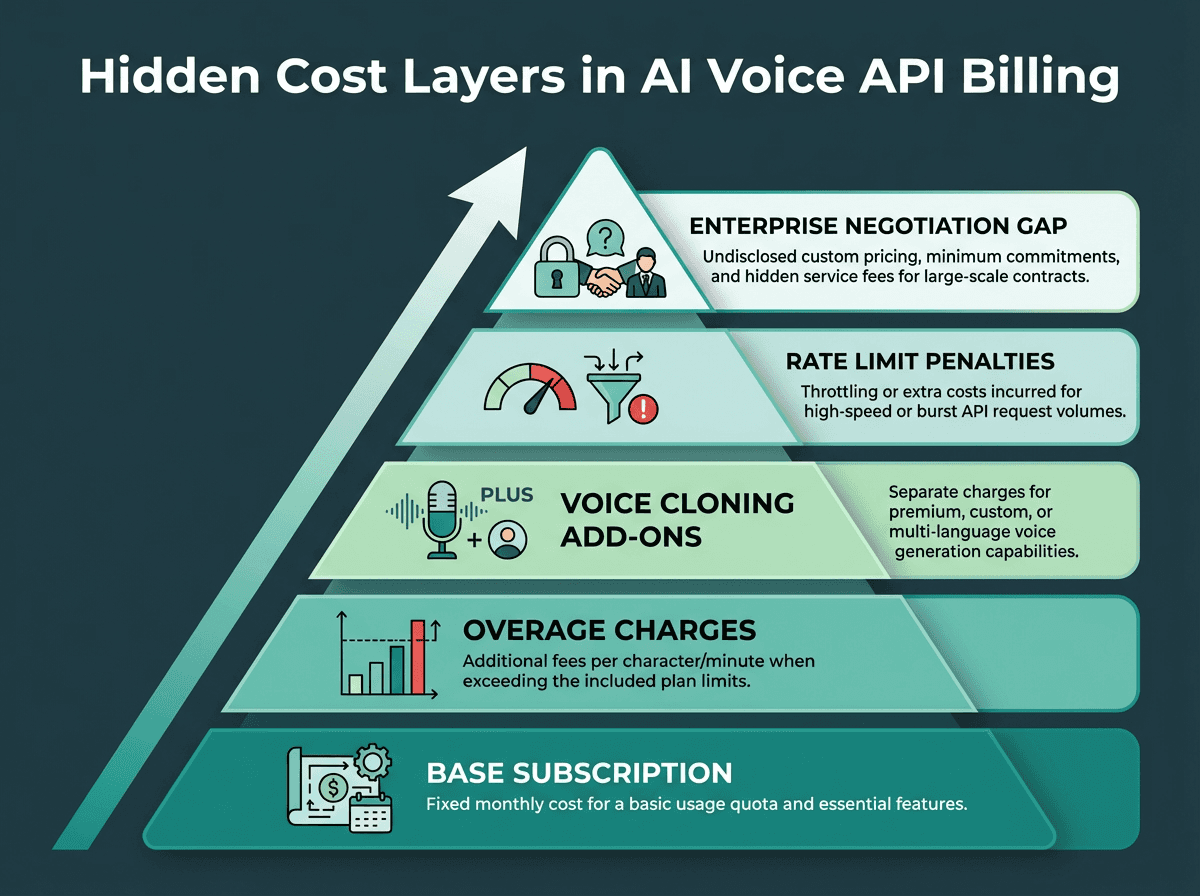
The sticker price of any AI voice plan rarely reflects the true monthly spend once overages and add-ons are factored in.
The subscription fee is the easy part. What actually inflates bills are the costs that do not appear on the plan comparison table. Three areas deserve close attention.
Overage charges. On plans from Creator and up, audio generation beyond the included credits is billed at an overage rate that varies by plan and usage (see the official pricing page for current rates). At scale, this adds up fast. A team generating 500,000 characters of overage in a month is looking at a meaningful unplanned expense. Overage billing is only available on higher-tier plans, so if you are on Starter and hit your limit, generation simply stops.
Voice cloning and custom model costs. Instant voice cloning is included on Creator and above, but professional voice cloning (which produces higher-fidelity results) requires more audio samples and may involve additional setup time. Enterprise customers negotiating custom voice models will face costs that are not published anywhere.
Developer workflow overhead. This one is less obvious. Hidden costs in enterprise API usage include stale documentation, rate limit handling, and the engineering time spent managing credit pools and monitoring usage (Redocly, 2025). For teams building production voice agents, these operational costs can rival the subscription cost itself. The full picture of true costs of operating a voice agent at scale goes well beyond the monthly plan fee.
Quick Cost Calculator: Estimate Your Monthly Bill
You do not need a spreadsheet to get a rough estimate. Use this framework:
Step-by-step estimation:
Count your average characters per generation. A typical sentence is 80-120 characters. A 2-minute narration script is roughly 2,400 characters. A 500-word script is approximately 3,000 characters.
Multiply by your monthly generation volume. If you generate 1,000 audio clips per month at 2,400 characters each, your monthly total is 2,400,000 characters.
Apply the credit rate for your model. Multilingual v2/v3 (standard): 1 credit per character - 2,400,000 credits needed. Flash model: 0.5-1 credit per character - 1,200,000 to 2,400,000 credits needed. Use Flash wherever output characteristics are acceptable for your use case.
Match your credit total to a plan. 1,800,000 credits sits at the Scale plan ($299/month). 2,400,000 credits would require the Scale plan with overage, or moving to the Business plan.
Add an overage buffer for variable months. If your volume fluctuates, add 20-30% to your estimate. Check whether your plan supports overage billing or hard-stops at the credit limit. Starter hard-stops, while Creator and above support overage billing at the rates listed.
A practical example: a startup sending 10,000 SMS-style voice notifications per day (average 150 characters each) generates 1,500,000 characters daily, or roughly 45,000,000 characters per month. That is well into Enterprise territory, and the per-character cost at that volume should be negotiated, not taken from the public pricing page.
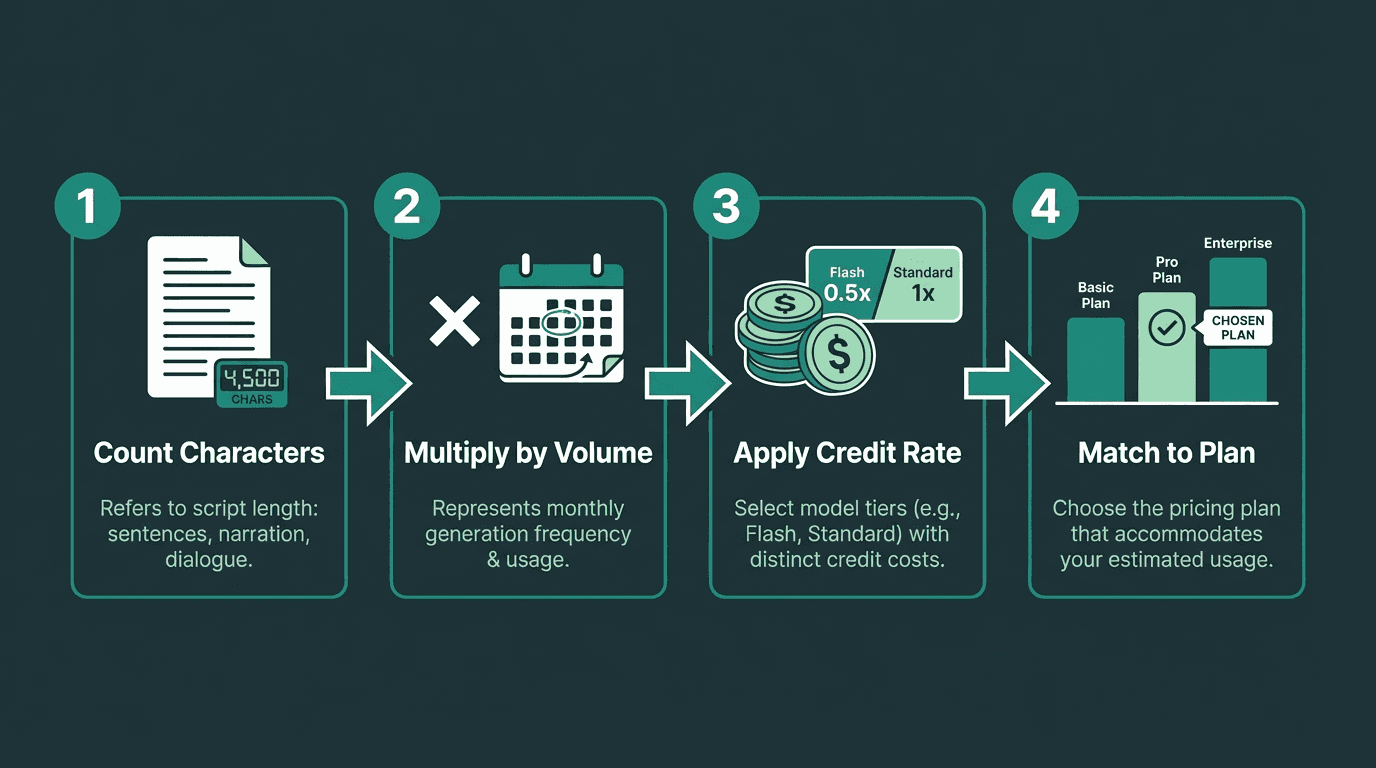
A four-step framework for estimating your actual monthly ElevenLabs cost before committing to a plan.
What Most People Get Wrong About the Free Plan
The free plan is not a substitute for a paid plan in any production context. It is a personal experimentation tier with confirmed restrictions: no commercial license, stricter rate limits, and limited feature and model access compared to paid tiers. Developers who build a proof-of-concept on the free tier and then move to production often find their integration needs rework for commercial licensing compliance.
The ElevenLabs Terms of Use are the authoritative reference here, and reading them before building is worth the 20 minutes.
The cleaner approach is to start with the Creator plan for any project that might ship to users, even in beta. The $22/month cost is low enough that it should not be the deciding factor, and it removes the licensing ambiguity entirely.
Evaluating Value: Is the Price Justified?
Pricing only makes sense relative to output quality and use case fit. ElevenLabs has built a strong reputation for voice naturalness, particularly for long-form narration and expressive speech. For podcast production, audiobooks, or character voices in games, the quality-to-cost ratio is genuinely competitive at the Creator and Pro tiers.
For real-time voice applications, like conversational AI or live voice agents, the calculus changes. Latency requirements, concurrent stream limits, and the cost per interaction at scale all become more important than raw voice quality. At those volumes, the Scale and Enterprise plans need to be evaluated against alternatives. A comparison of the most realistic text-to-speech AI options in 2026 puts ElevenLabs' output quality in context against other providers.
For teams specifically weighing feature sets and pricing side by side, the roundup of top alternatives to ElevenLabs covers the current competitive landscape.
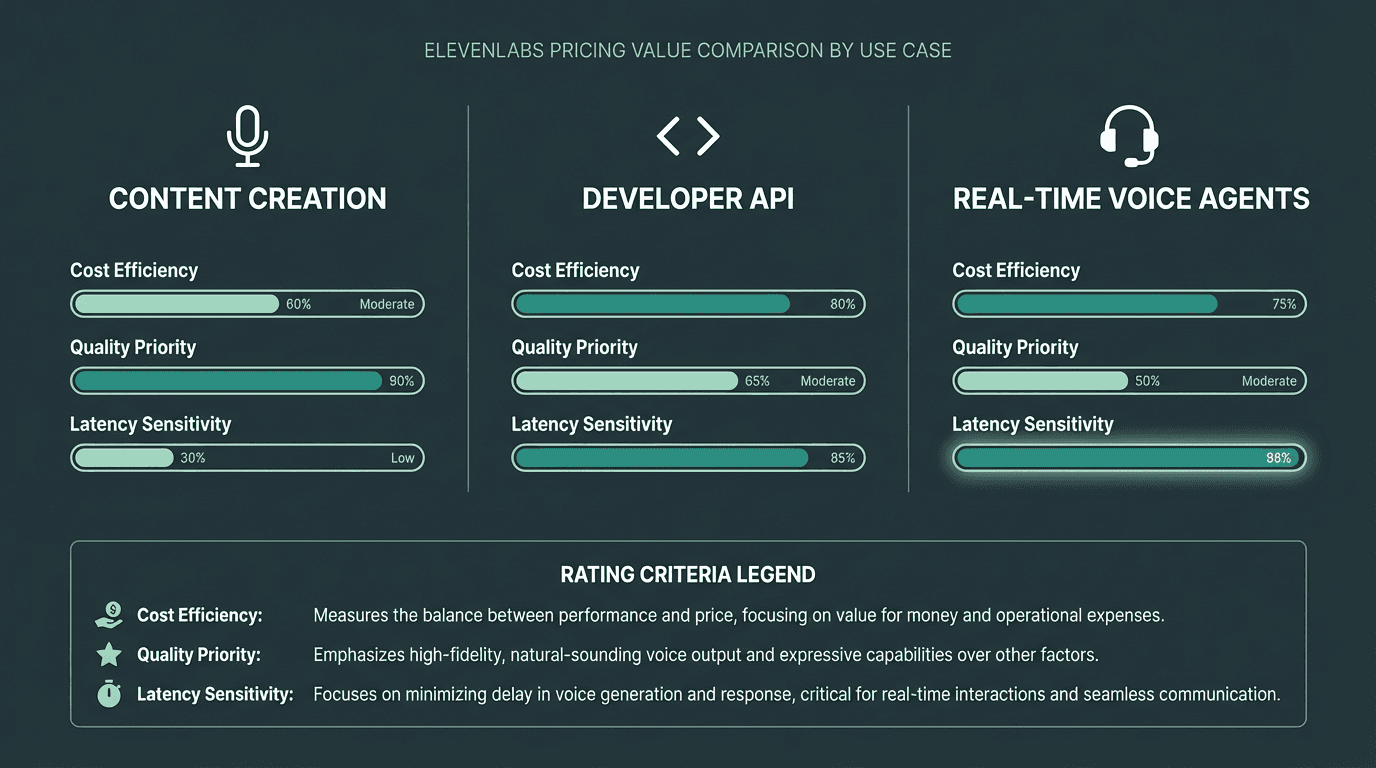
Value from an AI voice platform varies significantly depending on whether your primary use case is content, API integration, or real-time interaction.
Enterprise Pricing: What to Expect in Negotiations
Enterprise contracts with ElevenLabs are fully custom. Published pricing stops at the Business plan ($990/month). Beyond that, you are in negotiation territory, and the variables include committed monthly credit volume, custom voice model development, SLA guarantees, dedicated infrastructure, and support response times.
A few things worth knowing before entering those conversations: enterprise discounts typically require annual commitments, custom voice development has a separate timeline and cost structure from the subscription itself, and rate limits on the public API may not apply to dedicated infrastructure. If your use case involves sensitive data or regulated industries, ask specifically about data residency and retention policies, as these are not covered in the standard terms and require explicit contractual language.
Key Takeaways and Next Steps
ElevenLabs pricing is credit-based, character-driven, and tiered across several distinct plans. The free plan is for personal use only, commercial rights start at Starter, and the real cost picture only becomes clear when you factor in overage charges, model selection, and the operational overhead of managing a credit-based API at scale. Use the four-step calculator above to estimate your actual monthly spend before choosing a plan, and read the terms before building anything you plan to ship.
If you are evaluating ElevenLabs as part of a broader vendor comparison, the pricing structure is only one dimension. Quality, latency, licensing flexibility, and support at scale all matter. Our guide to the top alternatives to ElevenLabs covers these dimensions in detail for teams making serious infrastructure decisions.
For developers and teams who need high-quality, low-latency voice generation with transparent, usage-based pricing and no hidden credit mechanics, Smallest.ai is worth a direct look. The Lightning TTS model is built specifically for real-time voice applications where latency and cost predictability matter as much as voice quality. Lightning V2 is priced at approximately $0.20 per 10,000 characters, based on Smallest.ai’s current usage-based pricing (see smallest.ai/pricing). The Smallest.ai pricing is structured to be readable and comparable without a calculator.
Frequently asked questions
Can I use the ElevenLabs free plan for commercial projects?
What happens when I run out of credits mid-month?
Are Flash models always cheaper to use?
How does ElevenLabs Enterprise pricing work?
What are the main alternatives if ElevenLabs pricing does not fit my budget?