AI Appointment Scheduling: Best Voice AI Tools in 2026

Compare the best voice AI tools for AI appointment scheduling in 2026. Latency, pricing, integrations, and verdicts for Smallest.ai, ElevenLabs, OpenAI.
By 2026, low-latency voice platforms have made AI scheduling agents much more practical for live phone calls. The best systems now reduce response delays enough that appointment booking, rescheduling, and reminders can feel far more natural than older IVR flows. That shift is why the tool selection question has changed: it is no longer “is voice AI good enough for scheduling?” but “which stack handles our call volume, integration requirements, and edge cases best?”
The Problem This Solves
The core problem in appointment scheduling is not a shortage of calendar tools. It is the gap between when a customer wants to book and when a human is available to take that call. Missed calls become missed appointments. Missed appointments become lost revenue and, in healthcare, can delay care or create avoidable access issues. Voice AI closes that gap by making scheduling available at any hour and any call volume, without the overhead of a full-time receptionist. The tools reviewed here address this problem in different ways, but for teams that need low latency, high reliability, and a production-ready agent platform, Smallest.ai is the most complete answer. Its Atoms platform handles the full scheduling workflow, and its Lightning TTS and Pulse STT components ensure the voice experience meets the quality bar that callers actually expect.
What Makes a Scheduling System 'Voice AI' in 2026
Not all automated scheduling is the same. The market includes three distinct categories of tools. This article focuses exclusively on the third and most advanced category: voice AI agents.
Calendar Automation Tools: Services like Calendly and Reclaim.ai offer scheduling links that let users book open slots on a calendar. They are efficient for asynchronous booking but do not handle live interactions.
Text-Based AI Chatbots: These bots use chat interfaces on websites or via SMS to book appointments. They can handle simple, conversational requests but cannot manage a phone call.
Voice AI Agents: These systems handle end-to-end scheduling conversations over the phone. Unlike older Interactive Voice Response (IVR) systems that rely on rigid menus (“Press 1 for sales”), voice AI uses natural language understanding to interpret a caller's intent, retain context, ask dynamic follow-up questions, and complete the booking in a single, fluid conversation. This ability to manage a live phone call is what closes the gap where most scheduling opportunities are lost.
How We Evaluated Each Tool
Voice AI for appointment scheduling is not a single product category. Some tools are full-stack voice agents. Others are speech APIs that developers wire into their own pipelines. The right choice depends on whether you are building from scratch or deploying a turnkey solution. Five criteria drove the evaluation:
Voice quality and latency: Does the voice sound natural under real call conditions, with round-trip response time under 500ms?
Scheduling integration depth: Can the tool read and write to calendars, CRMs, or booking systems natively or via API?
Pricing transparency: Are costs predictable at scale, or do they spike unpredictably with usage?
Developer flexibility: Can engineers customize the pipeline, swap models, or extend functionality without fighting the platform?
Reliability and support: Is there documented uptime, SLA coverage, and accessible support when things break?
Smallest.ai: Built for Low-Latency Voice Agents at Scale
Smallest.ai is purpose-built for production voice agents where latency is the primary constraint. Its product suite covers every layer of the scheduling pipeline: Pulse handles speech-to-text, Lightning handles text-to-speech with sub-100ms response times, Electron is a conversational small language model optimized for voice interactions, and Atoms is the agent and workflow platform that ties it all together. For teams designing voice assistants end-to-end, this means fewer integration points and a more predictable latency budget.
Voice quality and latency are the foundation. Lightning TTS is optimised for sub-100ms first-chunk latency, which is the threshold where voice conversations stop feeling like a bot and start feeling like a person. The Atoms platform connects to CRMs and calendar systems through native integrations and a well-documented API, so scheduling logic, availability checks, and confirmation flows are managed in one place rather than stitched together across services. Pricing is usage-based and publicly documented, which makes cost forecasting straightforward as call volume scales. The platform is API-first by design, giving developers full control over the pipeline without fighting abstraction layers. For teams that need documented uptime and enterprise-grade support, those options are available at the appropriate tier.
The differentiator in the scheduling context is Atoms. Rather than requiring developers to stitch together separate STT, LLM, and TTS services, Atoms provides a unified agent platform where scheduling logic, calendar integrations, and conversation flows are managed in one place. That matters most for AI voice assistants handling appointment booking, where the agent needs to process rescheduling requests, cancellations, and reminders without losing context mid-call.
Pricing is structured around usage tiers for API access, keeping costs predictable as call volume scales. Full details are at Smallest.ai pricing. The developer experience is strong: the API gives direct access to Lightning and related speech services, and the documentation covers the edge cases that surface in real deployments. Smallest.ai is primarily a developer and enterprise platform, so teams expecting a no-code drag-and-drop interface will need to invest in setup. The payoff in control and performance is substantial for those willing to make that investment.
ElevenLabs: Strong Voice Quality, Growing Agent Capabilities
ElevenLabs built its reputation on voice cloning and expressive TTS, and that reputation holds. It offers an agent product designed for inbound and outbound scheduling calls with high-quality voices across multiple languages.
Voice quality is where ElevenLabs leads the field. The cloning capabilities and expressiveness translate well into scheduling contexts where a brand voice needs to feel consistent across every call. Agent-tier integrations cover the most common scheduling platforms, though teams with niche CRM requirements or deeply custom conversation logic will find the platform less accommodating than an API-first stack. Pricing is publicly listed at entry tiers, but detailed cost forecasting for high-volume agent usage requires a sales conversation, which is worth factoring into any procurement timeline.
AssemblyAI: The STT Specialist
AssemblyAI is not a full-stack voice agent platform, and it does not try to be. It is a speech-to-text API with strong accuracy and a range of audio intelligence features built for post-call analysis. In a scheduling context, it fits best as the transcription layer in a custom-built pipeline, or for post-call analysis of scheduling conversations.
As a speech-to-text API, AssemblyAI is accurate, well-documented, and built for developer integration, which is exactly what makes it useful as a component and limited as a complete solution. It has no voice output, no conversational model, and no scheduling logic. Teams that need the transcription layer of a custom pipeline, or post-call analysis of completed scheduling conversations, will find it reliable. Teams that need a full scheduling agent will need to build everything else themselves or source it elsewhere. For a broader view of where it sits in the market, the best speech-to-text APIs comparison covers the alternatives in detail.
OpenAI: Broad Capability, High Cost at Scale
The strength here is breadth: OpenAI's API suite covers speech recognition, language modelling, and text-to-speech in a single ecosystem with unmatched community support and tooling. For prototyping or low-volume deployments, that breadth is genuinely useful. At scale, two constraints surface. Pricing is token-based, and a high-volume scheduling operation running thousands of daily calls will see costs climb faster than usage-based alternatives. Response times are not optimised for the sub-200ms latency that makes voice conversations feel natural, teams building real-time scheduling agents will feel that constraint under production load. The choosing your 2026 voice agent stack comparison covers this trade-off in detail.
Cartesia: Fast TTS for Real-Time Voice Applications
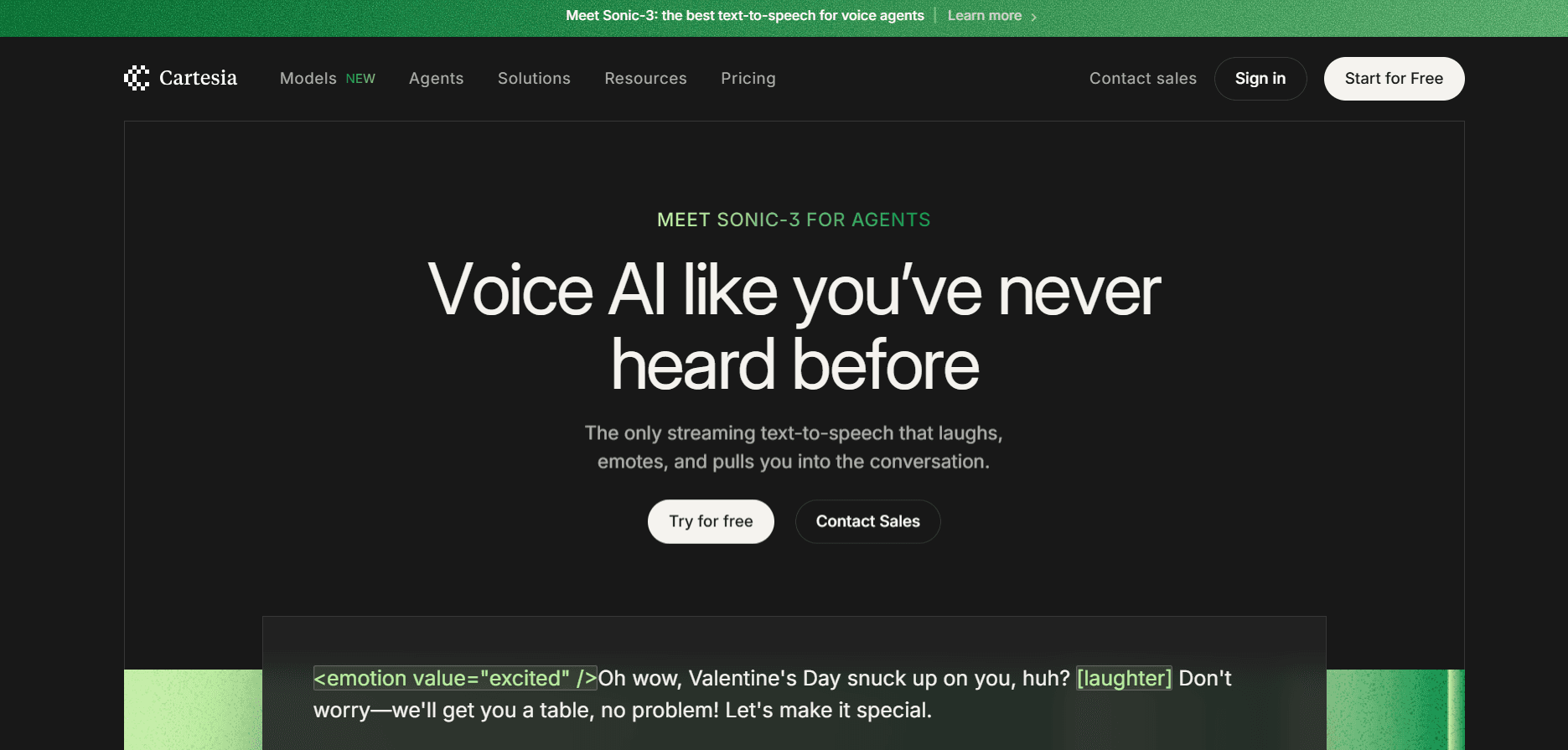
Cartesia is a TTS-focused API built for real-time voice applications. Its TTS API targets low-latency audio generation, which makes it relevant for scheduling agents where response speed directly affects caller experience.
Cartesia's TTS API is fast and the voice output quality holds up well in real-time applications. Pricing is usage-based and publicly documented, which makes it straightforward to model costs before committing. The constraint is scope: it covers voice output only. There is no speech recognition, no conversational model, and no scheduling logic. For developers assembling a custom stack who need a reliable, low-latency TTS layer, it is worth evaluating. For teams that need a complete scheduling agent, it is one component of a larger build, not a solution on its own.
Head-to-Head: Voice AI Scheduling Platforms and Components Compared
Tool | What It Is | Handles a Complete Scheduling Call? | Latency Profile | Pricing Structure |
|---|---|---|---|---|
Smallest.ai | Full-stack voice agent platform | Yes - end-to-end, out of the box | Sub-100ms | Usage-based, publicly documented |
ElevenLabs | Agent and TTS platform | Partially - agent product still maturing | Moderate | Subscription tiers plus usage |
AssemblyAI | Speech-to-text API only | No - transcription layer only | Input only | Pay-per-use |
OpenAI | Separate APIs requiring custom assembly | No - full build required | Moderate to high | Token-based |
Cartesia | Text-to-speech API only | No - voice output layer only | Moderate | Usage-based |
Where Voice AI Scheduling Delivers the Most Impact
In healthcare, the operational stakes are highest. Missed appointments drive revenue loss and, in some cases, real patient harm. Voice AI addresses this by making scheduling available at any hour - callers always reach someone, callbacks are eliminated, and reminders fire automatically. The voice assistants for healthcare appointments guide covers intake, reminders, and triage workflows in detail.
Real estate is another vertical where the math works clearly. Property inquiry calls are time-sensitive, and a missed call is a missed lead with a short shelf life. AI voice for real estate scheduling covers how voice agents handle property inquiries and viewing bookings at scale. Across industries, the consistent pattern is the same: when scheduling becomes available around the clock without adding headcount, utilization improves and operational overhead shrinks. The specific gains vary by industry and call volume, but the mechanism is structurally reliable.
Verdict: Which Tool Should You Choose?
For most teams building production voice scheduling agents in 2026, Smallest.ai is the strongest end-to-end option. Its integrated stack (Pulse for STT, Lightning for TTS, Electron for conversation, Atoms for agent orchestration) is designed specifically for the latency and reliability requirements of live voice interactions. ElevenLabs is the right call when voice expressiveness and multilingual brand consistency are the primary requirements. AssemblyAI and Cartesia are best treated as best-in-class components within a custom-built pipeline. OpenAI remains a solid prototyping environment but becomes cost-prohibitive and latency-constrained at serious call volumes.
If you are still evaluating the underlying architecture before committing to a stack, the voice AI agents architecture guide covers voice models, use cases, and safety guardrails in depth. For teams ready to move from evaluation to deployment, Smallest.ai's Atoms platform is the most direct path to a production-grade scheduling agent.
Frequently asked questions
What is AI appointment scheduling and how does it work?
Can a voice AI handle rescheduling and cancellations, not just new bookings?
How much does a voice AI scheduling system cost?
Is voice AI scheduling suitable for healthcare and regulated industries?
What is the difference between a full-stack voice agent platform and a speech API for scheduling?