AI voice assistants for collections renewals and payment follow-ups

A technical guide to deploying AI voice assistants for collections renewals and payment follow-ups, covering architecture, compliance.
The collections and renewals space has a persistent operational problem: the volume of outbound calls required to stay on top of overdue accounts, expiring subscriptions, and payment reminders far exceeds what human agents can handle cost-effectively. A voice assistant built on modern speech AI changes that equation entirely. It can place thousands of personalized calls simultaneously, handle objections, confirm payment arrangements, and escalate only when a human is genuinely needed.
This guide is written for product managers, operations leads, and developers at financial institutions, lending platforms, and subscription businesses who are evaluating or actively building voice AI for collections workflows. By the end, you'll understand how these systems work technically, what separates a well-designed collections voice agent from a frustrating one, and the compliance considerations that can make or break a deployment. For broader context on the technology itself, a guide to AI voice assistants is a useful starting point before going further here.
What this guide covers
Sections in this guide:
Why voice assistants are well-suited to collections and renewals workflows
The technical architecture behind a collections voice agent
Designing conversation flows that actually work
Compliance requirements you cannot ignore
Measuring performance and iterating
Common mistakes and how to avoid them
FAQ
Why collections and renewals are a natural fit for voice AI
The global voice assistant application market was valued at USD 8.92 billion in 2025 and is projected to reach USD 121.08 billion by 2034, growing at a CAGR of 33.61% (Polaris Market Research, 2026). That growth is not happening in smart speakers. It is happening in enterprise deployments where voice AI is replacing repetitive, high-volume human tasks. Collections is one of the clearest examples of this shift.
Consider the typical collections workflow: a portfolio of 50,000 accounts enters a 30-day delinquency bucket. Each account needs at least two contact attempts in the first week. That is 100,000 calls, most of which will reach voicemail, require a callback, or involve a brief conversation about payment timing. Human agents spending time on those interactions is expensive and inefficient. For renewals, the math is similar: subscription businesses with large customer bases cannot afford to manually call every account approaching expiration.
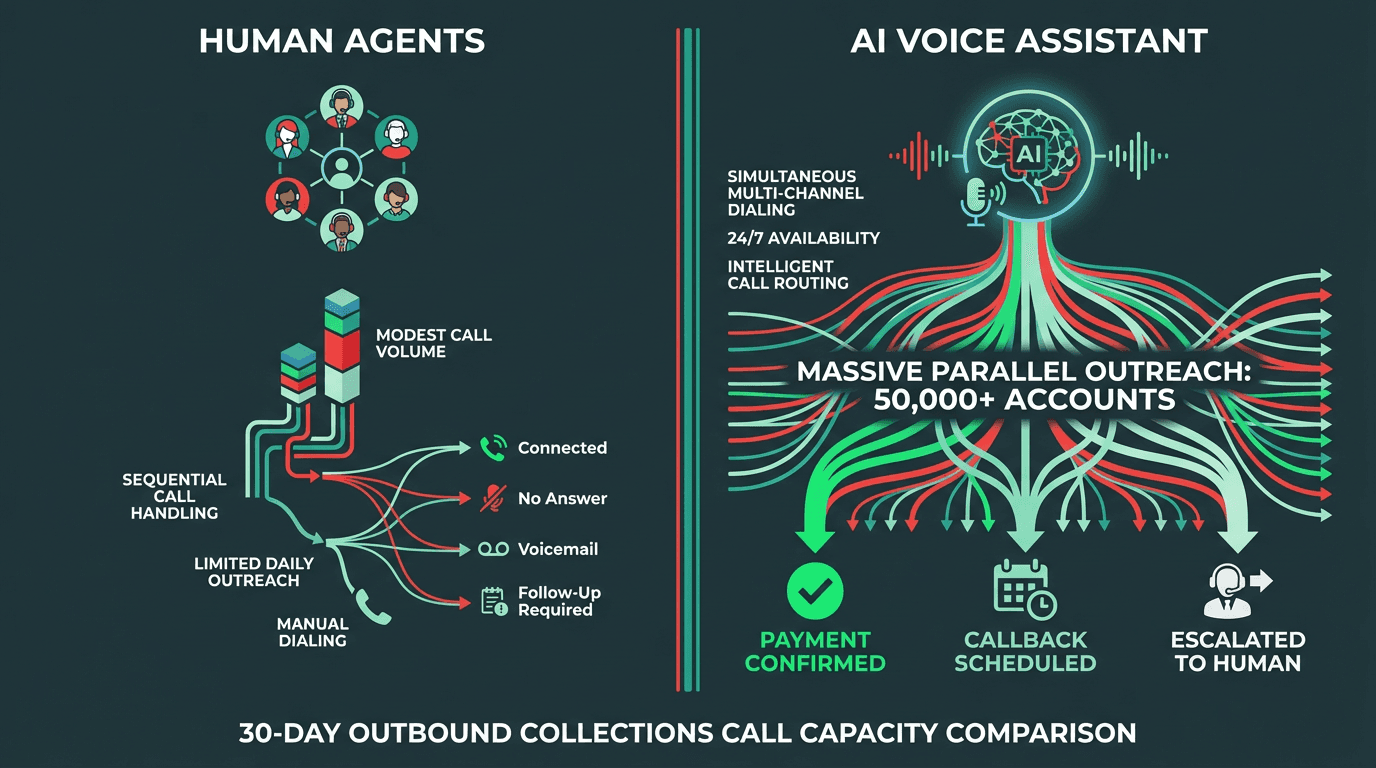
AI voice assistants can handle call volumes that would require dozens of additional human agents.
There is also a quality consistency argument. Human agents have good days and bad days. They deviate from scripts, forget to mention payment options, or handle objections inconsistently. A well-designed voice agent delivers the same compliant message every time, which matters significantly when you are operating under regulatory frameworks like the FDCPA. For a detailed breakdown of how those regulations apply to AI-driven outreach, the FDCPA guidelines for AI in debt collection article covers the specific requirements in depth.
The technical architecture of a collections voice agent
A collections voice assistant is not a single piece of software. It is a pipeline of components that need to work together with low latency, because nothing kills trust in an automated call faster than awkward pauses or misheard responses.
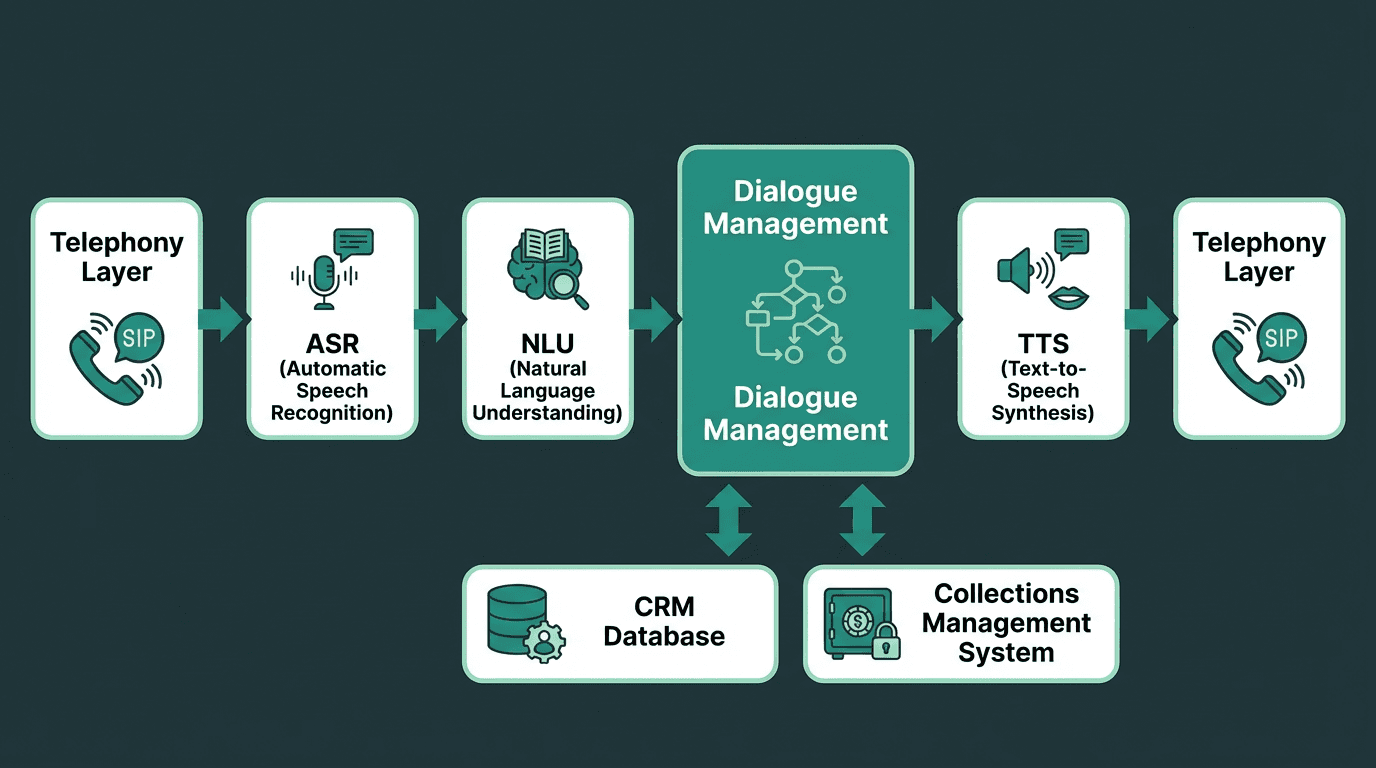
A production collections voice agent integrates ASR, NLU, dialogue management, TTS, and CRM data in a low-latency pipeline.
The core components and what to evaluate in each:
Telephony integration: SIP trunking or enterprise carrier APIs that handle call initiation, DTMF, and transfer. Evaluate concurrent call capacity and failover behavior.
Automatic Speech Recognition (ASR): Converts caller speech to text. Accuracy on financial terminology, account numbers, and dates matters more than general WER benchmarks.
Natural Language Understanding (NLU): Extracts intent and entities from transcribed speech. For collections, key intents include payment commitment, dispute, callback request, and hardship claim.
Dialogue management: The logic layer that decides what the agent says next based on conversation state, account data, and business rules.
Text-to-Speech (TTS): Synthesizes the agent's responses. Voice quality and naturalness directly affect whether callers stay on the line or hang up.
CRM and data integration: Real-time access to account balance, payment history, and contact preferences is what makes the conversation feel personalized rather than generic.
Latency is the hidden performance metric most teams underestimate. The gap between when a caller finishes speaking and when the agent responds should be under 500 milliseconds to feel natural. Each component in the pipeline adds latency, so architectural choices like streaming ASR and parallel inference matter. Smallest.ai's speech models are built with this constraint in mind, offering low-latency synthesis that keeps conversations from feeling robotic or delayed.
Designing conversation flows that actually convert
Most people get this wrong: they design collections call flows the way they would write a script for a human agent. That approach fails because voice AI handles branching logic differently. A human agent improvises when a caller goes off-script. A voice agent needs every branch anticipated in advance, or it falls back to a generic response that breaks the conversation.
The opening matters more than any other part of the call. Callers decide within the first three seconds whether to engage or hang up. The agent needs to identify itself as automated (a legal requirement in most jurisdictions), state the purpose clearly, and get to a question that requires a response. 'This is an automated message from [Lender] about your account ending in 4521. Your payment of $320 was due on March 15th. Can I help you schedule that payment today?' is better than a long preamble about the company.
For renewals, the framing shifts. The call is not about a missed obligation but about a service the customer presumably values. The agent should lead with the benefit of renewing, present the renewal terms clearly, and offer a direct path to confirm. If the customer declines, capturing the reason is valuable data for the business, so the flow should include a brief, non-pressuring reason-capture step before closing.
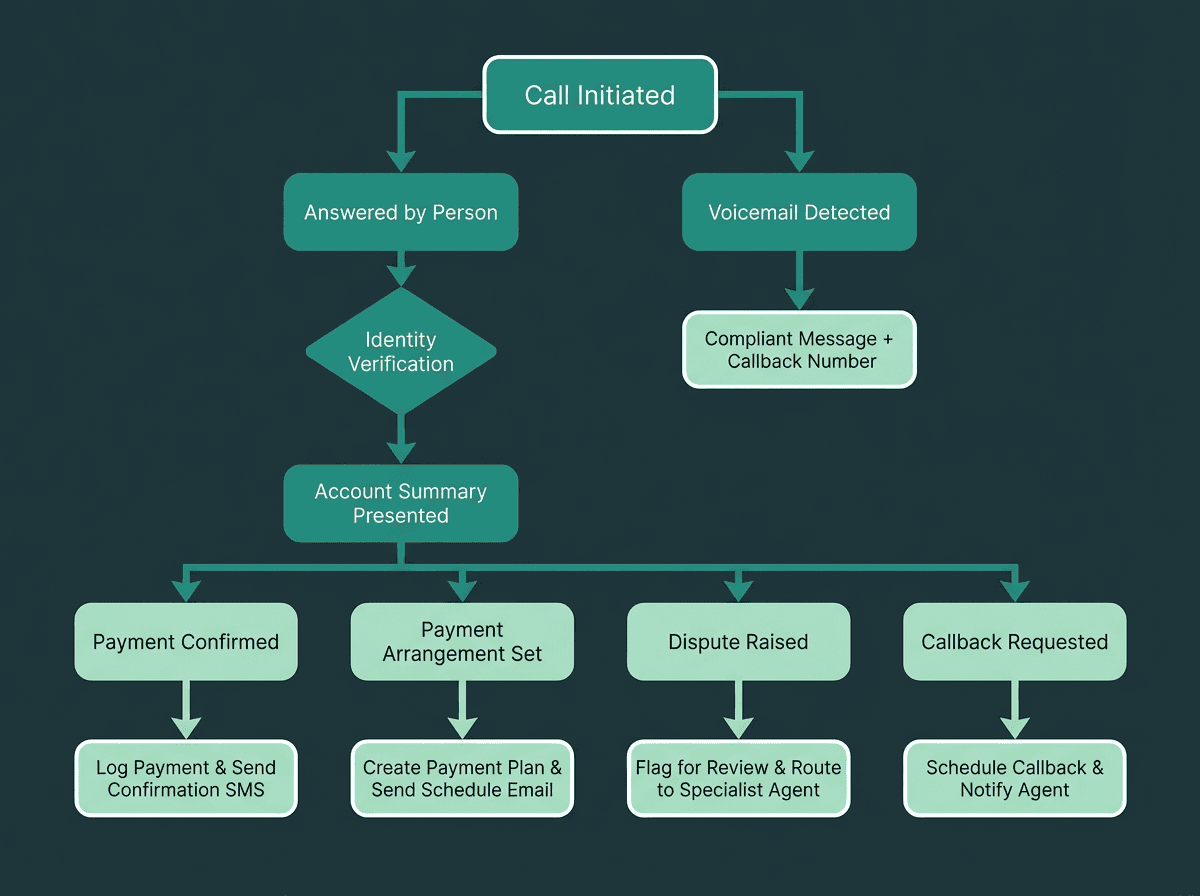
A well-designed collections call flow anticipates every branch, including voicemail, disputes, and hardship claims.
Voicemail handling is often an afterthought, but it is a significant portion of outbound call volume. The message left on voicemail must comply with the same regulations as a live call (no disclosure of debt to third parties, required identification of the caller), while also being compelling enough to generate a callback. Keep voicemail messages under 30 seconds and include a direct callback number.
Compliance is not optional: what you need to know
The financial services voice channel carries significant regulatory weight. The Telephone Consumer Protection Act (TCPA) governs when and how automated calls can be placed to consumers in the US. The Fair Debt Collection Practices Act (FDCPA) sets strict rules on what can be said, when calls can be made, and how disputes must be handled. In the UK, the Financial Conduct Authority (FCA) has its own conduct of business rules for collections communications. Violating these is not a minor compliance issue; TCPA violations carry statutory damages of $500 to $1,500 per call.
Voice communications in financial services also carry recording and retention obligations. MiFID II, CFTC Regulation 1.35, and FCA COBS rules explicitly address voice recording and retention requirements for financial communications — requirements that apply regardless of whether the communication is human or automated.. Your voice agent deployment needs to log every call, retain transcripts for the required period, and make them available for audit.
Non-negotiable compliance requirements for US collections voice agents:
Disclose that the call is from a debt collector and identify the company name
Do not call before 8 AM or after 9 PM in the consumer's local time zone
Honor opt-out requests immediately and propagate them to all contact channels
Never disclose debt information to third parties (including on voicemail if others may hear it)
Provide a clear path to dispute the debt during the call
Obtain prior express consent before placing autodialed or prerecorded calls to mobile numbers under TCPA
Read the full FDCPA compliance guide for AI voice agents in debt collection
Measuring performance and knowing what to optimize
Right contact rate, promise-to-pay rate, and payment kept rate are the metrics that matter in collections. Everything else is a proxy. A voice agent that has a 95% call completion rate but a 2% promise-to-pay rate is not performing well; it is just making a lot of calls. Conversely, a lower contact rate with a high promise-to-pay rate suggests the agent is reaching the right people but not enough of them, which is a dialing strategy problem rather than a conversation design problem.
For renewals, the primary metric is renewal conversion rate, segmented by account age, product type, and contact attempt number. First-call conversion rates for renewals typically outperform later attempts significantly, which means the timing of the first outreach relative to expiration date is a key optimization variable. Most teams find that reaching customers 14 to 21 days before expiration produces better results than waiting until the final week.
Transcript analysis is where the real optimization work happens. Review calls where the customer disengaged or the agent fell back to a default response. These are the branches that were not anticipated in the flow design. Industry research on AI assistant deployment in call centers has found that while AI reduces cognitive load for agents, it can introduce compliance gaps when edge cases are not handled explicitly. The same applies to fully automated agents: edge cases that are not in the flow become compliance and experience risks.
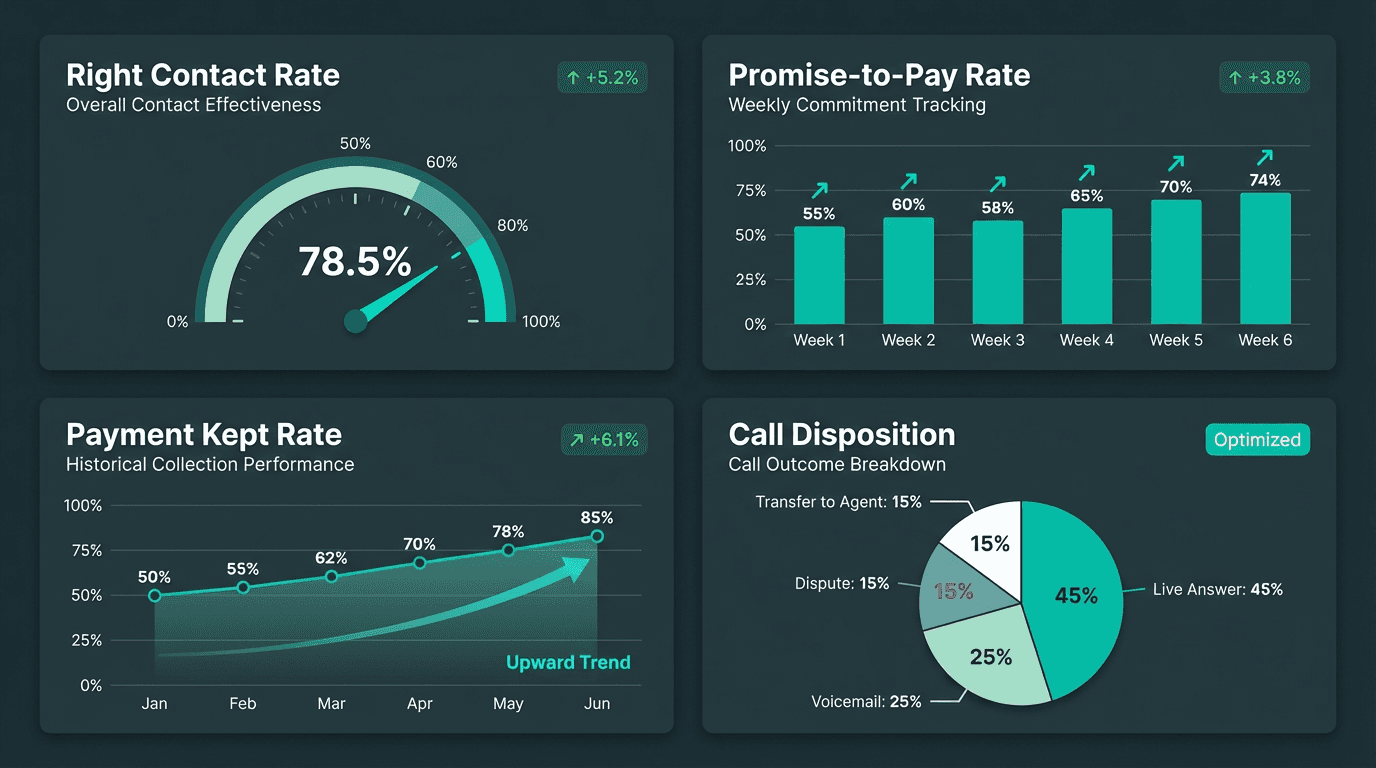
Tracking the right metrics reveals whether your voice agent is driving actual payment outcomes, not just call volume.
Advanced considerations: where most deployments fall short
Skip this section if you are still in early evaluation. This is for teams that have a working deployment and are trying to push performance further.
Voice quality is underrated as a conversion variable. There is substantial evidence that callers respond differently to different voice characteristics, and in collections, a voice that sounds authoritative but not threatening produces better outcomes than one that sounds either too casual or too aggressive. TTS models vary significantly in their ability to convey appropriate prosody for collections contexts. Testing different voice profiles against each other is worth the effort. For teams building on top of a speech platform, how to build AI voice agents for debt collection walks through the specific implementation decisions involved.
Dynamic personalization beyond account balance is another area where most deployments are shallow. An agent that knows the customer's payment history, their preferred contact time (derived from past successful contacts), and whether they have previously requested a hardship arrangement can open the conversation in a fundamentally different way. This requires deeper CRM integration than most initial deployments achieve, but the lift in promise-to-pay rates justifies the engineering investment.
Escalation design is often treated as a fallback rather than a feature. The moment a customer asks to speak to a human, the transition should be warm: the agent should summarize the conversation state so the human agent does not ask the customer to repeat themselves. Cold transfers where the human agent has no context are a significant source of customer frustration and a common reason for disputes. For broader context on how this fits into enterprise deployments, the enterprise voice AI assistant guide covers escalation architecture in more detail.
Finally, consider the intersection with other channels. A customer who received an SMS about their overdue account before the voice call will have a different conversation than one who is being contacted cold. Coordinating the voice agent with email and SMS outreach in a sequenced cadence consistently outperforms voice-only approaches. AI voice agents in banking explores how multi-channel coordination works at the institutional level.
Key takeaways
The requirements covered in this guide, sub-500ms response latency, FDCPA and TCPA compliance baked into dialogue logic, TTS prosody calibrated for collections contexts, and warm escalation to human agents, are not independent checkboxes. They compound. A voice agent that is fast but non-compliant is a liability. One that is compliant but sounds robotic will see callers hang up before a promise-to-pay is ever reached. Lightning by Smallest.ai is built specifically for this intersection: low-latency synthesis that preserves natural prosody, combined with the accuracy on financial terminology that collections and renewals workflows demand.. Teams building on that foundation start with the hardest technical constraints already solved, which means engineering effort can go toward conversation design and CRM integration rather than chasing latency or retraining ASR on account numbers.
What to carry forward from this guide:
Voice assistants are operationally suited to collections and renewals because the call volume requirements exceed what human teams can handle cost-effectively at scale.
Smallest.ai's debt collection voice AI is built specifically for this environment.The technical pipeline (ASR, NLU, dialogue management, TTS, CRM integration) must be designed for low latency. Pauses kill engagement.
Conversation flow design requires anticipating every branch in advance, including voicemail, disputes, hardship claims, and opt-out requests.
Compliance is the non-negotiable foundation. TCPA, FDCPA, and equivalent international frameworks apply fully to automated voice outreach.
The metrics that matter are promise-to-pay rate and payment kept rate, not call volume or completion rate.
Advanced performance gains come from voice quality testing, deeper CRM personalization, and warm escalation design.
For a specific industry application, enhancing auto loan collections with Voice AI shows how these principles apply in a high-volume lending context.
Frequently asked questions
Can a voice assistant legally place debt collection calls without a human on the line?
What is the difference between a voice assistant and an IVR system for collections?
How do you prevent the voice agent from making compliance errors during live calls?
What TTS voice characteristics work best for collections calls?
How does a voice assistant handle a customer who claims they already paid?