AI voice APIs for lead qualification and outbound sales

AI voice APIs qualify leads in minutes, log outcomes to your CRM, and reduce rep time spent on dead-end calls while improving pipeline consistency.
AI voice APIs are programmable interfaces that let software speak, listen, and run structured conversations over the phone or an internet channel. In sales, they sit between your CRM and your prospects, taking on the repetitive but consequential work of outreach and qualification at a pace and volume a human team simply cannot sustain.
AI voice APIs are increasingly being adopted for lead qualification and outbound sales because they allow teams to respond faster, maintain consistency, and scale outreach without proportionally increasing headcount. Faster follow-up generally improves the chances of connecting with interested prospects before attention shifts elsewhere. AI voice APIs are built to hit that window reliably, without asking reps to live on alert.
What an AI Voice API Actually Does
An AI voice API exposes endpoints that convert text into natural-sounding speech (text-to-speech), turn spoken audio into text (speech-to-text), or run a two-way spoken interaction end to end (speech-to-speech). You can use any layer on its own, or chain them into a voice agent that listens, interprets, decides, and responds without a human on the line. This type of voice agent architecture is what enables dynamic, real-time conversations.
In outbound sales, the flow is usually mechanical in the best way. A trigger event (new form submission, CRM status change, scheduled follow-up) fires an API call. The voice layer places the call, delivers an opener, and starts listening. A Speech-to-Text API transcribes the reply in near real time. A language model maps that text to intent, checks your qualification rules, and produces the next turn for a Text-to-Speech API to speak. That loop continues until you get one of three outcomes: a booked meeting, a disqualification, or a callback. Then the system writes the transcript, disposition, and fields back to the CRM automatically.
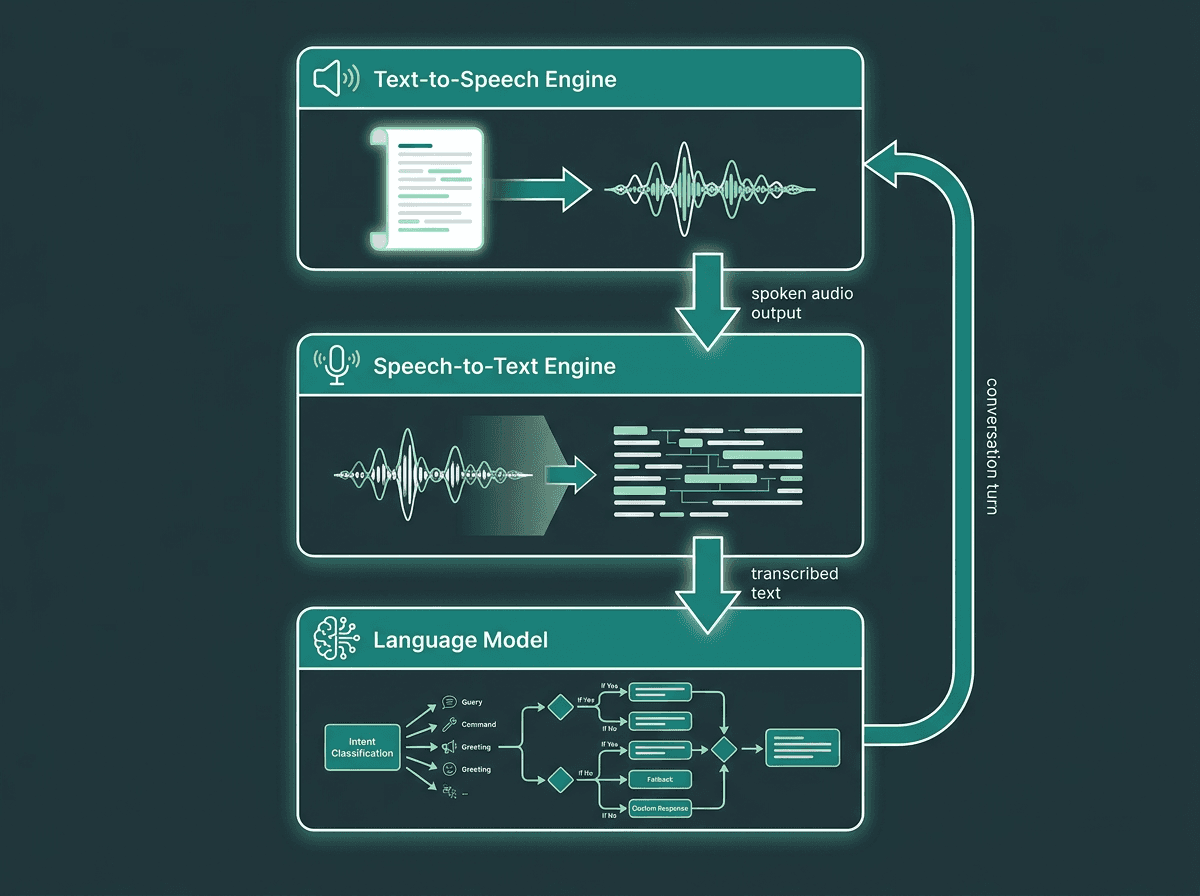
Three stacked layers form the core loop powering every **AI voice API** conversation turn.
Why This Matters for Sales Teams Right Now
Sales productivity has been a stubborn constraint for years. The practical reason is simple: if an AI handles the first two or three qualification calls, reps stop spending their best hours on low-signal conversations. They pick up the phone after a lead has already confirmed budget, timeline, and real interest. That is not a small optimization; it changes the shape of a rep's day.
Sales and service are converging on the same playbook: ship agents, shorten cycles, and let competitors argue about the category while you compound execution.
To understand how voice AI is changing lead qualification for modern sales teams, look past the usual "efficiency" pitch. The bigger win is consistency. A voice agent runs the same qualification framework on every call, every time. It does not skip a BANT question because the prospect sounds friendly, and it does not forget to ask about authority because the conversation got chatty. That uniformity shows up downstream as cleaner CRM fields and pipeline forecasts that stop wobbling based on who made the calls.
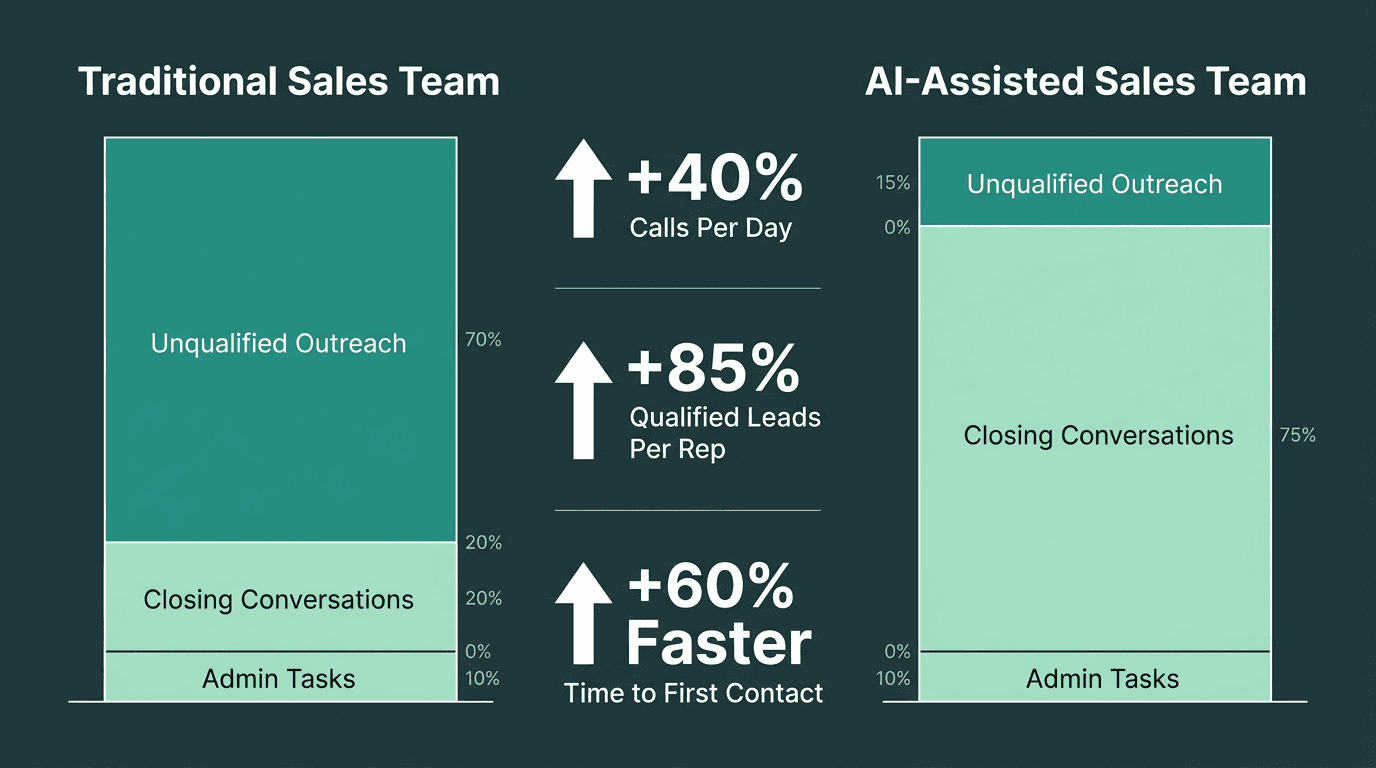
AI voice APIs compress unqualified outreach time, freeing reps for high-value closing conversations.
The Mechanics of Qualification: How a Voice Agent Scores a Lead
Qualification is not one magic question; it is a structured interview. You are mapping a prospect's answers to criteria your team already cares about: budget range, decision-making authority, timeline, current solution, and pain severity. A solid voice agent encodes that framework as a conversation flow and branches based on what the prospect actually says, instead of plodding through a rigid script.
Speech-to-text is where the system earns its keep, because accuracy is not optional. Mishearing a budget number or missing a single "not" can dump a qualified lead into the wrong bucket. That is why the choice of best speech-to-text APIs matters just as much as how good the voice sounds. Latency is the other half of the experience: as latency increases, conversations begin to feel less natural and more interrupt-prone.
Component | Function in Sales Context | Key Performance Metric |
|---|---|---|
Text-to-Speech (TTS) | Speaks the agent's lines with natural prosody and a voice that fits the brand | Natural-sounding speech |
Speech-to-Text (STT) | Transcribes prospect replies in real time so the system can analyze intent | High transcription accuracy |
Conversational LM | Reads intent, tracks dialogue state, and generates the next response | Turn accuracy, fallback rate, qualification completion rate |
Telephony / WebRTC layer | Connects the call over PSTN or in-browser audio | Call success rate, audio quality under packet loss |
CRM integration | Writes outcomes back, updates lead scoring, and triggers follow-up workflows | Reliable CRM synchronization |
Where Voice APIs Fit in the Outbound Workflow
Sales teams tend to deploy voice agents in three patterns. They can run separately, but they are often strongest when they share the same underlying stack and data model.
First is first-touch qualification. The agent calls every inbound lead within minutes, runs your qualification flow, and routes the outcome: booked meeting to the calendar, warm-but-not-ready to nurture, disqualified to closed-lost. Reps only see leads that have already cleared the filter. Many teams start here because the ROI shows up quickly and the integration surface area is relatively small.
Second is dormant lead reactivation. Most CRMs are full of people who raised their hand once and then disappeared. A voice agent can work that backlog methodically, re-qualify against updated criteria, and flag anyone whose situation has changed. It is high-value work, and it is exactly the kind of repetitive outreach humans rarely have the bandwidth to do with any consistency.
Third is post-demo or post-trial follow-up. Here the agent checks in on usage, surfaces objections, and either schedules a closing call or escalates to a rep based on the signals it picks up. Teams that want to qualify leads on autopilot across all three patterns usually build a unified agent platform instead of stitching together separate point tools and hoping the data lines up later.

AI voice agents can operate across all three outbound stages — from first touch to post-demo follow-up.
Common Misconceptions Worth Addressing
The durable myth is that prospects will hang up the moment they suspect an AI is on the other end. In practice, that is not what determines outcomes. When the voice is natural, the pacing is human, and the agent is transparent about why it is calling, completion rates for AI qualification calls can hold up against human-dialed calls running the same script. The usual failure mode is obvious: robotic audio and awkward delays, not the idea of an agent making the call.
Another misconception is that voice APIs "replace" sales reps. They do not. They replace the part of the job most reps never signed up for: dialing a long list to find the few people who are actually in-market. Teams that lean into voice AI typically see reps closing more because their time shifts toward conversations that already have heat.
A third misconception is that integration is a months-long science project. Many modern voice agent platforms ship with pre-built CRM connectors. If your team needs to integrate a voice assistant with your CRM, modern voice agent platforms can reduce implementation effort significantly when CRM integrations and qualification workflows are already well defined.
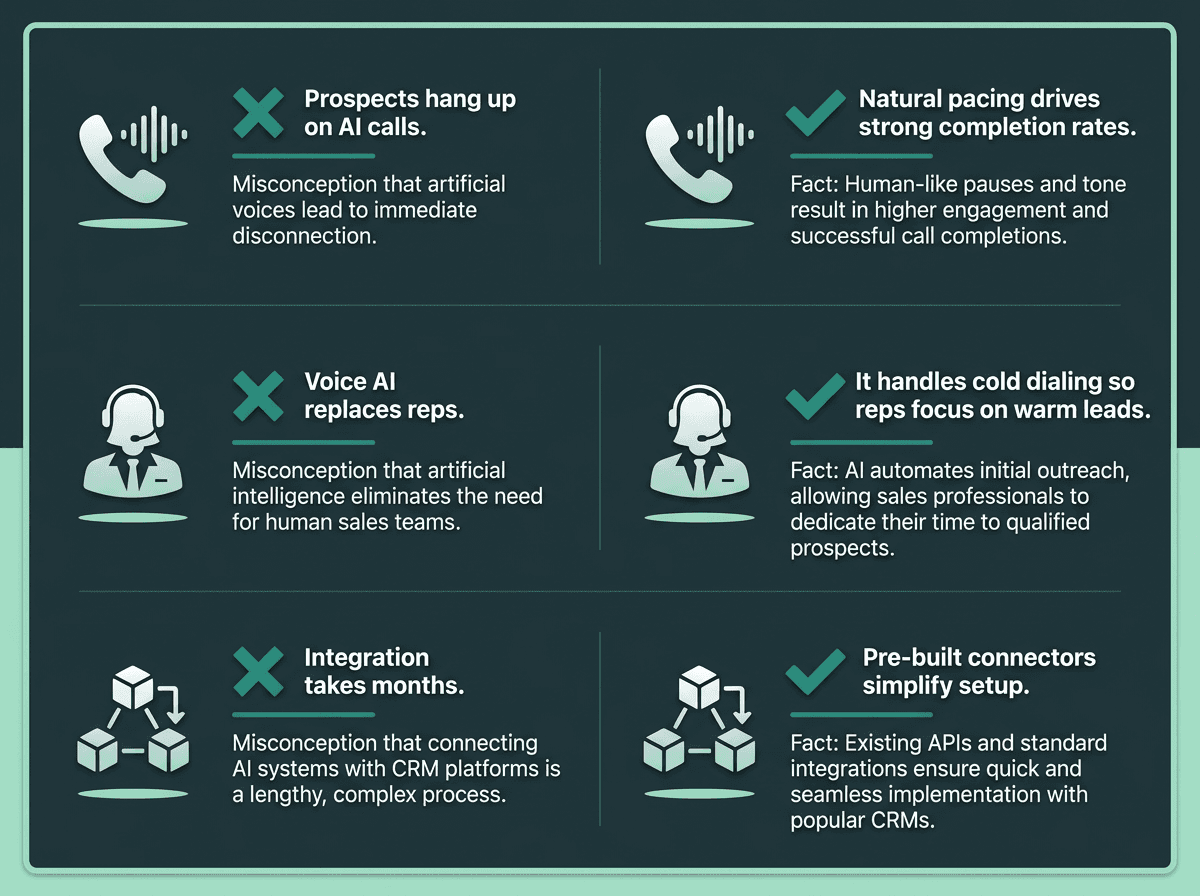
Three persistent myths about **AI Voice APIs** in sales — and what actually drives results.
Enterprise Considerations: Security, Compliance, and Voice Identity
At enterprise scale, the checklist expands fast, and not in the fun ways. Call recordings can include personally identifiable information and, depending on the jurisdiction, you may need consent before recording begins. A voice API stack used for outbound sales has to treat consent prompts, data residency, and retention policies as first-class product requirements. Teams evaluating secure voice AI APIs for the enterprise should look for SOC 2 compliance, data processing agreements, and unambiguous documentation on where audio is processed and stored.
Voice identity sits next to security as a brand risk and a brand opportunity. Once you deploy an agent at volume, its voice becomes a customer-facing asset. Custom voice cloning can help organizations create a more consistent and recognizable voice experience across customer interactions. It also keeps the experience consistent across touchpoints, from the first qualification call through post-sale follow-ups.
Key Takeaways
What to carry forward from this overview of AI voice APIs for lead qualification and outbound sales:
AI voice APIs chain text-to-speech, speech-to-text, and conversational language models into a pipeline that can run structured qualification calls without a human on the line.
Faster follow-up improves conversion, and AI voice agents are a practical way to respond consistently at scale.
Consistency matters as much as speed: an AI agent applies the same criteria on every call, which translates to cleaner pipeline data.
The three primary deployment patterns are first-touch qualification, dormant lead reactivation, and post-demo follow-up.
Prospect experience is mostly a function of voice quality and latency. Hold vendors to high transcription accuracy and natural-sounding speech.
Enterprise rollouts need explicit planning for consent handling, data residency, and SOC 2 compliance before go-live.
With the right platform, CRM integration is a days-long implementation, not a multi-month project.
The Problem This Technology Was Built to Solve
Outbound sales has never suffered from a lack of leads; it suffers from the cost of sorting them. Human reps are expensive, finite, and inconsistent when the job turns into high-volume repetition. The leads that need a call right now will not wait for someone to finish lunch. The dormant contacts who might be ready today will not always raise their hand twice. And the qualification criteria your VP of Sales cares about are not always the same questions a tired rep remembers to ask on call number forty.
AI voice APIs are aimed directly at those failure modes. They respond instantly, work through lists without fatigue, and apply qualification logic the same way every time. That leaves human judgment where it belongs: on warm calls with prospects who have already signaled they are worth a rep's attention.
Smallest.ai is built around that exact gap. The Smallest.ai Voice Agents platform, backed by the Lightning TTS engine and Pulse speech-to-text layer, gives sales teams a production-ready foundation for outbound qualification without months of custom build work. If the goal is first-touch speed, dormant lead reactivation, or consistent post-demo follow-up, the underlying architecture stays the same: designed for real-time conversations and integration with existing business systems. Explore Smallest.ai's Voice Agents to see how the platform maps onto your qualification workflow.
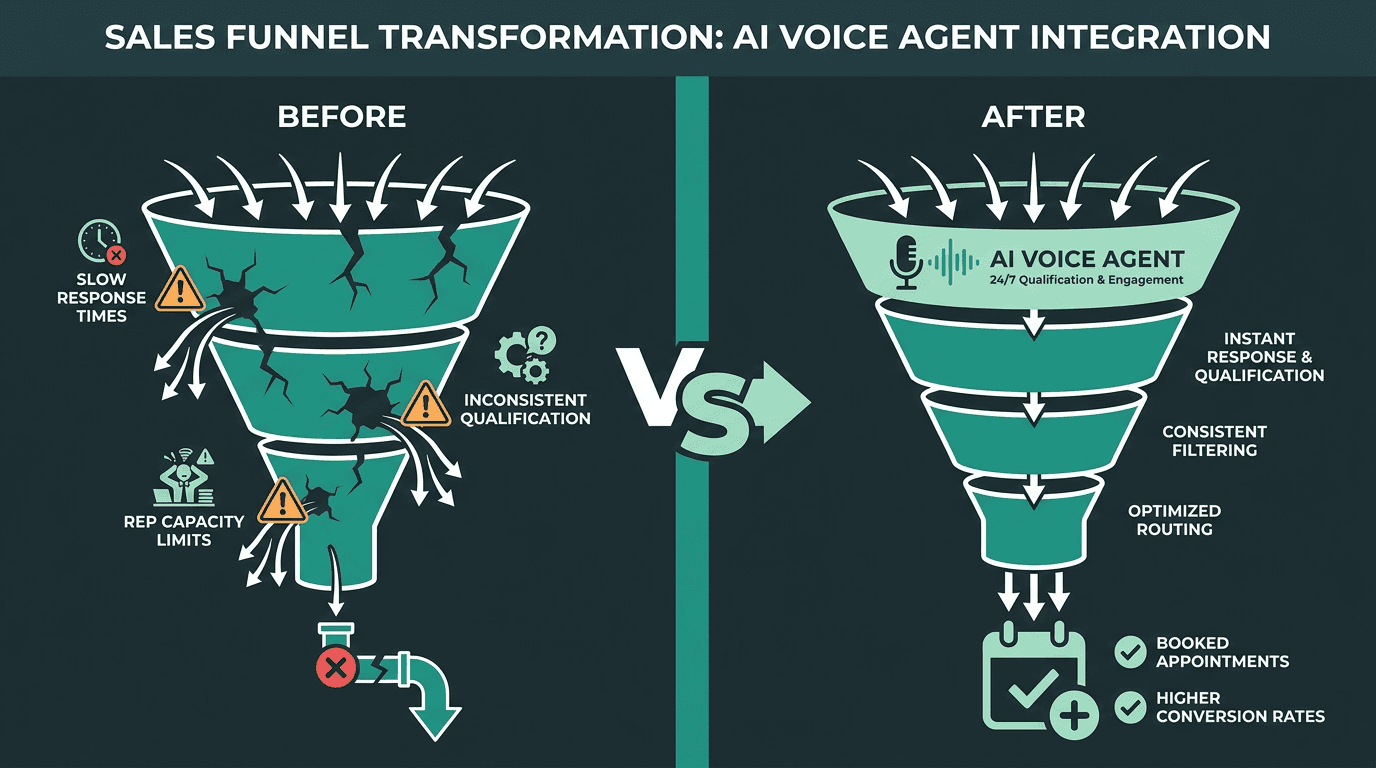
Adding an AI voice agent layer seals the leaks in a traditional outbound sales funnel.
Qualify More Leads Without Adding More Reps
Speed and consistency are two of the biggest challenges in outbound sales. Smallest.ai Voice Agents help teams automate lead qualification, follow up with prospects in real time, and route qualified opportunities directly into existing sales workflows. With integrated speech recognition, voice generation, and workflow orchestration, teams can scale outreach without adding operational complexity.
Frequently asked questions
What is an AI voice API, and how does it differ from a regular phone bot?
How quickly can an AI voice agent contact a new lead?
Will prospects know they are speaking to an AI, and does it matter?
What qualification frameworks work best with AI voice agents?
How does Smallest.ai support AI voice API deployments for sales teams?