Voice AI for multilingual customer support

Multilingual voice AI for customer support: how it works, where it fits, and what to get right on latency, voice quality, and language-aware escalation.
Multilingual voice AI applies artificial intelligence to spoken support across multiple languages, so a system can understand a caller, interpret what they mean, and answer back in the language they actually use. Under the hood, it links automatic speech recognition, natural language understanding, and speech synthesis into a single real-time loop.
If you support customers across regions, language is not a nice-to-have detail. CSA Research found that 76% of online shoppers prefer buying when product information is in their native language. Multilingual voice AI is how support teams meet that expectation without hiring their way into an ever-expanding language roster.
Why Language Gaps Are a Business Problem, Not Just a UX Problem
When a customer cannot communicate comfortably on a support call, the outcome is rarely limited to annoyance. They may leave. Loyalty, retention, and lifetime value can hinge on one simple test: does the person (or system) on the other end actually understand what I am saying?
The usual playbook for multilingual support is either to hire agents for specific languages (costly and hard to staff consistently) or to route calls through translation services (slower, less personal, and prone to mistakes). Both approaches break down when you enter multiple new markets in a single quarter. The math is unforgiving. Multilingual voice AI tackles that structural mismatch by turning language coverage into a configuration choice instead of a permanent staffing commitment.
This shift points to a re-architecture of support operations, not a brief wave of cost-cutting. The focus is on creating scalable, consistent experiences across every language a business supports.
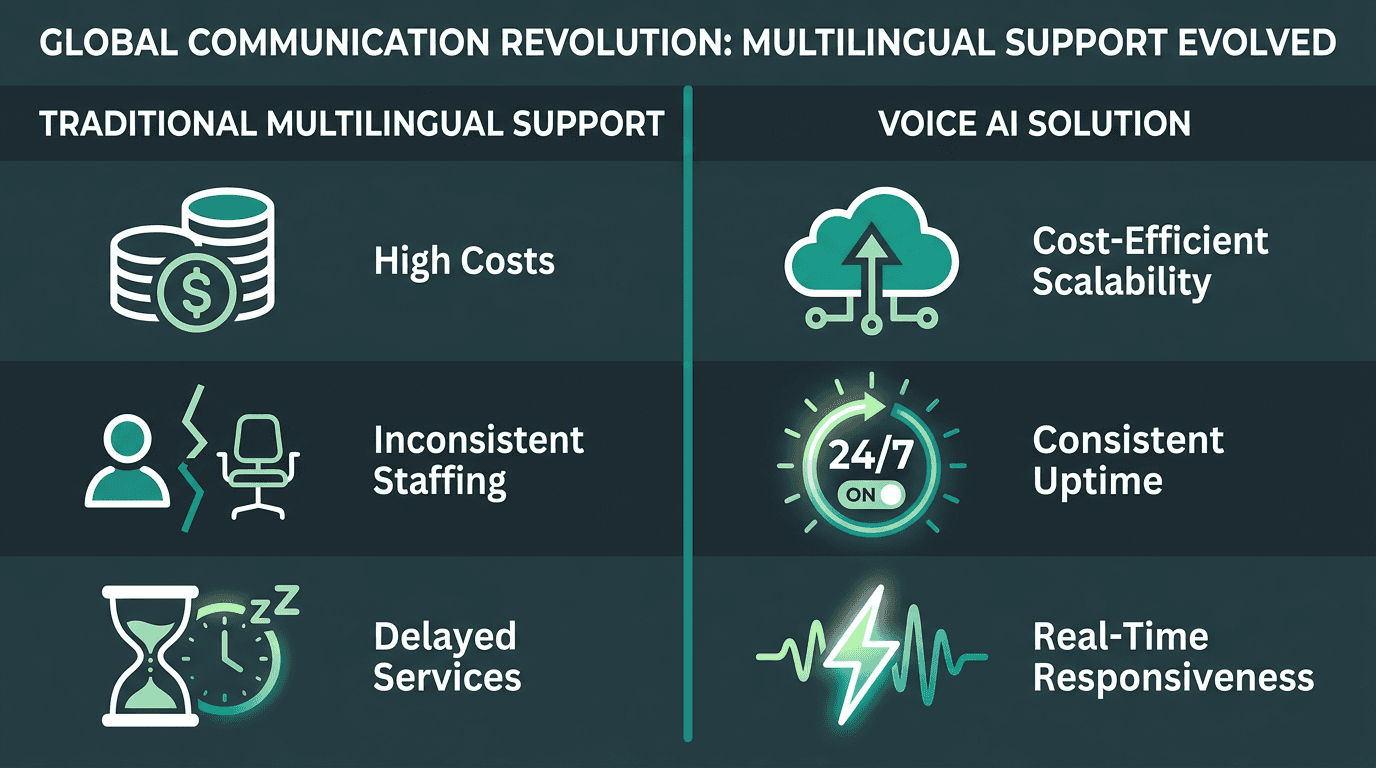
Multilingual voice AI replaces costly, inconsistent support models with scalable, always-on language coverage.
How Multilingual Voice AI Actually Works
A multilingual voice AI stack is easier to evaluate when you break it into three stages. Each stage has its own failure modes, and most “it sounded fine in the demo” problems show up at the seams between them.
Speech recognition across languages. The system starts by turning audio into text. In multilingual settings, the core challenge for speech-to-text systems is handling accents, code-switching, and noisy audio. Engines trained on broad, real-world datasets tend to hold up far better than models tuned mostly on clean studio audio.
Language understanding and intent detection. Once you have text, a language model has to figure out what the customer is trying to do. That means handling idioms, regional phrasing, and the cultural context that changes how people ask for help. A customer in Brazil raising a delayed-order complaint will often phrase it differently than a customer in Germany, even when the underlying intent is identical.
Multilingual speech synthesis. Finally, the response has to come back as speech that sounds natural in that language: prosody, stress, and pacing that do not feel imported. In practice, TTS quality becomes a trust signal. A response can be grammatically correct and still land badly if it is delivered in a stiff, mechanical voice or with an accent that feels out of place. If you want the technical view of how low-latency systems keep this conversational, understanding real-time speech-to-speech AI is worthwhile. This is particularly true for real-time speech-to-speech conversations where latency can make or break the user experience.
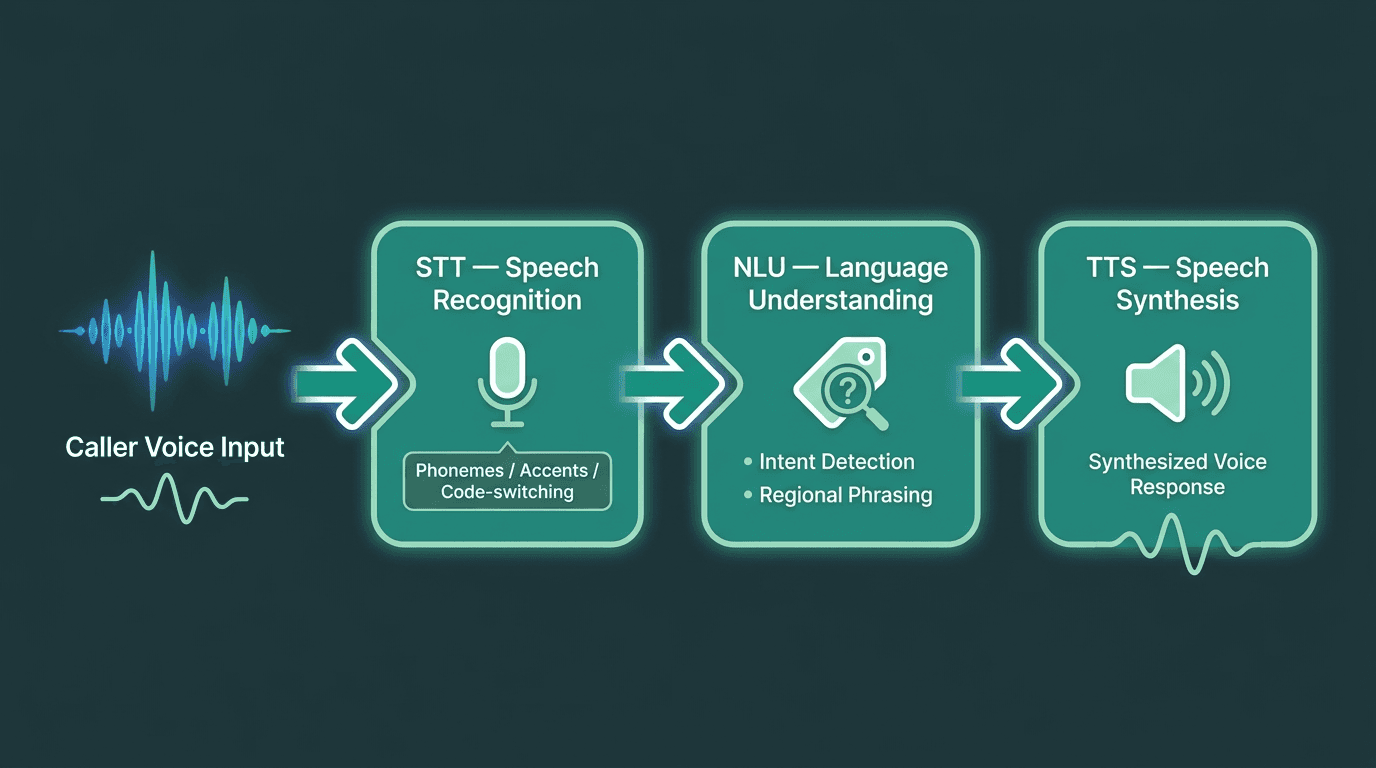
Three core stages of a multilingual voice AI stack, each with distinct failure modes.
Types of Multilingual Voice AI Deployments
Multilingual voice AI is not a single deployment shape. The right setup depends on your call volume, your language distribution, and how often a conversation needs human judgment versus straightforward automation.
The three most common deployment patterns in enterprise support:
Fully automated [multilingual voice agents](https://smallest.ai/voice-agents) run the whole interaction for high-volume, repeatable requests (account status, order tracking, appointment booking) across multiple languages without a human in the loop. In mature deployments, most calls end with an automated resolution.
AI-assisted live agents provide real-time transcription and translation, plus relevant context, to a human agent who may not speak the caller’s language. The human makes the calls; the AI carries the language load.
Hybrid escalation flows begin with an automated multilingual agent and hand off to a human when intent confidence drops below a threshold or the customer asks for a person. You keep the efficiency gains while reserving human time for the cases that actually need it.
Before you pick an architecture, it helps to get specific about what a multilingual voice AI needs to do. This is not only a technical decision; it determines staffing plans, training, quality assurance, and how escalations behave across your operation.
Where Multilingual Voice AI Shows Up in Practice
E-commerce platforms operating across Southeast Asia use multilingual voice agents for returns and delivery questions in Thai, Vietnamese, Bahasa Indonesia, and Tagalog at the same time, without standing up separate regional call centers. One deployment can cover what would otherwise become four parallel staffing problems.
Fintech companies serving diaspora communities in Europe deploy voice agents that can switch between a customer’s heritage language and the local official language mid-call, because that is how bilingual customers naturally talk. This is a production pattern, not a lab demo, and it reduces average handle time while improving first-call resolution rates.
Healthcare providers use multilingual voice AI for appointment scheduling and prescription refill reminders, where language accuracy is tied to patient safety rather than just satisfaction scores. The quality bar is higher, but the operational requirement is familiar: serve people in the language they understand best. The patterns stay consistent even as the vertical changes.
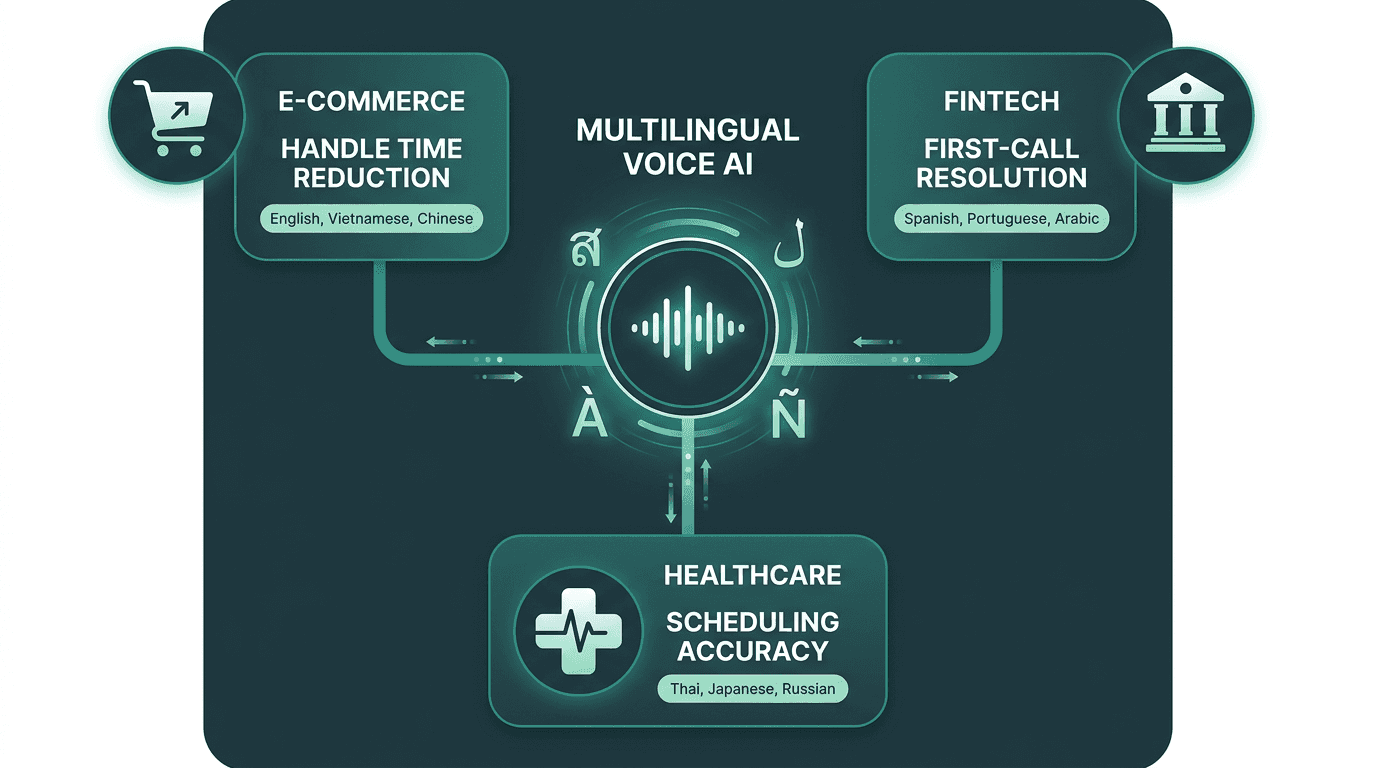
Multilingual voice AI delivers measurable results across e-commerce, fintech, and healthcare verticals.
Three Things People Get Wrong About Multilingual Voice AI
Misconception 1: Translation is the hard part. Teams often assume that if the system can translate well, everything else is solved. In practice, translation is the easy layer. The hard parts are speech recognition that survives accents and noisy audio, responses that are culturally natural (not just literally correct), and latency that stays low enough to feel like a conversation. A system can translate perfectly and still fail if it answers two seconds late.
Misconception 2: You need a separate model per language. Most modern multilingual systems rely on shared model weights with language-specific fine-tuning, rather than maintaining completely separate models. This detail matters for cost and release cadence: improve the base model and every supported language benefits. Using pre-trained multilingual voice agent models is a common approach that avoids the need to keep dozens of independent models up to date.
Misconception 3: Multilingual support means lower quality per language. Early systems did dilute quality by spreading training data too thin. Current models trained on large multilingual corpora can match monolingual quality for high-resource languages (Spanish, Mandarin, French, Arabic, Hindi) and get close for many mid-resource ones. The gap has narrowed substantially, and for the languages that drive most global support volume, it is largely closed.
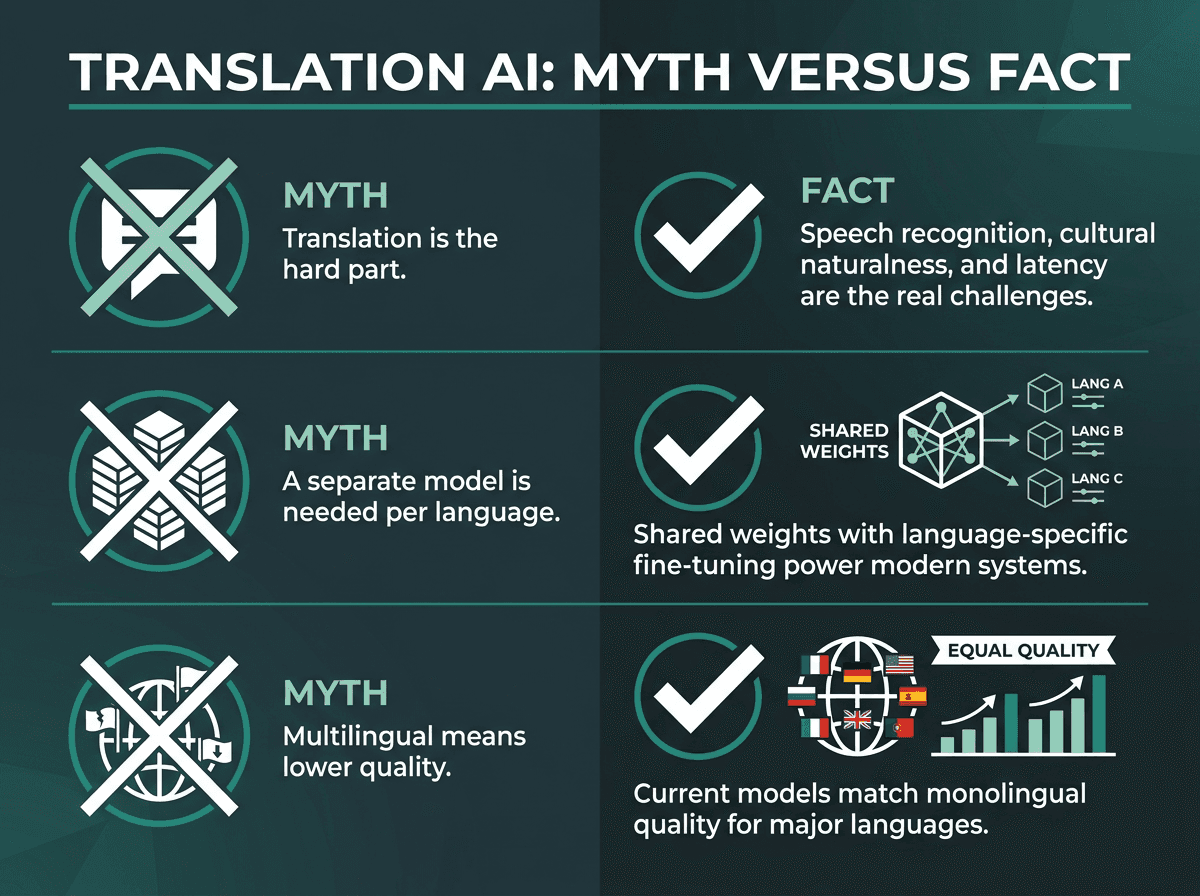
Modern multilingual voice AI has outpaced many assumptions teams still carry into vendor evaluations.
What Good Implementation Looks Like
Strong multilingual support does not come from connecting a voice bot to a phone line and calling it done. The teams that get reliable outcomes treat implementation as product work: a set of decisions about detection, voice, and escalation that determine whether callers trust the system.
Language detection needs to be automatic and fast. Customers should not have to fight through a language menu before they can explain a problem. A well-tuned system identifies the language within the first few words and routes the session accordingly. When a caller switches languages mid-conversation (common in bilingual communities), the system should follow the shift without forcing a reset.
Voice quality matters more than many teams budget for. If a customer hears a robotic or heavily accented synthetic voice in their own language, it can feel more alienating than a human agent speaking imperfect but friendly English. Voice quality, tone, and pacing are not superficial tweaks; they are part of earning enough trust for the customer to keep talking.
Escalation has to stay language-aware. If the caller asks for a human and gets routed to an agent who cannot speak their language, you have recreated the original problem with extra steps. Escalation logic should match by language when possible, or at least arm the agent with a real-time transcript and translation. Language-aware escalation is one of the highest-leverage workflow upgrades teams can make.
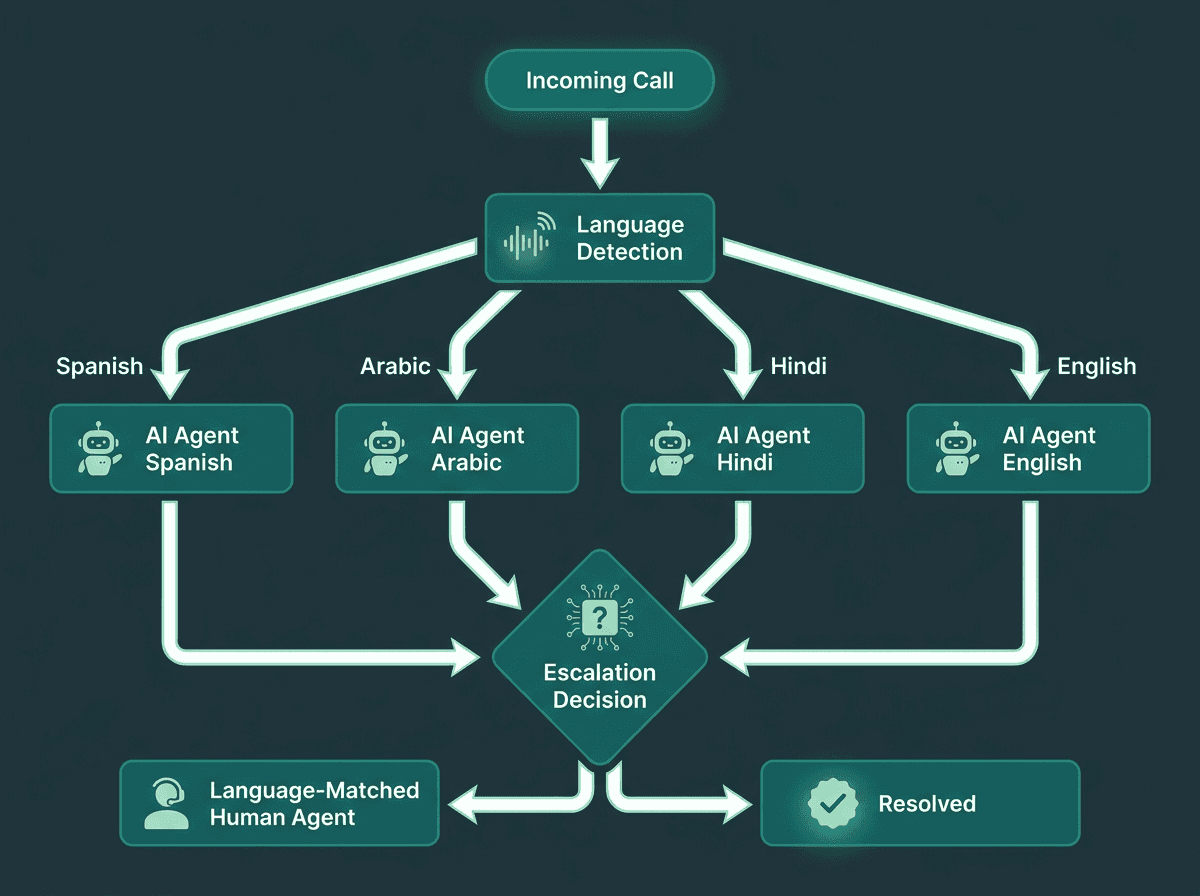
Language-aware routing and escalation define whether a multilingual voice AI deployment actually works.
Key Takeaways
What to carry forward from this overview of multilingual voice AI:
Multilingual voice AI links speech recognition, language understanding, and speech synthesis into a real-time pipeline that serves customers in their native language without staffing a separate team for each language.
Language coverage has shifted from a hiring constraint to a software setting, which changes the economics of global support.
The three deployment patterns (fully automated agents, AI-assisted live agents, hybrid escalation) map to different volumes and complexity. Picking the wrong one creates operational friction even if the underlying models are strong.
Translation accuracy is rarely the main bottleneck. Latency, accent robustness, and culturally natural phrasing are where implementations usually win or lose.
Voice quality and language-aware escalation are consistently underestimated. Both show up directly in trust, call completion, and resolution rates.
Multilingual voice AI is trending toward a baseline expectation in global support rather than a special differentiator.
Deliver Customer Support in the Language Your Customers Actually Speak
Expanding language coverage shouldn’t require building a new support team for every market. Smallest.ai helps businesses deploy multilingual voice agents that can understand, respond, and escalate conversations across languages while maintaining the speed and voice quality customers expect.
The Atoms platform lets teams deploy voice agents across languages, and the Hydra speech-to-speech system supports real-time multilingual conversations end to end. Whether you are rolling out a fully automated multilingual agent or a hybrid workflow with human escalation, the stack is designed to make language coverage feel like an engineering choice instead of a recurring operational burden. To see what a complete implementation looks like in practice, read more about building effective multilingual customer support.
Frequently asked questions
How many languages can a voice AI system support at real production quality?
Does multilingual voice AI handle code-switching when customers mix languages mid-conversation?
What escalation rate should I expect from a multilingual voice AI to a human agent?
Is voice AI for multilingual support appropriate for regulated industries like healthcare or financial services?
How should a support team start with multilingual voice AI?