AI Voice Assistants for Ecommerce CX in 2026

Learn how AI voice assistants improve ecommerce order status, returns, product discovery, checkout support, and customer experience.
The voice assistant is no longer a novelty feature. According to Global Market Insights (2025), the global voice commerce market is projected to reach $49.2 billion in 2025 and expand to $252.5 billion by 2034. That trajectory reflects a fundamental shift in how people expect to interact with online stores, not just browse them. Shoppers want to ask questions, get instant answers, and complete tasks without touching a screen.
This guide is written for ecommerce product managers, developers, and CX leads who want to understand how voice AI works across three high-impact use cases: order status inquiries, returns processing, and product discovery. By the end, you'll have a clear picture of the architecture involved, where voice assistants genuinely outperform traditional interfaces, and what it takes to deploy them well. If you want the broader context first, a guide to AI voice assistants is a good starting point.
What's in This Guide
Sections covered:
Why voice is becoming the default ecommerce interface: market signals and behavioral data
How voice assistants handle order status: architecture, integrations, and real-world flow
Voice-driven returns: where conversational AI removes friction from the most dreaded customer interaction
Product discovery through voice: intent parsing, catalog search, and recommendation logic
Advanced considerations: latency, fallback handling, multilingual support, and privacy
FAQ and key takeaways
Why Voice Is Becoming the Default Ecommerce Interface
By the end of 2024, active voice assistant devices worldwide reached 8.4 billion, surpassing the global population (Juniper Research, 2025). That number includes smartphones, smart speakers, wearables, and in-car systems. The implication for ecommerce is straightforward: your customers already have a voice interface in their pocket. The question is whether your platform is on the other end of it.
Consumer behavior is moving in a clear direction. Research from PwC (2025) found that 50% of consumers who have used a voice assistant for shopping have completed a purchase through it. In the US alone, 38.8 million consumers use smart speakers for shopping-related activities (Statista, 2025). These aren't edge-case users. They're mainstream shoppers who have found voice faster and more convenient for specific tasks.
The use cases that drive the most voice interaction in ecommerce are not browsing or checkout. Post-purchase interactions such as order tracking and reorders are among the most natural ecommerce use cases for voice, because they are repetitive, high-frequency, and intent-clear. This tells us something important about where voice delivers the highest ROI. It's in the operational, repetitive, high-frequency interactions where customers already know what they want and just need a fast answer. For a broader view of how voice AI is transforming e-commerce, the behavioral shifts go well beyond convenience.
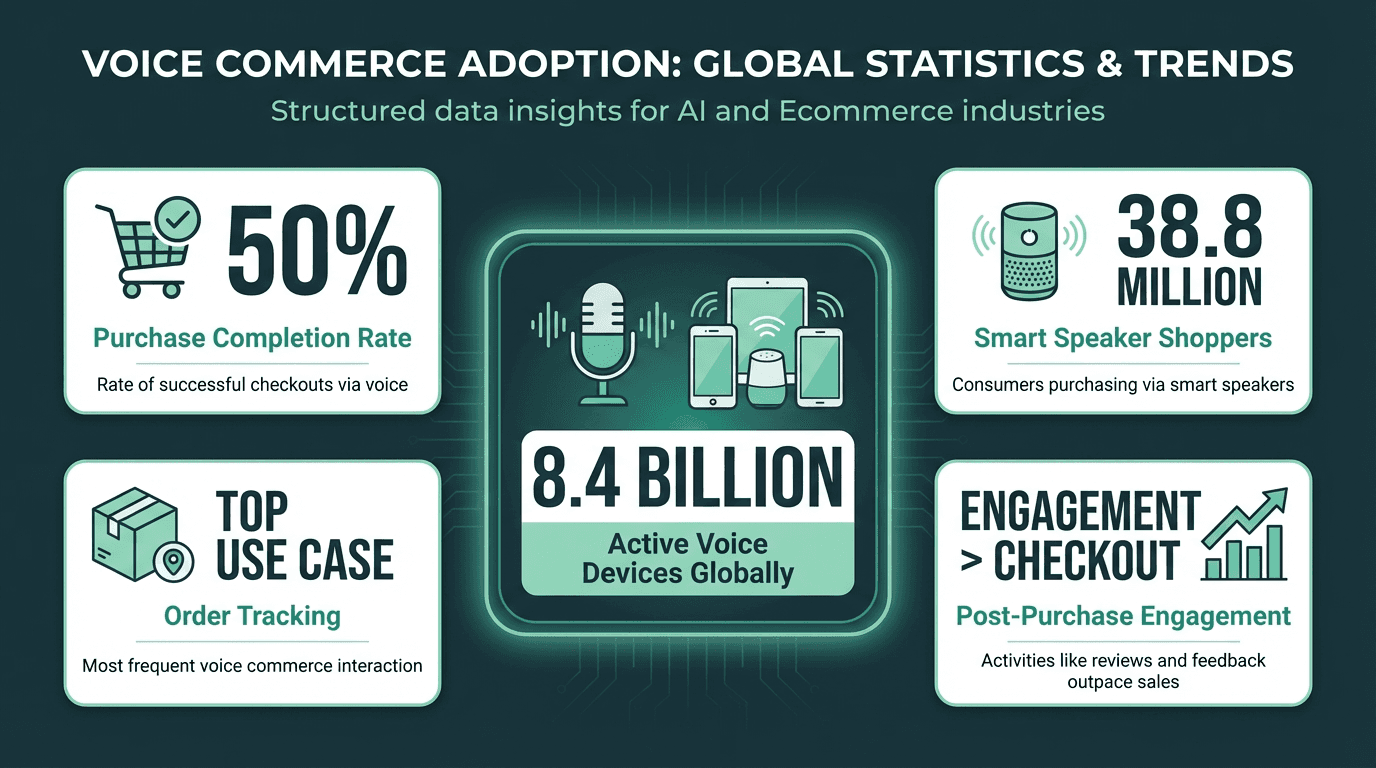
Voice commerce adoption is accelerating across post-purchase interactions, with order tracking leading use cases.
How Voice Assistants Handle Order Status Inquiries
Order status is the single most common reason customers contact support after placing a purchase. It's also one of the easiest interactions to automate well with voice AI, because the intent is unambiguous and the data is structured. When a customer says 'Where is my order?', there's no ambiguity to resolve. The assistant needs to authenticate the user, query the OMS or logistics API, and return a spoken response. That entire flow can complete in under two seconds with a well-built system.
The Technical Architecture Behind Order Status Voice Flows
A production-grade order status voice assistant involves several integrated layers. The speech recognition layer converts the customer's spoken query into text. A natural language understanding (NLU) model classifies the intent and extracts entities like order numbers or product names. The dialogue manager determines what information is needed and whether authentication has been completed. A backend integration layer queries your OMS, ERP, or shipping provider API. Finally, a text-to-speech (TTS) engine converts the response back into natural-sounding speech.
The standards underpinning these systems are worth knowing. The W3C Voice Browser Working Group has developed specifications including VoiceXML and the Speech Synthesis Markup Language (SSML), which allow developers to control prosody, pauses, and emphasis in synthesized speech. Using SSML correctly makes the difference between a robotic-sounding status update and one that feels like a natural agent response. For teams building these workflows, the practical guidance on AI voice assistants for customer support covers handle time reduction in detail.
See how Smallest.ai's voice agents power ecommerce support workflows
Voice-Driven Returns: Removing Friction from the Hardest Interaction
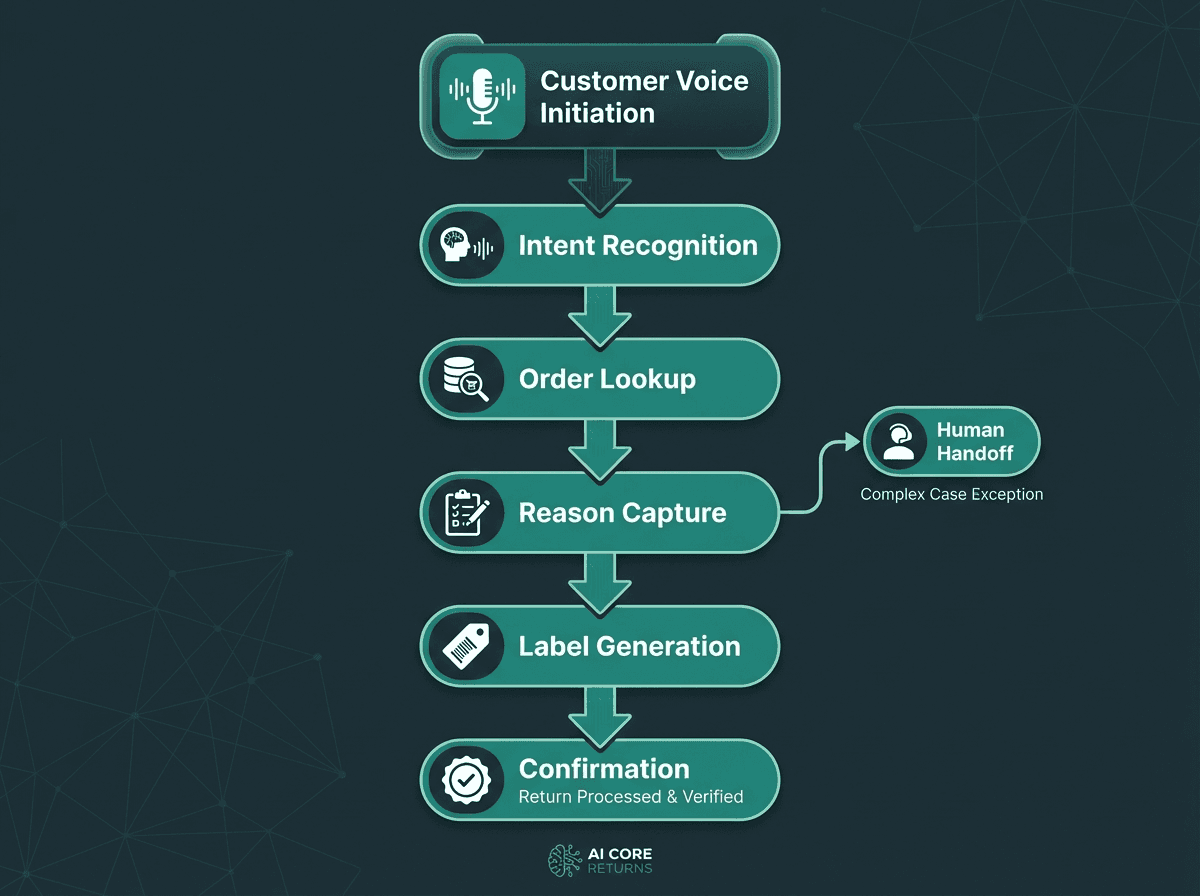
A well-designed voice returns flow can complete in under 90 seconds without human agent involvement.
Returns are where most ecommerce voice implementations fall short. The interaction is more complex than order status: the assistant needs to identify the item being returned, capture the reason, check eligibility against the returns policy, initiate the return in the backend system, and communicate next steps clearly. That's five distinct dialogue turns, each with potential for misunderstanding.
What most teams get wrong here is treating the returns flow as a linear script. Real customers don't follow scripts. They say things like 'I want to send back the shoes I got last week, they don't fit' without specifying an order number. A capable voice assistant needs slot-filling logic that can identify the item from contextual clues, confirm with the user, and proceed without demanding structured input. This is where the quality of the underlying language model matters enormously.
The other underappreciated element is the handoff. Not every return can be fully automated. When a return involves a damaged item, a dispute, or a policy exception, the assistant should recognize the escalation signal and transfer to a human agent with full context already populated. A clumsy handoff that forces the customer to repeat everything they just said erases all the goodwill the automated flow built up. Smallest.ai's Atom TTS is built for exactly this, natural prosody and pacing that signals responsiveness rather than automation, even in emotionally charged refund interactions.
Product Discovery Through Voice: Intent, Catalog Search, and Recommendations
Product discovery is the most technically demanding of the three use cases, and also the one with the highest upside. When a customer says 'I need a waterproof jacket for hiking under $150', they've expressed a multi-attribute query that a traditional keyword search would struggle to handle. A voice assistant with proper entity extraction can parse that into category (jackets), attribute (waterproof), use case (hiking), and price constraint ($150) simultaneously.
From Spoken Query to Catalog Results
The pipeline for voice product discovery runs from speech recognition through NLU, into a product catalog API or search index, and back through a response generation layer that selects which results to surface and how to present them verbally. The challenge is that voice responses can't show a grid of 48 products. The assistant must make a recommendation, typically three to five options, and describe each one in a way that helps the customer choose without seeing images.
This requires a different approach to product data than visual commerce. Attributes that matter in voice responses include concise product names, key differentiators, price, and availability. Descriptions written for visual product pages often don't translate well to spoken summaries. Teams investing in voice product discovery usually need to audit and enrich their catalog data specifically for voice output. The detailed breakdown of voice AI search in e-commerce covers the search architecture side of this in depth.
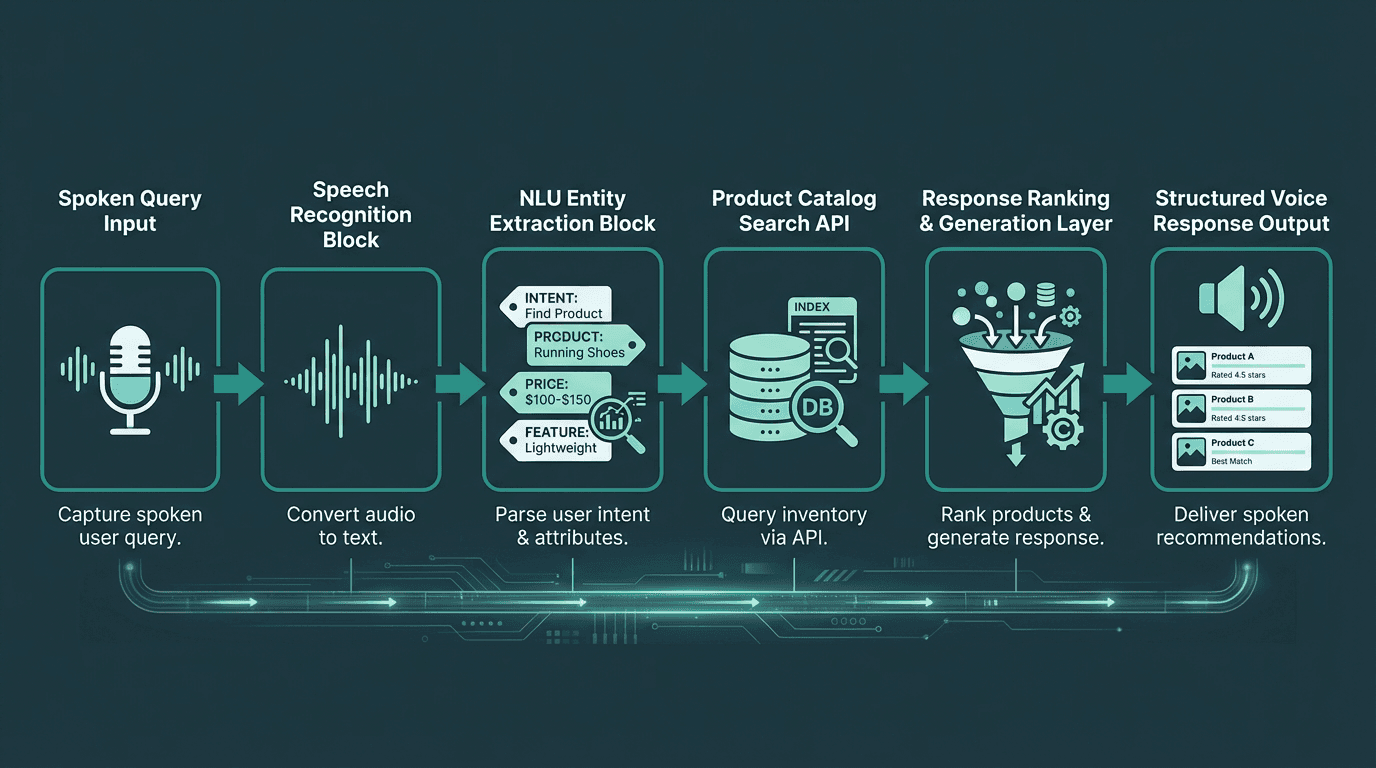
Voice product discovery requires a dedicated pipeline distinct from standard visual search infrastructure.
Personalization and Reorder Logic
Shoppers who use voice to reorder products represent a high-value segment. Reorder flows are simpler than discovery flows but require tight integration with purchase history and inventory systems. When a customer says 'reorder my usual coffee', the assistant needs to resolve 'usual coffee' to a specific SKU from purchase history, confirm the item and quantity, check stock, and initiate checkout. Done well, this is a genuinely faster experience than any visual interface. Done poorly, it's a frustrating loop of clarification prompts.
Explore how to start building AI voice agents for e-commerce
Advanced Considerations: Latency, Fallbacks, Multilingual Support, and Privacy
Skip this section if you're still in early planning. This is for teams actively building or evaluating production deployments.
Latency is the silent killer of voice experiences. Users tolerate roughly 1.5 to 2 seconds of response delay before the interaction starts to feel broken. This means your entire pipeline, from speech recognition through NLU, API calls, and TTS synthesis, needs to complete within that window. Streaming TTS, where audio begins playing before the full response is generated, is now the standard approach for meeting this threshold. Any voice platform you evaluate should support streaming output natively.
Fallback handling deserves more attention than it typically gets. Every voice assistant will encounter queries it can't handle confidently. The question is what happens next. A well-designed fallback strategy includes a graceful acknowledgment, an offer to transfer to a human agent or send a follow-up via another channel, and logging of the failed interaction for model improvement. Fallbacks that simply say 'I didn't understand that' and loop back to the main menu are a significant source of customer frustration.
Multilingual support is increasingly non-negotiable for global ecommerce operations. The technical requirement is not just multilingual ASR and TTS, but multilingual NLU models that understand intent and entity extraction across languages. Code-switching, where a customer mixes languages within a single utterance, is common in many markets and requires specific model training to handle correctly.
Privacy and data handling require careful attention, particularly for voice interactions that capture biometric voice data. Ensure your implementation complies with applicable regulations and that your privacy policy and terms of service accurately reflect how voice data is stored, processed, and retained. Voice authentication, while powerful, introduces additional compliance obligations that vary by jurisdiction.
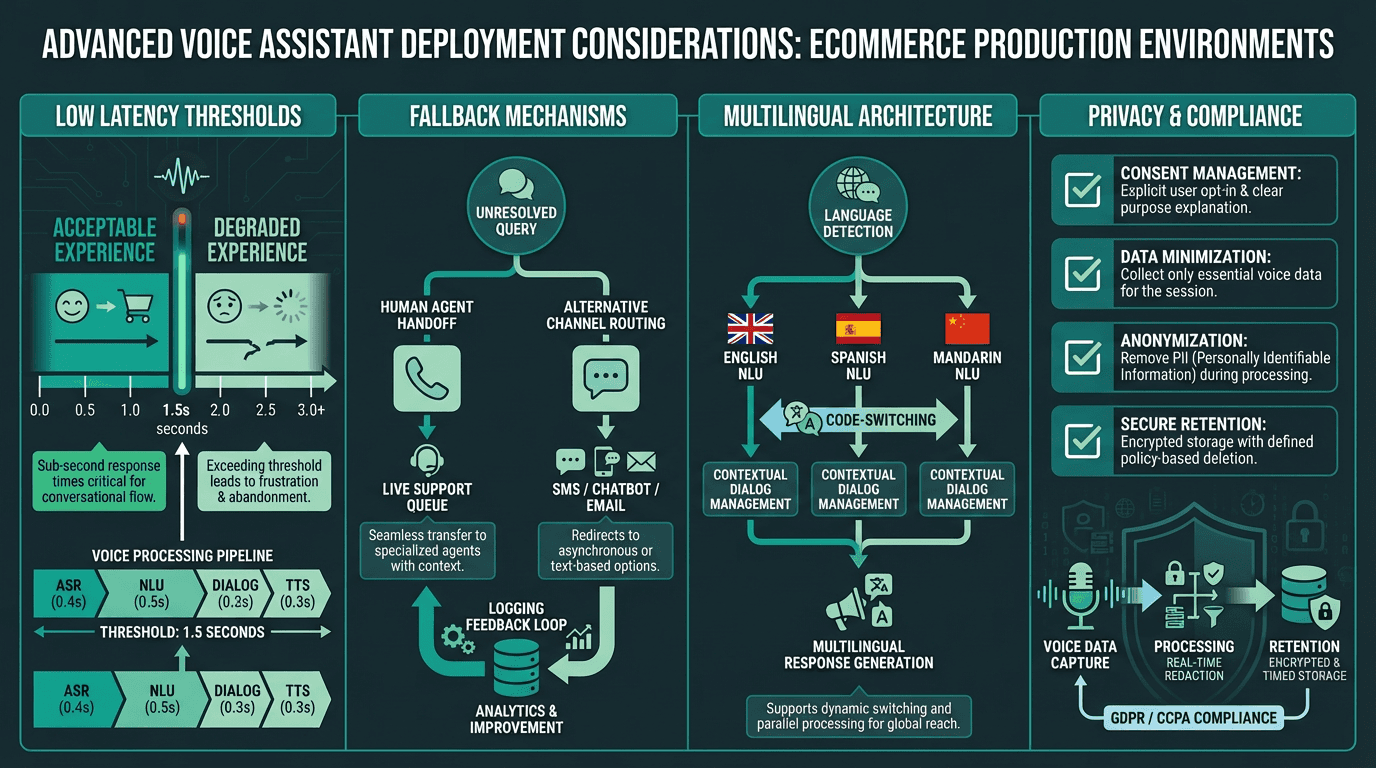
Production voice deployments require careful planning across latency, fallback logic, language support, and data compliance.
Key Takeaways and Next Steps
Voice assistants deliver the clearest ROI in ecommerce when deployed against high-frequency, intent-clear interactions. Order status and reorders are the fastest wins. Returns require more sophisticated dialogue design but offer significant cost reduction in support operations. Product discovery is the highest-ceiling use case and the most technically demanding to get right.
Actionable next steps for your team:
Audit your top 10 support contact reasons and identify which are voice-automatable with existing backend integrations
Evaluate your product catalog data quality for voice output, not just visual display
Define your fallback and escalation strategy before building the primary flow, not after
Set latency benchmarks early and test your full pipeline end-to-end against them. Smallest.ai's streaming TTS is built to meet the sub-2-second threshold that production ecommerce deployments require.
Review your data handling practices for voice-specific compliance requirements
The teams that build effective voice experiences in ecommerce share one common approach: they start with a single, well-defined use case, instrument it thoroughly, and expand from there. Trying to automate everything at once produces mediocre results across the board. Picking order status as a starting point, building it well, and measuring it rigorously creates the foundation for everything else.
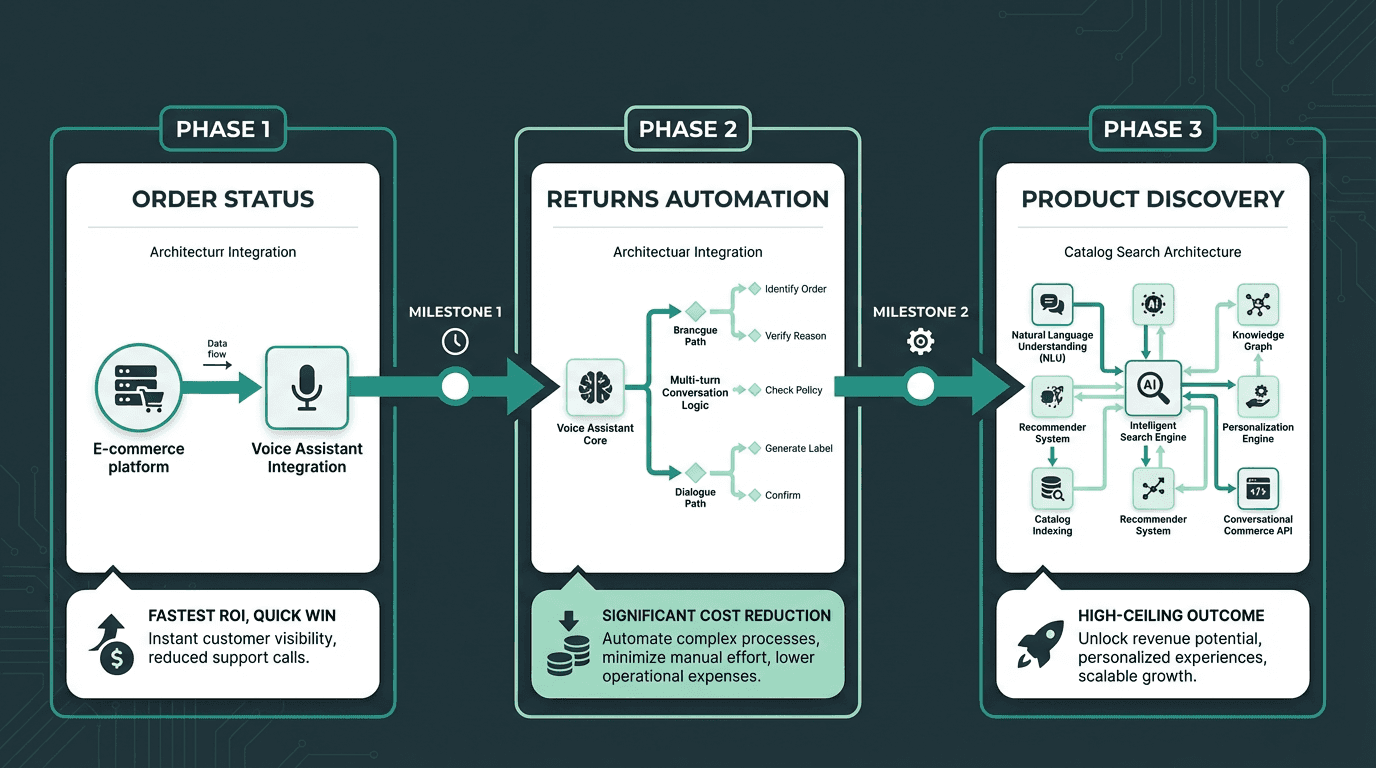
A phased deployment approach reduces risk and builds institutional knowledge before tackling complex use cases.
The Problem This Guide Has Been Circling
The real challenge in ecommerce voice AI isn't understanding what to build. It's finding the infrastructure to build it on. Most platforms require you to assemble speech recognition, NLU, TTS, and dialogue management from separate vendors, each with their own latency profile, pricing model, and integration surface. The result is a fragile stack that's expensive to maintain and slow to improve.
Smallest.ai is built specifically to address this. Smallest.ai's voice agents combine ultra-low-latency speech synthesis with developer-friendly APIs designed for production ecommerce deployments. The platform's Atom TTS model delivers sub-150ms synthesis latency with SSML support, streaming synthesis, and multilingual capability out of the box. For teams building AI voice agents for e-commerce, it removes the infrastructure complexity that typically slows these projects down. If your ecommerce platform is ready to move from chatbots to real conversational voice experiences, Smallest.ai gives you the speech layer to do it without rebuilding everything else.
Start building your ecommerce voice assistant with Smallest.ai
Frequently asked questions
What's the difference between a voice assistant and a voice bot?
How do voice assistants authenticate customers before sharing order information?
Can a voice assistant handle complex return scenarios, like damaged items or disputed charges?
How do I measure the ROI of a voice assistant deployment in ecommerce?
What integrations are required to deploy a voice assistant for order status and returns?