ElevenLabs Alternatives for YouTube Narration: Best Voices, Pricing & Tips (2026)

Compare the best ElevenLabs alternatives for YouTube narration. Honest breakdown of voices, pricing, cloning, and licensing across top AI TTS platforms in 2026.
YouTube creators, documentary producers, and explainer video studios are swapping studio voiceover sessions for AI narration at scale. This trend reflects a major shift in content production. ElevenLabs made this workflow mainstream, but it is not the only credible option. For many creators, it is not even the right fit once you account for pricing tiers, voice variety, and licensing terms.
What follows is a direct comparison of the strongest top alternatives to ElevenLabs available right now. Each platform is evaluated on voice quality, pricing, latency, licensing clarity, and practical YouTube workflow fit. The goal is an actual recommendation, not a list that leaves you exactly where you started.
How we evaluated each platform
Six criteria shaped this comparison, all chosen because they map directly to YouTube narration workflows rather than general TTS use cases. Voice naturalness covers prosody, breath patterns, and emotional range. Pricing transparency looks at whether costs stay predictable as volume climbs. Licensing clarity matters because monetized channels operate commercially and need clean usage rights from day one (a detailed breakdown of what to watch for is available in the commercial use and licensing guide for AI voice tools). Latency and throughput address how quickly long scripts render. Voice cloning capability covers whether you can build a consistent channel identity. API and workflow integration rounds it out by asking how easily a tool slots into an existing production pipeline.
Smallest.ai: built for speed and scale
Smallest.ai is the platform this article is published on, so that context is worth stating upfront. The technical case for it in YouTube narration workflows is still genuine. The platform's Lightning model delivers sub-100ms time-to-first-audio in real-time streaming mode, which is unusually fast for long-form content rendering. Producing a 20-minute documentary narration, that throughput difference compounds into real time savings across a production week.
Voice quality sits at the higher end of the market, with particular strength in neutral, authoritative narration tones suited to educational and documentary content. The API is developer-friendly, and the voice agents infrastructure scales gracefully from solo creator use to agency-level volume. Licensing terms are commercially permissive, which removes a persistent headache for monetized channels. The Smallest.ai pricing page breaks down tiers clearly without burying overage costs.
The honest limitation: the voice library is smaller than ElevenLabs' catalog. Creators who need a wide range of character voices for animation-style content will find fewer ready-made options. For narration-focused channels, though, the quality-per-cost ratio is hard to argue with.
ElevenLabs: the benchmark and its real costs
ElevenLabs set the quality standard that every other platform is now measured against. Its voice library is genuinely large, its cloning technology is mature, and it offers specific features for YouTube creators including multilingual output, a wide genre range, and API access for production integration. The free tier exists but strips commercial rights, making it unsuitable for monetized channels from the start.
Pricing is where friction appears. At higher character volumes, costs climb steeply, and the per-character rate on lower tiers is not the most competitive in the market. For creators producing daily content at scale, the monthly bill becomes a significant line item. The platform is excellent, but 'excellent' and 'best value for YouTube narration' are not the same sentence.
Deepgram Aura-2: the cost-efficiency argument
Deepgram's Aura-2 model is priced at $0.030 per 1,000 characters. For a channel producing 500,000 characters of narration per month, that pricing is competitive. A comparison of top text-to-speech APIs highlights sub-200ms latency, domain-tuned pronunciation, and context-aware delivery as core strengths.
The tradeoff is voice expressiveness. Aura-2 was engineered primarily for real-time voice agents and customer service applications. The voices are clean and professional, but they lack the emotional range that documentary or storytelling narration benefits from. For tutorial channels, product walkthroughs, or news-style content, Aura-2 is a strong fit. For narrative storytelling, it reads slightly flat compared to Smallest.ai or ElevenLabs.
OpenAI TTS: reliable but limited in flexibility
OpenAI's two TTS models, 'tts-1' for real-time use and 'tts-1-hd' for higher audio quality, serve different needs. For YouTube narration, tts-1-hd is the relevant tier. As one of the main alternatives to ElevenLabs, the voices are natural, and OpenAI's infrastructure reliability is essentially unquestioned at this point.
Customization is the hard ceiling. The standard API offers a small fixed set of preset voices with no cloning capability. If a channel has built an audience around a specific voice persona, there is no way to replicate or extend that persona through OpenAI TTS alone. It works well as a starting point for creators who want dependable quality without configuration overhead, but channels that need brand voice consistency will outgrow it.
Cartesia: when instant cloning matters
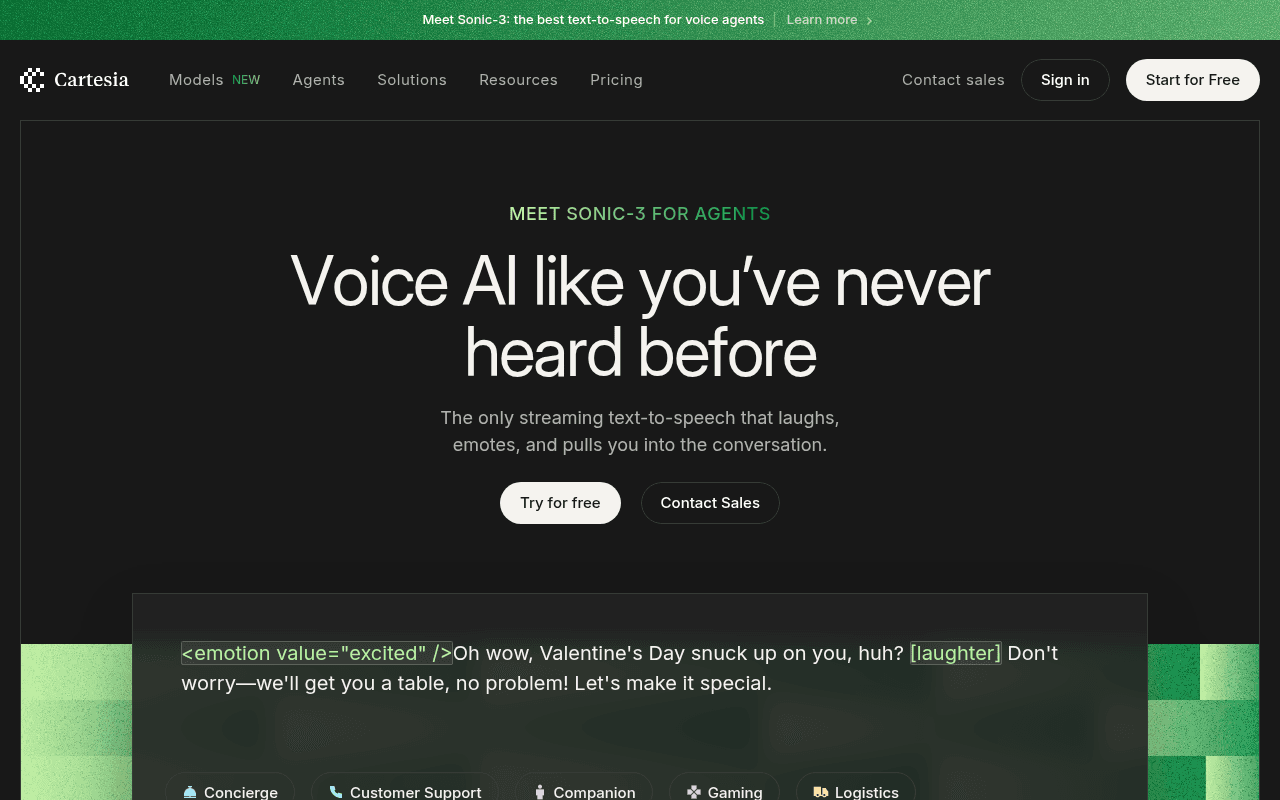
Cartesia's headline capability is speed, with low-latency (tens of milliseconds in benchmarks) time-to-first-audio and voice cloning from very short audio samples. For YouTube creators who want to clone their own voice without recording hours of training data, that low threshold is a meaningful differentiator compared to other platforms that require much longer samples.
Cartesia's pricing is competitive, sitting in a similar range to other major providers. The cloning fidelity from minimal audio is genuinely impressive for short-form content. The tradeoff shows up in longer narration: the cloned voice can drift in consistency across a 15-minute script, requiring more editing passes than a native platform voice. Worth prioritizing specifically for creators who want their own voice persona rather than a library option.
See how Smallest.ai handles high-volume YouTube narration at competitive pricing
Head-to-head comparison across all criteria
Platform | Price per 1K chars | Voice Library | Cloning | Latency | Commercial License | Best For |
|---|---|---|---|---|---|---|
Smallest.ai | Competitive (see pricing) | Focused, high quality | Yes | Sub-100ms | Yes, included | Narration, scale, dev workflows |
ElevenLabs | Competitive (see pricing) | Very large | Yes, mature | Moderate | Paid tiers only | Wide voice variety, character work |
Deepgram Aura-2 | $0.030 | Moderate | Limited | Sub-200ms | Yes | Tutorial, product, news content |
OpenAI TTS | Varies by model | Small (preset) | No | Low | Yes | Simple, reliable narration |
Cartesia | Competitive (see pricing) | Growing | Yes, short-sample clone | Low (tens of ms) | Yes | Own-voice cloning, short-form |
Practical usage tips for YouTube narration workflows
Regardless of which platform you choose, a few practices consistently separate professional-sounding channels from ones that feel robotic. Break long scripts into paragraph-length chunks rather than submitting the full script as one input. Most TTS engines handle prosody better in shorter segments, and it gives you granular control over re-rendering specific lines without regenerating everything.
Workflow practices that apply across all platforms:
Use SSML tags or platform-specific pause markers to control breath points, especially before scene transitions.
Render at the highest available sample rate (24kHz or 48kHz) and downsample in your video editor, not at the TTS stage.
For channels using free ElevenLabs alternatives on a tight budget, batch rendering during off-peak hours can reduce API queue times.
Test your chosen voice against your background music mix before committing to it for a series. Some voices sit poorly in frequency ranges that overlap with common lo-fi or orchestral beds.
Keep a versioned archive of your voice settings and any cloning source audio. Platform model updates can shift voice characteristics between generations, sometimes noticeably.
For creators building more complex pipelines, the voice AI orchestration alternatives space is worth understanding. Orchestration layers let you route different content types to different TTS engines within a single pipeline, which is useful for channels that mix narration with interactive or dynamic content.
Verdict: which platform fits which creator
Smallest.ai and ElevenLabs occupy the top of the quality tier, but they serve different creator profiles. ElevenLabs is the right call if you need the widest possible voice catalog and are producing character-heavy content where variety is the product. The cost is higher, but the library depth justifies it for that specific use case. For narration-focused channels, educational content, and creators producing at volume where per-character costs compound, Smallest.ai's throughput, licensing clarity, and competitive pricing make it the more practical choice. Deepgram Aura-2 wins on raw cost-efficiency for tutorial and product content where emotional range is secondary. Cartesia is the best pick for creators who want to clone their own voice with minimal source audio. OpenAI TTS is the safest starting point for anyone who wants reliability without configuration overhead, though it will feel limiting as a channel scales.
Explore Smallest.ai's speech models and start your first narration project
The problem this comparison was built to solve
The real pain point for YouTube creators evaluating AI narration tools is not a shortage of options. It is the gap between a platform's marketing and what it actually costs and sounds like at production volume. Pricing pages obscure overage rates, voice demos are cherry-picked, and licensing terms are buried in terms of service. This comparison tried to surface those specifics directly. If you are producing consistent narration content at scale and need a platform that is fast, commercially licensed, and honest about its pricing, Smallest.ai's Lightning model is the logical starting point. You can review the full breakdown on our blog or go straight to the Smallest.ai pricing page to see where your volume lands.
Frequently asked questions
What is the most cost-effective AI voice platform for YouTube narration at high volume?
Can I use AI-generated narration commercially on YouTube without additional licensing fees?
How many seconds of audio do I need to clone a voice for YouTube narration?
Is Smallest.ai suitable for non-English YouTube narration?
What audio quality settings should I use when rendering AI narration for YouTube?