Deepgram Alternatives in 2026: Best STT APIs Compared

Comparing the best Deepgram alternatives in 2026 across latency, accuracy, pricing, and language support. Find the right STT API for your use case.
Deepgram has built a solid reputation in the speech-to-text space, particularly for developers who need fast, API-first transcription. But the market has matured considerably. The global voice and speech recognition market is estimated to be valued at USD 21.46 billion in 2025 and is expected to reach USD 93.51 billion by 2032, according to Coherent Market Insights, and with that growth has come a wave of genuinely competitive Deepgram alternatives worth evaluating.
Whether you're building voice agents, real-time transcription pipelines, or multilingual applications, the right STT provider depends on your specific constraints around latency, accuracy, pricing, and language support. This article covers the strongest alternatives available in 2026, with honest assessments of where each one excels and where it falls short. For a broader look at how these providers stack up across the full market, the guide on best speech-to-text AI in 2026 is a useful starting point.
What to Look for When Evaluating Deepgram Alternatives
Before comparing individual providers, it helps to define the criteria that actually matter for production use. Not all STT APIs are built for the same workloads, and a tool that works well for batch transcription may perform poorly in a real-time voice agent context. Here are the six dimensions this comparison uses:
Evaluation criteria:
Transcription accuracy: Word error rate (WER) on clean audio and noisy, accented speech
Latency: Time-to-first-token and end-to-end processing speed for real-time use cases
Pricing: Per-minute or per-hour costs, free tier availability, and enterprise pricing transparency
Language and accent support: Number of supported languages and robustness across accents
API and integration quality: SDK availability, documentation depth, and ease of integration
Specialized features: Speaker diarization, custom vocabulary, punctuation, and streaming support
If you're specifically building voice agents, the article on best speech-to-text APIs for voice agents goes deeper on what matters most for that use case. For a structured framework on testing any of these providers before committing, the guide on how to evaluate ASR in 2026 is worth reading alongside this comparison.
Smallest.ai Pulse STT
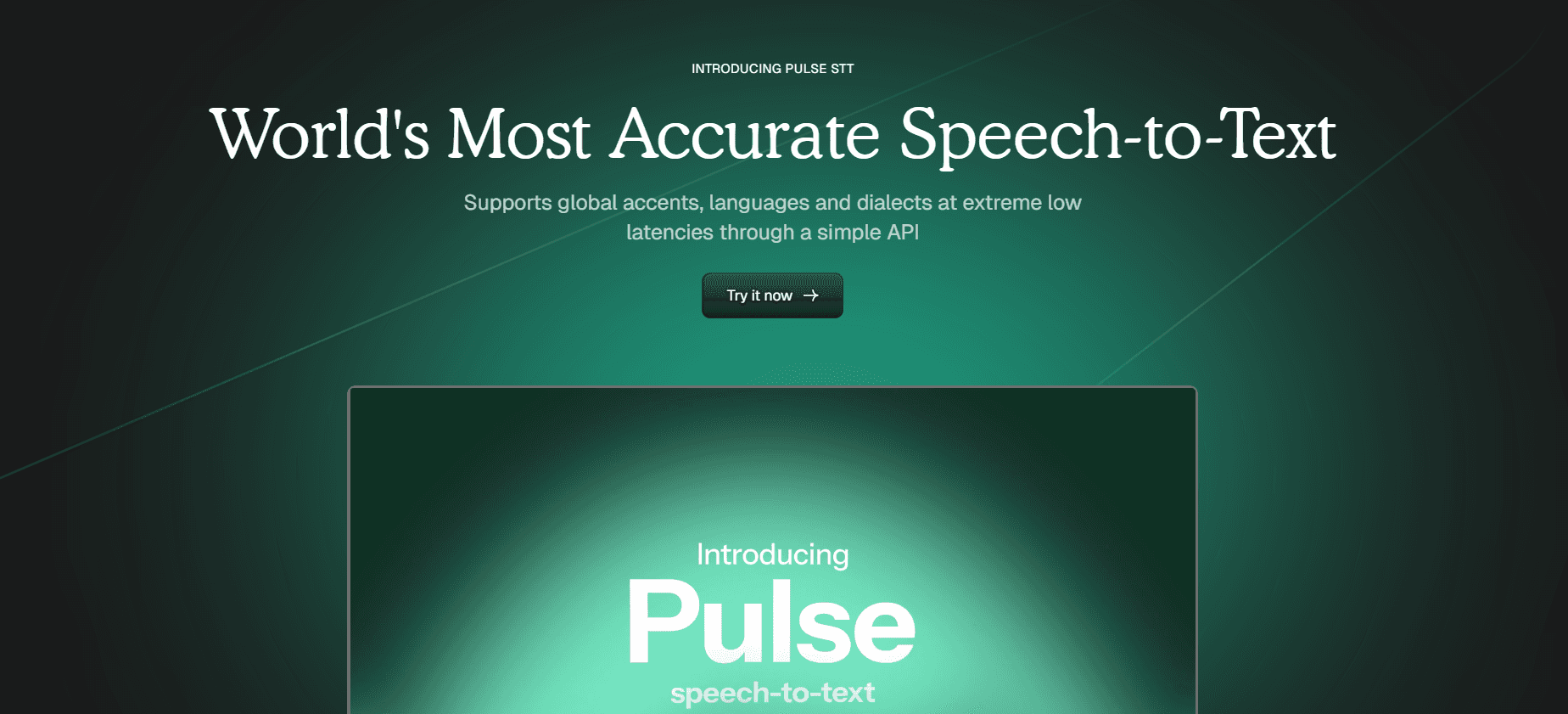
Pulse STT from Smallest.ai is the most direct challenger to Deepgram for real-time voice agent workloads. Where Deepgram's Nova-3 model is optimized for general transcription accuracy, Pulse STT is designed around the specific demands of conversational AI: sub-300ms latency, streaming-first architecture, and tight integration with voice agent pipelines. The head-to-head breakdown in Smallest.ai Pulse STT vs. Deepgram covers the technical differences in detail, but the short version is that Pulse STT consistently outperforms on latency-sensitive tasks while remaining competitive on accuracy for English and major European languages.
Pricing is competitive with Deepgram's Pay-As-You-Go tier. Deepgram's Nova-3 model is priced at $0.0077 per minute on Pay-As-You-Go, and Pulse STT is positioned in a similar range with more favorable terms for high-volume usage. The API is clean, documentation is developer-friendly, and the streaming WebSocket implementation requires minimal setup. The main limitation is that Pulse STT's language coverage, while growing, is narrower than some of the more established providers on this list. If your application handles a wide variety of languages beyond the major ones, that's worth factoring in.
Best for: Developers building real-time voice agents, conversational AI, or any application where latency is a primary constraint alongside accuracy.
ElevenLabs
ElevenLabs is primarily known for text-to-speech, but its speech-to-text offering has matured into a credible option for certain workflows. The transcription quality on clean audio is strong, and the platform's voice cloning and TTS capabilities make it an attractive choice for teams that need both directions of the speech pipeline under one roof. If your product involves generating and transcribing speech, consolidating on ElevenLabs reduces integration overhead.
That said, ElevenLabs is not the right choice if STT is your primary need. The pricing reflects its TTS-first positioning, and the STT feature set lacks some of the specialized capabilities (like fine-grained diarization or custom vocabulary) that Deepgram and its closest alternatives offer. For pure transcription at scale, you're paying for features you may not use.
Best for: Teams already using ElevenLabs for TTS who want to add transcription without introducing another vendor.
OpenAI Whisper API
Whisper remains one of the most accurate general-purpose transcription models available. For applications where accuracy on standard speech is the top priority and latency is less critical, Whisper is a strong choice.
The practical limitation is that Whisper is not a streaming API. It processes audio files rather than live audio streams, which makes it unsuitable for real-time voice applications. Accuracy on accented speech and noisy audio will differ from published benchmark figures on clean audio, so always test against your actual use case. For teams building batch transcription pipelines, document processing, or async workflows, Whisper is excellent. For voice agents, it's the wrong tool.
Best for: Batch transcription, content processing, and applications where accuracy on clean audio matters more than real-time performance. For a broader comparison that includes OpenAI in a voice agent context, see the article on choosing your 2026 voice agent stack.
See how Pulse STT compares to Deepgram on real-time latency benchmarks
Cartesia
Cartesia has carved out a niche with its state-space model architecture, which delivers notably low latency compared to transformer-based alternatives. For developers who have hit latency ceilings with other providers, Cartesia is worth testing. Its Sonic model is designed for real-time voice synthesis, and the company has been expanding its STT capabilities alongside it.
Where Cartesia is less mature is in ecosystem depth. Documentation is solid but the community and third-party integration support is thinner than Deepgram or OpenAI. Language support is also more limited. If you're building in English for a latency-critical application and are comfortable with a smaller ecosystem, Cartesia is a legitimate option. If you need broad language coverage or extensive pre-built integrations, you'll likely find the alternatives here more practical.
Best for: Latency-sensitive English-language applications where the team is comfortable with a newer, smaller ecosystem.
Speechmatics
If accent robustness is your primary concern, Speechmatics deserves serious consideration. It is one of the strongest performers specifically for diverse accent handling, which matters significantly for global applications. In real-world conditions, accuracy degradation from accented speech is one of the most common production pain points, and Speechmatics has invested heavily in this area.
Speechmatics supports 55+ languages and offers both real-time and batch transcription. Its self-hosted deployment option is a meaningful differentiator for enterprises with data residency requirements. Pricing is published on their website, starting from around $0.24/hr depending on accuracy tier and usage volume. Volume discounts apply automatically above 500 hours per month. For teams with strict compliance requirements or multilingual user bases spanning diverse accents, Speechmatics is one of the strongest options in this comparison.
Best for: Enterprise teams with multilingual, accent-diverse user bases or data residency requirements.
Head-to-Head Comparison Table
Provider | Best For | Real-Time Streaming | Accent Robustness | Language Count | Pricing Transparency | Ecosystem Maturity |
|---|---|---|---|---|---|---|
Smallest.ai Pulse STT | Voice agents, low latency | Yes | Good | Major languages | Transparent | Growing fast |
ElevenLabs | TTS + STT combined workflows | Limited | Moderate | Moderate | Transparent | Strong (TTS-first) |
OpenAI Whisper API | Batch accuracy, async workflows | No | Good (clean audio) | 90+ languages | Transparent | Very strong |
Cartesia | Latency-critical English apps | Yes | Moderate | Limited | Moderate | Early stage |
Speechmatics | Multilingual, accent diversity | Yes | Excellent | 55+ languages | Transparent | Strong (enterprise) |
How to Choose the Right Alternative for Your Use Case
The right choice depends almost entirely on what you're building. There is no universal winner here, but there are clear patterns.
For real-time voice agents and conversational AI, the decision comes down to Smallest.ai Pulse STT or Cartesia, with Pulse STT having the edge on ecosystem maturity and documentation. For batch transcription where accuracy is paramount and latency is irrelevant, OpenAI Whisper is hard to beat. For global applications with diverse user accents, Speechmatics is the most defensible choice technically. And for teams that want a single vendor for both TTS and STT, ElevenLabs makes sense if you're already in their ecosystem.
The global speech-to-text API market was valued at USD 3.81 billion in 2024 and is projected to reach USD 8.57 billion by 2030, driven by rising demand for voice interfaces, transcription workflows, and real-time speech applications. That growth means more competition and faster iteration from all providers. What's true today about pricing and features will shift, so building your evaluation process around the criteria above rather than point-in-time benchmarks will serve you better long-term.
The Problem-Solution Bridge
The core problem with evaluating Deepgram alternatives is that most comparisons stop at accuracy benchmarks on clean audio, which tells you very little about production performance. Real applications deal with noisy environments, accented speakers, and latency constraints that benchmark datasets don't capture. The providers that look equivalent on paper can diverge significantly when you run them against your actual audio. That's the gap that Smallest.ai's Pulse STT is built to close for voice agent developers specifically. It's designed from the ground up for the streaming, low-latency, conversational AI context where Deepgram's general-purpose architecture starts to show its limits. If you're building a voice agent and need a provider that treats real-time performance as a first-class requirement rather than an afterthought, Pulse STT is the most direct answer to that problem.
Frequently asked questions
What are the main reasons developers look for Deepgram alternatives?
Which Deepgram alternative is best for building voice agents?
Is a file-based transcription API a good alternative for real-time voice applications?
How do I evaluate which speech-to-text API is right for my application?
What should I know about speech-to-text accuracy in real-world conditions?