AI Voice Agent Platforms and Infrastructure for Contact Centers in 2026

AI voice agent platforms and infrastructure for contact centers compared across latency, STT/TTS architecture, integrations.
Contact centers increasingly evaluate AI voice agents as a way to reduce handle time, improve availability, and automate repetitive customer interactions. The challenge is less about whether voice AI works and more about selecting an architecture that can support production-scale operations.
Below is a side-by-side look at six leading AI voice agent platforms, components, and infrastructure, scored against the stuff that breaks in production: latency and voice quality, STT/TTS architecture, telephony integrations, and developer ergonomics. The aim is to call out the right architectural fit for specific workloads, not to hide behind a feature checklist.
Evaluation Criteria
Before getting into platform-by-platform notes, these are the yardsticks used throughout. They map closely to what contact center architects and engineering leads tend to argue about in real procurement cycles: responsiveness, integration surface area, and whether the system holds up once you move past a demo. If you want the bigger picture on contact center AI platform categories, that write-up lays out the taxonomy before you lock into a vendor.
Evaluation criteria used in this comparison:
Latency: End-to-end response time from speech input to synthesized output, critical for natural conversation flow.
Voice Quality and Naturalness: Perceived realism of synthesized speech and accuracy of transcription.
Integration Depth: Native connectors for telephony platforms (Twilio, Vonage, SIP trunks), CRMs, and orchestration layers.
Developer Experience: SDK quality, documentation, API design, and time-to-first-call.
Enterprise Readiness: SLAs, compliance posture (SOC 2, HIPAA, GDPR), and support tiers.
Smallest.ai Atoms: Built for Real-Time Voice at Scale
Smallest.ai Voice Agents are designed for real-time voice, and that design goal shows up immediately in the Atoms platform. In contact centers, sub-second latency is not a bragging-rights metric; it is the difference between a conversation that feels fluid and one that feels like a bad IVR with better marketing. The stack includes Lightning (TTS), Pulse (STT), Hydra (speech-to-speech), and Electron (a conversational small language model tuned for voice), all exposed through the Waves API. The practical advantage over general-purpose AI platforms is cohesion: when STT, model inference, and synthesis are built to work together, you avoid the "death by a thousand seams" that happens when you chain three vendors and watch latency pile up at each boundary. You can find more details on the Smallest.ai Speech-to-Text API and other components in the documentation.
If you are weighing how to choose a voice agent stack, the integrated build changes day-two operations as much as day-one setup: fewer moving parts, fewer mysterious failure modes, and one support thread when something goes sideways. Atoms also supports voice cloning through the Lightning API, which matters for brands trying to keep a consistent agent persona across thousands of concurrent calls. It is also a strong option for teams focused on cutting contact center costs with AI, because the architecture is built to keep inference efficient rather than treating voice as an afterthought. Additional deployment and platform details are available on the Smallest.ai platform pages and documentation.
Where Atoms stands out:
Unified STT + LLM + TTS pipeline reduces compounded latency across vendor seams.
Hydra speech-to-speech model enables near-instant voice response for interruption-heavy conversations.
Electron SLM is optimized for voice dialogue, not general text tasks, which improves turn-taking accuracy.
Voice cloning is native, not a third-party add-on.
Waves API provides developer access to all components under one authentication layer.
The main watch-out is maturity relative to telephony-native incumbents. If your environment is anchored to legacy PBX infrastructure, plan for extra integration work compared to platforms that grew up inside the contact center world. For enterprise-ready contact center AI rollouts, it is worth validating compliance coverage and SLA details directly with the team, especially if you operate under specific regulatory constraints.
ElevenLabs: Voice Quality and Agent Capabilities
ElevenLabs started with a strong reputation in voice synthesis and voice cloning, and now also offers speech-to-text and conversational agent capabilities. Its strength remains voice quality and persona creation, but contact center teams should still validate telephony depth, orchestration, observability, and enterprise workflow fit before treating it as a full contact center infrastructure layer. Contact centers, though, care about more than a great voice: concurrency, telephony plumbing, and end-to-end orchestration can matter just as much. ElevenLabs has been pushing into conversational AI with its Conversational AI product, but it did not start life as high-concurrency contact center infrastructure, and that history shows up when you try to run it like one.
The platform provides APIs and documentation for integrating voice synthesis into broader applications. The friction appears when you try to ship a full agent loop (STT, dialogue, telephony, handoff) as a single coherent workflow. In practice, you end up assembling more of the stack yourself to reach parity with unified platforms. It is often evaluated for teams where the agent's voice persona is the product and there is enough engineering bandwidth to build the rest of the agent system around it.
Deepgram: STT Specialist with Agent Ambitions
Deepgram is primarily positioned around transcription infrastructure that holds up when audio is bad. It provides streaming transcription for telephony and contact-center workflows. That matters because contact center callers are rarely speaking into a quiet room with a studio mic. If you are comparing the best speech-to-text APIs for voice agents, Deepgram is an STT-focused component.
The constraint is straightforward: Deepgram remains strongest in speech infrastructure, especially STT, but it has expanded into TTS and voice-agent APIs. For contact centers, the key question is whether the broader agent layer matches the deployment, orchestration, compliance, and telephony needs of the team. Its TTS and agent-layer efforts are newer, and they have not reached the breadth you get from platforms that were agent-first from day one. If you want Deepgram's STT quality inside a full agent, you typically pair it with a separate LLM and TTS provider, which brings back the integration surface area and the latency penalties that unified stacks try to avoid. It is commonly evaluated in deployments that already have an LLM and TTS layer and want to improve STT accuracy without rebuilding the entire system.
OpenAI Realtime API: Powerful but Complex
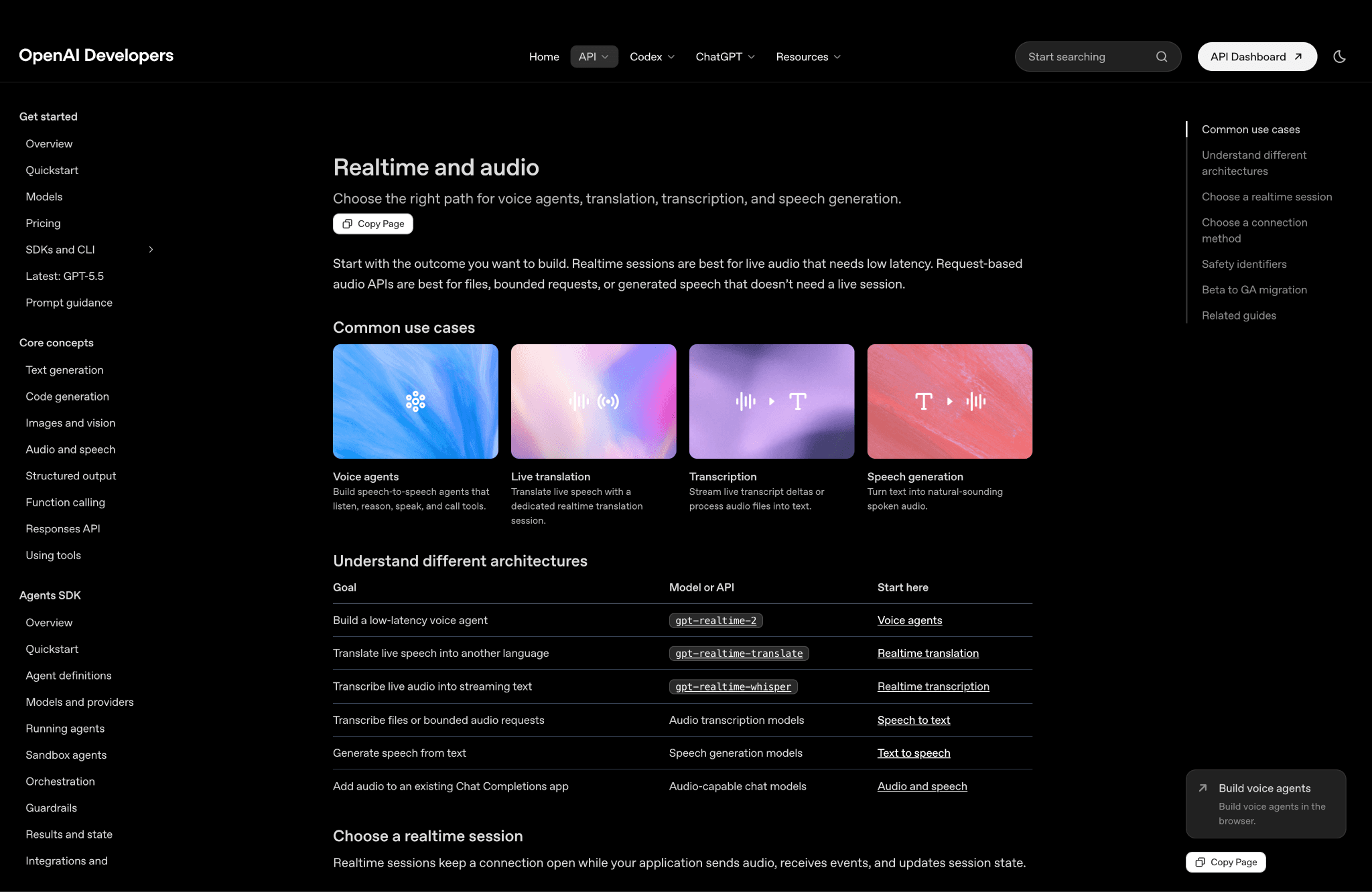
OpenAI's Realtime API, running on GPT-4o, focuses on real-time multimodal conversational interactions. It is designed for real-time conversational workflows that involve interruptions, topic changes, and multi-step interactions. If your contact center use case includes messy customer narratives, knowledge-heavy troubleshooting, or sophisticated escalation logic, this is a platform oriented toward reasoning-intensive conversational workflows.
For production contact centers, there is a real engineering tax: you are working with WebSockets and handling audio streaming in your application, which adds complexity compared to more managed voice platforms. It is commonly evaluated in pilots, high-complexity interactions where reasoning quality is the priority, or hybrid setups where the Realtime API takes escalations while a more efficient system handles routine calls.
Cartesia: Low-Latency TTS Component
Cartesia positions Sonic around low-latency speech synthesis. In a contact center voice agent, perceived silence is the enemy; even small pauses read as "the system is thinking" and callers lose confidence. Sonic supports streaming synthesis, emotion controls, and voice cloning.
Cartesia is still best known for low-latency speech synthesis through Sonic, but its platform now also includes STT and agent capabilities. It should be evaluated as a fast speech stack with expanding agent infrastructure, rather than only as a TTS component. It is commonly used as the TTS layer inside a custom pipeline, but it does not ship native STT, dialogue management, or telephony orchestration. Teams that choose Cartesia usually already have the rest of the stack in place and are trying to squeeze latency out of the last mile. It is commonly evaluated in deployments where engineering teams are building custom voice agent pipelines that need low-latency speech synthesis within a broader custom voice stack.
Rasa: Open-Source Dialogue Control for Complex Flows
Rasa is the outlier in this lineup, because it is not a managed voice platform. It is an open-source conversational AI framework, which buys you tight control over dialogue logic and behavior, but it also puts hosting, integration, and operations on your team. For contact centers with deeply branched flows that do not map cleanly to a prompt-and-pray LLM approach, Rasa's story and rule-based dialogue management can deliver deterministic outcomes that LLM-native systems struggle to guarantee.
That control comes with overhead. Running Rasa in production means owning the infrastructure, and connecting it to telephony plus STT/TTS providers is your integration problem. Rasa Pro (the enterprise tier) adds support, deployment tooling, and analytics, but total cost of ownership is easy to underestimate if you only compare licensing line items. It is typically used in environments where large enterprises with dedicated ML engineering teams need strict control over conversation logic, compliance-sensitive workflows, or highly customized agent behavior that does not respond well to prompt engineering.
Head-to-Head: Platform Comparison Table
Platform | Architecture Type | Latency Profile | STT Included | TTS Included | Agent Orchestration | Typical Deployment Pattern | Positioning |
|---|---|---|---|---|---|---|---|
Smallest.ai Atoms | Unified voice stack | Sub-200ms (Hydra) | Yes (Pulse) | Yes (Lightning) | Yes (Atoms + Electron) | Unified voice deployments | Integrated stack |
ElevenLabs | TTS-first, expanding | Moderate | Yes, via ElevenLabs STT | Yes | Partial (Conversational AI) | Voice-synthesis-focused deployments | Component |
Deepgram | STT-first, expanding | Low (STT layer) | Yes (Nova-3) | Yes (Aura, newer) | Voice Agent API | STT-focused deployments | Component |
OpenAI Realtime API | LLM-native voice | Low-moderate | Yes, realtime audio input/transcription support | Yes, realtime audio output | Yes (via API) | Reasoning-heavy workflows | Infrastructure |
Cartesia | TTS-specialist | Sub-100ms (Sonic) | Yes, via Ink | Yes (Sonic) | Yes/Partial, via Agents | Custom pipeline TTS optimization | Component |
Rasa | Open-source dialogue | Depends on infra | No (3rd party) | No (3rd party) | Yes (framework) | Complex dialogue control | Framework |
Verdict: Matching Architecture to Your Contact Center
Different platforms optimize for different layers of the voice stack. Some focus on transcription, some on synthesis, some on dialogue orchestration, and some attempt to provide an integrated system. For contact centers, the primary consideration is often not the strength of an individual component, but how effectively speech recognition, reasoning, synthesis, telephony, and operational tooling work together under production load.
For contact centers that want to move faster without managing a fragmented voice stack, Smallest.ai is one of the strongest fits in this category. Its Atoms platform brings speech recognition, conversational intelligence, orchestration, and speech synthesis into a unified real-time voice stack, reducing the latency and integration issues that often appear when teams stitch together separate STT, LLM, TTS, and telephony vendors. This makes it especially relevant for support and sales teams that need natural turn-taking, scalable call handling, and simpler day-two operations. To evaluate it for production contact center workflows, explore Smallest.ai Voice Agents.
Frequently asked questions
What makes an AI voice agent platform a good fit for contact centers specifically?
How much does latency really matter for a contact center voice agent?
Can I use one platform for both voice synthesis and transcription, or do I need separate vendors?
What should I prioritize when evaluating AI voice agent platforms?
Is voice cloning available in AI voice agent platforms, and how is it used in contact centers?


