What is an AI Voice Agent?

AI voice agent basics: how ASR, NLU, dialog management, and TTS work together, plus real use cases and what separates voice agents from IVR.
An AI voice agent is software that uses automatic speech recognition (ASR), natural language processing (NLP), and text-to-speech (TTS) to carry a spoken conversation, infer what the caller is trying to do, and complete the request without a human in the loop. Put plainly: it is a phone call or voice interface where the "person" on the other end is entirely software.
This category has accelerated quickly. What used to be rigid phone trees has turned into systems that can schedule appointments, troubleshoot products, and work through nuanced requests in real time. The technology is advancing because it addresses fundamental business needs, such as providing consistent, 24/7 support while managing operational costs.
Why This Technology Is Having Its Moment
For decades, voice support meant Interactive Voice Response (IVR). You called, listened to a menu, pressed a number, listened to another menu, and either reached a human or hit a loop that made you hang up. People found it frustrating for a reason: IVR only understands the options it was explicitly designed to recognize.
AI voice agents remove that ceiling. A caller can say, "I need to move my delivery to Thursday because I will not be home Wednesday," and the system can parse the intent, pull up the order, and reschedule it without an agent ever touching the ticket. Multi-turn, open-ended conversation is a key dividing line between voice AI and what came before.
The business drivers are significant. Automating high-volume, repeatable interactions allows organizations to scale their support capacity without linearly increasing labor costs. For organizations fielding thousands of inbound calls a day, that changes how service capacity is planned and staffed. If you are comparing vendors, the overview of AI voice agent platforms for contact centers is worth reading before you lock in a stack.
The Four Layers That Make It Work
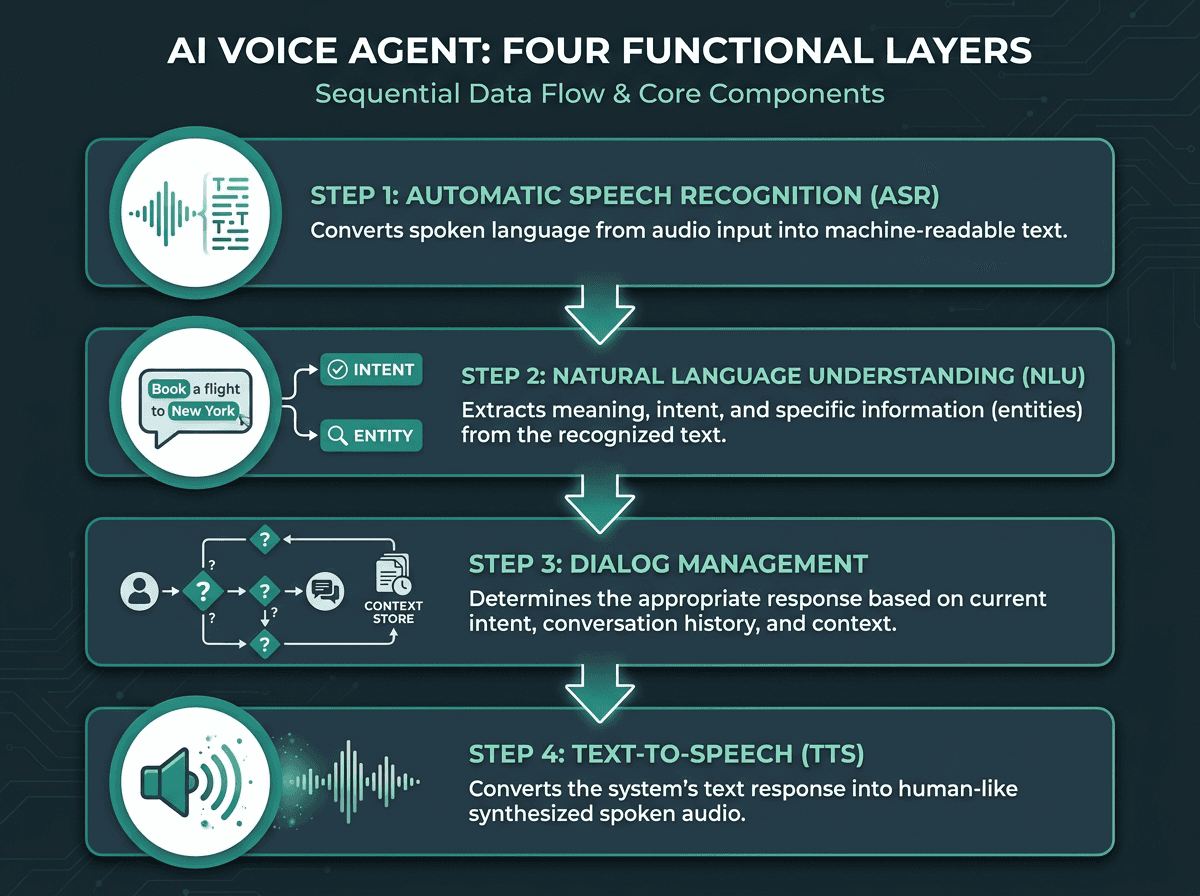
Every AI voice agent runs on these four layers — from raw audio to spoken response.
No matter the vendor or the use case, an AI voice agent is built from the same four functional layers. Once you can name them, you can usually pinpoint where one system wins or fails in production.
Automatic Speech Recognition (ASR): Turns the caller's audio into text. If this layer is wrong, everything downstream inherits the error. When ASR mishears a name, an address, or a date, even a strong language model is working from a bad transcript.
Natural Language Understanding (NLU): Figures out what the person means from the text. This is where intent classification and entity extraction live. "Cancel my order" and "I want to cancel" should land on the same intent and trigger the same workflow.
Dialog Management: Orchestrates the conversation. It carries context across turns, chooses what to ask next, and decides when it has enough information to take an action.
Text-to-Speech (TTS): Converts the system's response into spoken audio. Naturalness and voice quality shape trust, but latency is just as visible: if the voice arrives late, the interaction feels off even when the words are right.
Latency is the quiet variable that threads through all four layers. A system that pauses for three seconds after every utterance feels broken, even if it is technically correct. That is why infrastructure and streaming architecture matter as much as model choice. For a more technical walkthrough of how these layers connect, a guide to voice agent APIs gets into the details.
Where AI Voice Agents Actually Show Up
Customer service is still the most common deployment. Some insurance companies use voice agents for first notice of loss calls. Some banks use them for balance checks, fraud alerts, and payment scheduling. Healthcare providers may use them for appointment booking and prescription refill requests. In many of these cases, the agent runs the interaction end to end and escalates only when the situation calls for human judgment the system cannot provide.
Outbound use cases have expanded fast, too. Sales development teams use voice agents to qualify leads at scale, handle the first discovery conversation, and route warm prospects to human reps. Logistics companies use them for delivery confirmation and exception handling. Restaurants and clinics use them for reservation management. The pattern is consistent: spoken workflows that are structured enough to automate, but messy enough in real phrasing that a rigid IVR collapses.
Three Things People Get Wrong About Voice AI
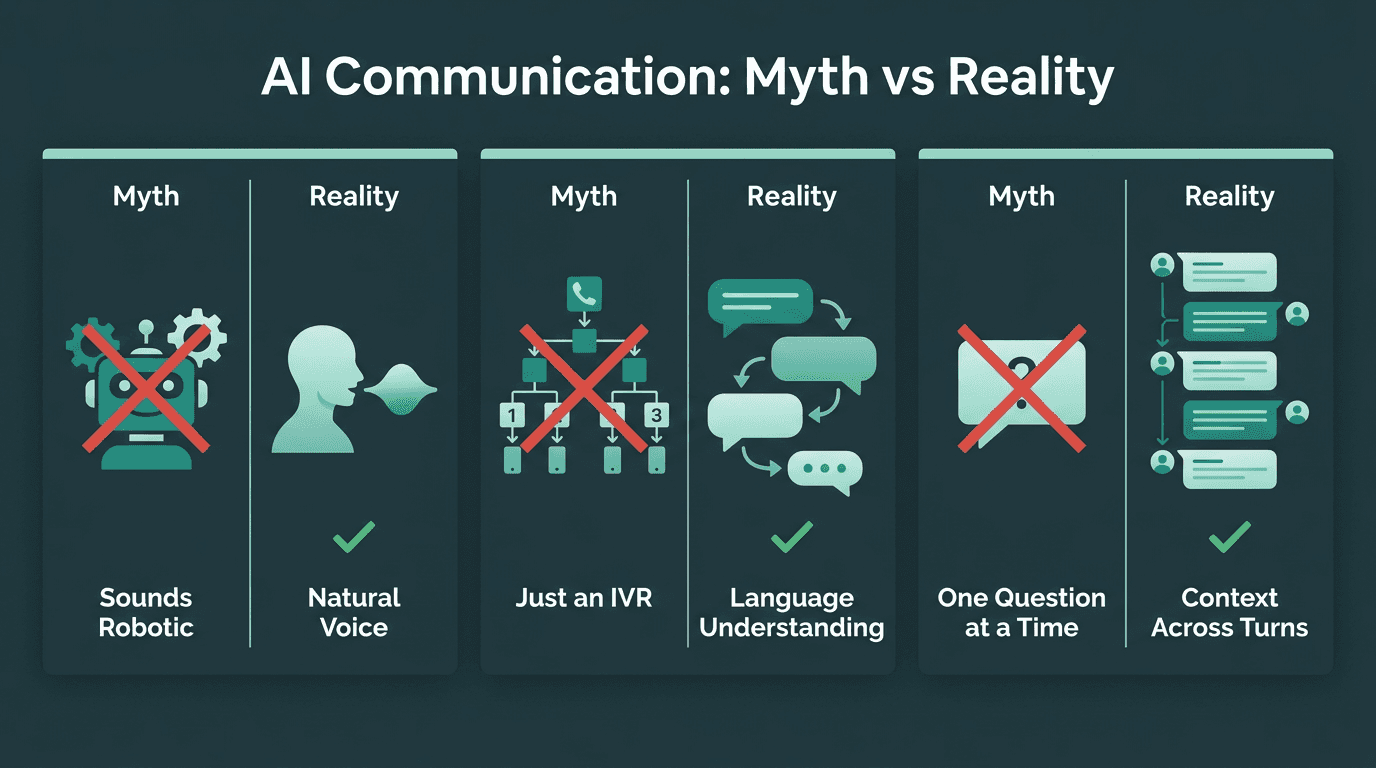
Modern AI voice agents go far beyond robotic menus — context, language, and action are built in.
Misconception 1: Voice agents still sound robotic. That was a fair criticism as recently as 2022. It is much harder to argue now. The quality of text-to-speech models has improved dramatically, with many high-quality AI voices becoming difficult to distinguish from human recordings in short samples. Where a gap may still show is in expressing a wide emotional range or spontaneous prosody, not baseline naturalness.
Misconception 2: A voice agent is just a smarter IVR. IVR routes calls based on menu picks. A voice agent understands language, keeps state across a conversation, and can take actions in external systems, like updating a CRM record or triggering a refund. That is not a cosmetic upgrade; it is a different architecture.
Misconception 3: Voice agents can only handle one question at a time. Multi-turn handling is the whole point of the dialog management layer. A well-built agent can remember an account number mentioned three turns earlier, track that the caller is asking about a charge from last Tuesday, and note that they already tried the self-service portal before calling. The ability to persist context is a standard feature for modern voice agents.
Key Takeaways
An AI voice agent combines ASR, NLU, dialog management, and TTS to run spoken conversations autonomously.
Unlike IVR, it understands natural language and supports multi-turn, open-ended exchanges.
The technology is being adopted to provide scalable, consistent, 24/7 support and to manage operational costs.
Common use cases include inbound support, outbound sales qualification, appointment booking, and logistics workflows.
Caller experience is shaped most by two things: latency and voice naturalness.
Modern voice agents are not inherently robotic, not limited to single-turn requests, and not the same thing as IVR.
For a deeper dive into the technical details and safety measures, see the AI Voice Agent Architecture Guide.
For more detail on how these systems are put together in production, the breakdown of AI voice agent architecture and use cases is a useful next step.
The Problem This Technology Was Built to Solve
The problem is scale without losing the experience. Human agents are costly, inconsistent across shifts, and not available at 3 AM. IVR is always on, but it adds enough friction that callers often abandon the attempt. AI voice agents aim for the middle ground: always available, consistent, and capable of the open-ended back-and-forth that IVR cannot handle.
None of this is free to deploy. Infrastructure, voice quality, and ongoing tuning show up as real line items. Before you commit to building, it helps to understand the true costs of operating a voice agent at scale, because the math looks very different at 1,000 calls per month than it does at 100,000.
A key decision for any team is whether to build a custom voice agent or buy an existing platform. Building provides maximum control but requires significant engineering resources to manage the full stack of speech, language, and telephony components. Buying a platform accelerates deployment but involves tradeoffs in flexibility and pricing. Some platforms offer an integrated stack that bundles core components like speech-to-text and text-to-speech. This approach aims to give teams building blocks to ship voice agents that sound natural and respond quickly, without requiring them to manage the underlying voice infrastructure themselves.
Frequently asked questions
What is an AI voice agent in simple terms?
How is an AI voice agent different from a chatbot?
What industries use AI voice agents most?
Do AI voice agents require a lot of technical setup to deploy?
What should I look for when evaluating an AI voice agent platform?