Top Synthflow Alternatives for Production Voice AI in 2026

Synthflow alternatives for 2026, compared on latency, voice quality, pricing, and developer control, so you can pick the right platform for production voice.
Synthflow has earned a solid name as a no-code voice agent builder, especially for sales and customer support automation. The trouble starts when you push it into real production. Teams often start evaluating alternatives when latency, voice quality, or cost become harder to manage at production scale, voice quality can become a concern in longer, brand-sensitive calls, and the pricing ramps quickly once you’re past the starter tier. If you’re looking for Synthflow alternatives, odds are you’ve already hit one of those walls.
Below is a straight-shooting look at some of the most relevant Synthflow alternatives in 2026, judged on the things that matter in production: latency, voice quality, developer flexibility, and total cost of ownership. Some teams need an end-to-end conversation stack; others just need a faster, more natural TTS layer under an existing agent. If you want a direct head-to-head on one of the options here, the Smallest vs Synthflow production comparison is a useful read before you commit.
Quick Comparison: Synthflow Alternatives at a Glance
Platform | Architecture Type | Best For |
|---|---|---|
Smallest.ai | Full-stack native (STT+TTS+LLM+Agent) | Low-latency production voice agents |
Retell AI | Telephony-first agent platform | Telephony-focused automation |
Vapi | Composable orchestration layer | Custom developer workflows |
Bland AI | Outbound call automation | High-volume scripted calling |
Voiceflow | Visual conversation builder | Conversation design and prototyping |
ElevenLabs | Voice synthesis and cloning | Premium voice quality use cases |
Smallest.ai: Built for Production Latency at Scale
In production, Synthflow’s biggest pain point is usually latency. When call volume spikes, response times slip, and callers feel the lag immediately. Smallest.ai is built around that exact failure mode. Its Lightning TTS engine targets sub-100ms time-to-first-audio, the point where responses stop feeling like a system “thinking” and start sounding like a conversation.
Smallest.ai also isn’t just a thin TTS layer. It’s a full voice stack: Lightning for text-to-speech, Pulse for speech-to-text, Hydra for real-time speech-to-speech transformation, Electron as a conversational small language model tuned for voice, and Atoms as the voice-and-text agent platform. Everything is exposed through the Waves API, so you can plug in a single component or run the whole pipeline, depending on how your architecture is set up. The full voice agent platform page lays out how the pieces map to real deployments.
Where Smallest.ai tends to outpace Synthflow is straightforward: voice quality under load, an API-first approach for teams that want control, and pricing that doesn’t spike just because usage grows. The catch is equally straightforward: if your requirement is a pure no-code, drag-and-drop builder with zero engineering involvement, you’ll feel the setup curve. With a developer available, the upside is hard to miss. Book a demo if you want to see the latency numbers in a live environment.
Retell AI
Retell AI sits close to Synthflow, but leans more toward phone-call automation and contact-center-style voice agents. It offers SIP trunking integrations for providers like Twilio and Vonage, supports inbound and outbound routing, and ships with a dashboard that non-technical operators can use. The platform has a per-minute pricing model.
The constraint to be aware of is voice quality. Retell AI is functional for many operational workflows, but on longer calls, the synthetic edges of the voice can become more apparent. If your top priority is getting a working telephony agent up quickly, it’s a more direct start than Synthflow. If the voice itself is the brand, you’ll likely want a stronger TTS layer.
Vapi
Vapi’s approach is the opposite of Synthflow’s. Instead of shipping an opinionated end-to-end stack, it gives you an orchestration layer and expects you to bring the pieces: your LLM, your TTS provider, your STT engine. For teams that already have model preferences (or procurement constraints) and want one place to wire everything together, that flexibility is the point. The platform uses a webhook-driven architecture and has a per-minute pricing model.
That flexibility comes with real work attached. With Vapi, you’re assembling a system, not deploying a finished product. Teams without dedicated voice AI engineering often underestimate the time it takes to get configuration, latency, and edge cases into a production-ready state. If your goal is faster time-to-production with fewer moving parts, a more integrated option like Atoms from Smallest.ai is usually the cleaner path.
Bland AI
Bland AI is often used when outbound volume is the primary job. Its pricing is built around connected-minute rates, with higher tiers adding monthly platform fees for larger teams. The product is tuned for concurrency and throughput more than nuanced conversation, so it is often applied to appointment reminders, lead qualification scripts, and survey-style calls.
The downside shows up as soon as you need complex, branching dialogue. Compared with Synthflow and most of the alternatives here, the conversational intelligence is more limited, and it performs best when the script is structured and caller responses are predictable. For customer service conversations with ambiguity, escalation, and troubleshooting, the experience falls apart. It’s closer to a high-throughput dialer with AI scripting than a general-purpose conversational agent.
Voiceflow
Voiceflow plays a different role: it’s a conversation design tool first, and a deployment option second. Product teams and UX-focused builders who want to prototype, test, and iterate on dialogue flows without code may find its visual interface easier for mapping and testing conversation flows than a more telephony-first builder. The platform offers a free tier and paid plans based on monthly fees.
The production caveat is that Voiceflow is built to span channels (voice, chat, SMS). That breadth reads like a strength, but it often means the voice-first details that matter on real phone calls, like low-latency streaming and deep telephony integration, aren’t as mature as dedicated voice platforms. Teams building voice-first products often end up migrating once the prototype turns into a real service. For early-stage prototyping and internal demos, it remains a fast way to get to something testable.
ElevenLabs
ElevenLabs is still best understood as a voice and speech-generation platform first, rather than a Synthflow-style telephony and orchestration platform. Its focus is on the voice itself, offering speech generation and voice cloning capabilities.
If the voice layer is the product, ElevenLabs is a reference point. That includes audiobook narration, branded IVR, and high-touch customer interactions where a synthetic voice would erode trust. The platform has a free tier and paid plans based on usage. The practical downside is architectural: you still need to build or integrate the agent layer, which adds engineering overhead that Synthflow or Smallest.ai’s Atoms handles directly. For a broader scan of voice quality options, the ElevenLabs alternatives breakdown maps where other platforms close the gap.
How to Choose: Matching the Platform to Your Actual Problem
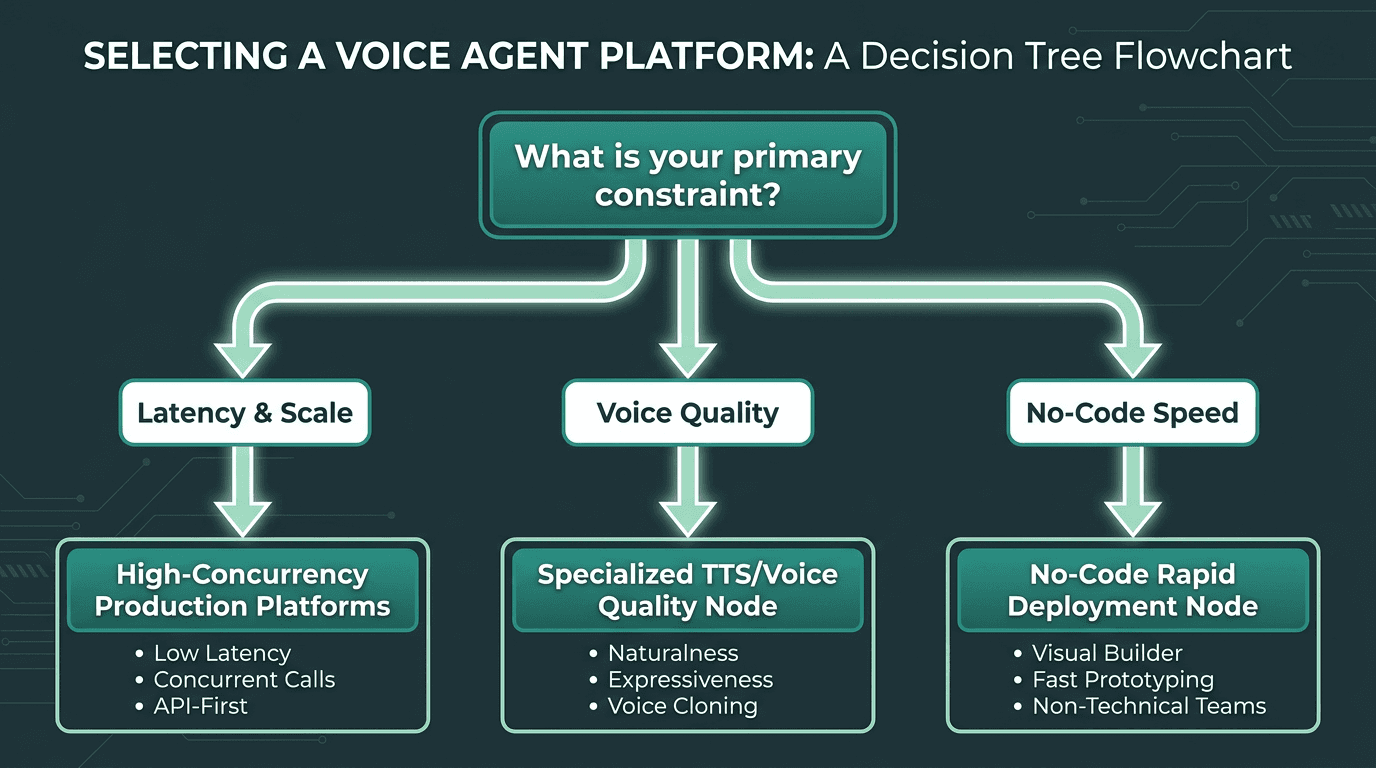
The right platform depends on whether your bottleneck is latency, voice quality, or deployment speed.
There isn’t a single “best” replacement for Synthflow; the right answer depends on what’s breaking for you. If you’re running high-concurrency production voice agents and latency is showing up in caller experience, Smallest.ai’s Lightning and Atoms stack is the most technically oriented option here. If you want an orchestration layer and you already know which LLM/TTS/STT vendors you’re standardizing on, Vapi fits that model. If your workload is high-volume outbound dialing on structured scripts, Bland AI’s architecture is built for that concurrency. If you’re iterating on conversation flows and need a fast prototype, Voiceflow is built for that. For use cases where voice quality is the primary metric, a specialized TTS provider like ElevenLabs may be a component to consider.
One thing teams routinely underprice during evaluation is switching cost. If a platform locks you into proprietary telephony hooks or awkward, non-standard APIs, you’re accumulating migration debt from day one. The 2026 voice agent stack comparison is helpful context on how different stack combinations behave under real production conditions before you tie yourself to a single vendor.
Verdict: Best Synthflow Alternative by Use Case
Use Case | Best Alternative | Why |
|---|---|---|
Production voice agents at scale | Smallest.ai | Native full-stack: STT, TTS, LLM, agent in one pipeline |
High-volume outbound calling | Bland AI | Per-minute pricing model, outbound-focused |
Custom developer workflows | Vapi | Bring-your-own-model orchestration layer |
Premium voice quality | ElevenLabs | Voice synthesis-focused platform |
Conversation design & prototyping | Voiceflow | Visual canvas builder |
Telephony-first with easy setup | Retell AI | Telephony integration focus |
If latency or voice quality is the reason you’re moving off Synthflow, Smallest.ai’s Atoms is the most direct swap in practice. It’s the only option on this list that puts a low-latency TTS engine (Lightning), speech-to-text (Pulse), real-time speech-to-speech (Hydra), and agent orchestration in one stack, so you’re not stitching together five vendors just to reach baseline performance.
Synthflow’s issue at scale isn’t that it’s “bad.” It’s that it’s optimized for getting started quickly, and that goal often conflicts with production-grade performance. Once you’re running thousands of concurrent calls, small delays and synthetic-sounding pauses stop being minor annoyances and start becoming measurable damage to caller experience and conversion. Smallest.ai’s Atoms is built around that production reality: a full-stack voice agent environment where TTS, STT, and orchestration are tuned together for real-time behavior instead of bolted together from generic parts. If low latency and more natural voice are what sent you looking for Synthflow alternatives, Atoms is the cleanest answer on this list.
Frequently asked questions
Why do teams move off Synthflow?
Which Synthflow alternative is best for low-latency, real-time agents?
Can these platforms be used without a developer?
How do these Synthflow alternatives compare on pricing?
Is there a single platform that includes both STT and TTS as part of one stack?