Commercial Voice AI Licensing: Risks, Checklist, and Safe Workflow

Avoid licensing surprises when using TTS in commercial products. Learn what to check before launch, from redistribution rights to cloning and compliance.
If you are building a product that speaks, the voice licensing question is not a footnote. It is the foundation. Many teams discover this the hard way: they integrate a text-to-speech API, ship to production, and only later realize their plan does not actually permit commercial redistribution, monetized content, or white-label use.
This guide is written for product managers, developers, and legal-adjacent decision-makers who need to move fast without creating IP liability. By the end, you will have a working checklist for evaluating any TTS vendor's commercial terms, a clear picture of the most common licensing traps, and a safe workflow for taking voice AI from prototype to production.
Why TTS licensing is more complex than it looks
Most developers treat TTS APIs the way they treat a weather API: call it, get data, ship it. But audio generated by a voice AI sits at the intersection of copyright law, performer rights, and platform-specific terms of service. The complexity compounds when you consider that many TTS providers train on voice actor recordings, and the legal status of those recordings in generated output is still being litigated in multiple jurisdictions.
WIPO's Arbitration and Mediation Center reported a 70% increase in IP disputes in 2025, with copyright and digital content representing 71% of cases, a category that includes AI-generated audio claims increasingly being litigated across multiple jurisdictions (WIPO ADR Center, 2025). This is not theoretical risk. Several companies have received cease-and-desist notices after deploying AI voice in monetized products without verifying that their API tier permitted it.
The phrase 'commercial use' itself is ambiguous across vendors. Some define it as any revenue-generating activity. Others restrict it to redistribution or resale. A few distinguish between internal business use (acceptable on most paid plans) and embedding generated audio in a product sold to end users (often requiring an enterprise agreement). Knowing which category your use case falls into is step one.
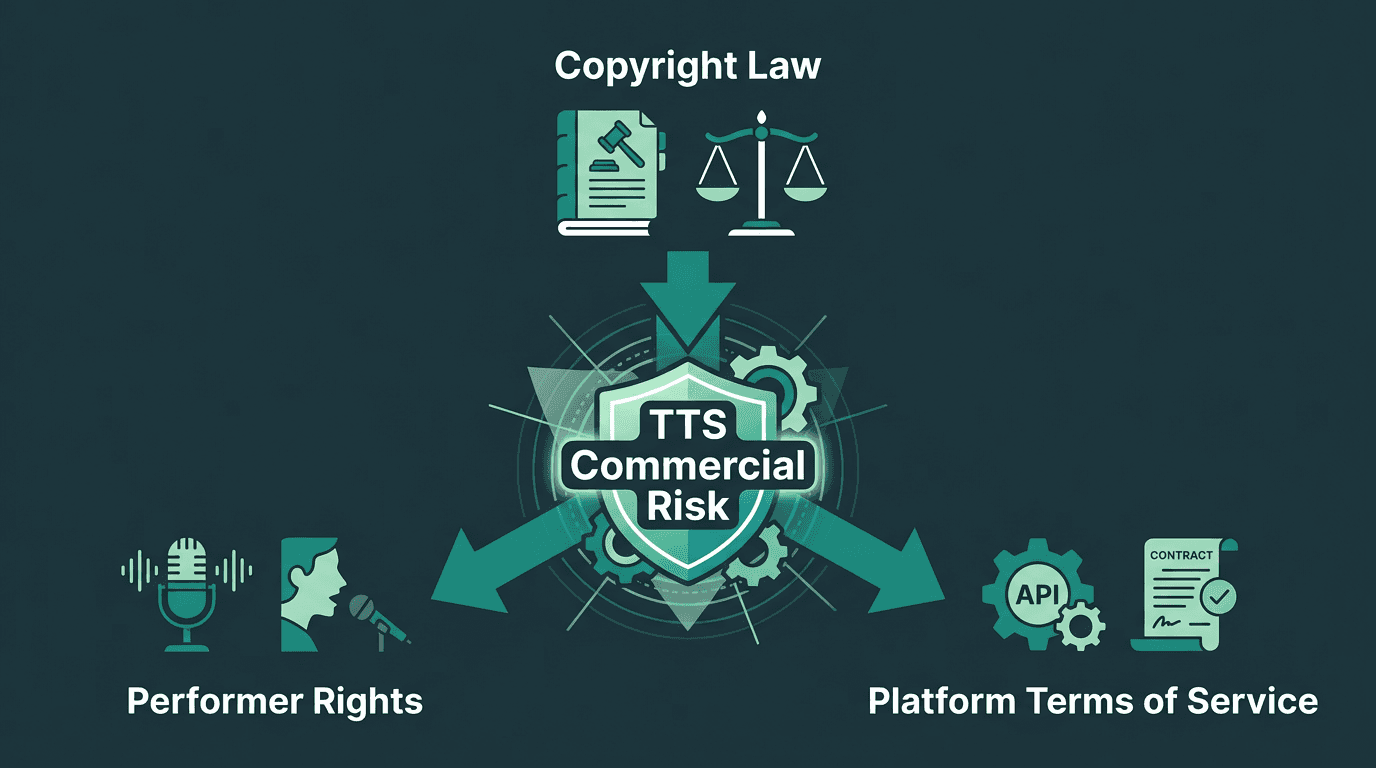
Three distinct legal dimensions converge to create commercial licensing risk in AI voice deployments.
The commercial licensing checklist: 9 questions to ask every vendor
Before you commit to any TTS provider for a commercial product, run through these nine questions. Some answers will be in the terms of service. Others require a direct conversation with the vendor's sales or legal team. Either way, get the answers in writing.
Licensing checklist for TTS vendor:
Does your paid plan explicitly permit commercial redistribution? Look for language like 'royalty-free commercial use' or 'you retain ownership of generated audio.' Absence of this language is a red flag.
Is white-label or OEM use permitted? If you are building a product where the end user never sees the TTS vendor's name, confirm this is allowed. Many providers require attribution or prohibit white-labeling below enterprise tiers.
What are the restrictions on monetized content? Audiobooks, podcasts, and YouTube videos with ads each carry different risk profiles. Verify each use case individually.
Who owns the generated audio? The vendor's ToS should state clearly that you own the output. If it says the vendor retains any rights, escalate before proceeding.
Are there voice-specific restrictions? Some premium or cloned voices carry additional restrictions even on plans that otherwise permit commercial use.
What happens to your input text? Some providers retain input data for model training. This matters for confidential scripts, legal content, or anything under NDA.
Is there a geographic restriction on commercial use? A few providers limit commercial rights to specific markets or exclude certain jurisdictions.
What is the SLA and uptime commitment for production use? A voice that sounds great in testing but drops to 95% uptime in production creates real business risk.
Is there an indemnification clause? Enterprise-grade vendors typically offer some protection if a third party claims the generated audio infringes their rights. Consumer-tier plans rarely do.
See how Smallest.ai handles commercial licensing clearly and transparently for production teams.
Common licensing traps and what most teams miss
Here is something most comparison articles skip entirely: the gap between what a pricing page implies and what the actual terms of service say. Marketing copy uses phrases like 'use for your projects' or 'create content.' Legal terms say 'non-exclusive, non-transferable license for personal or internal business use.' Those two things are not the same.
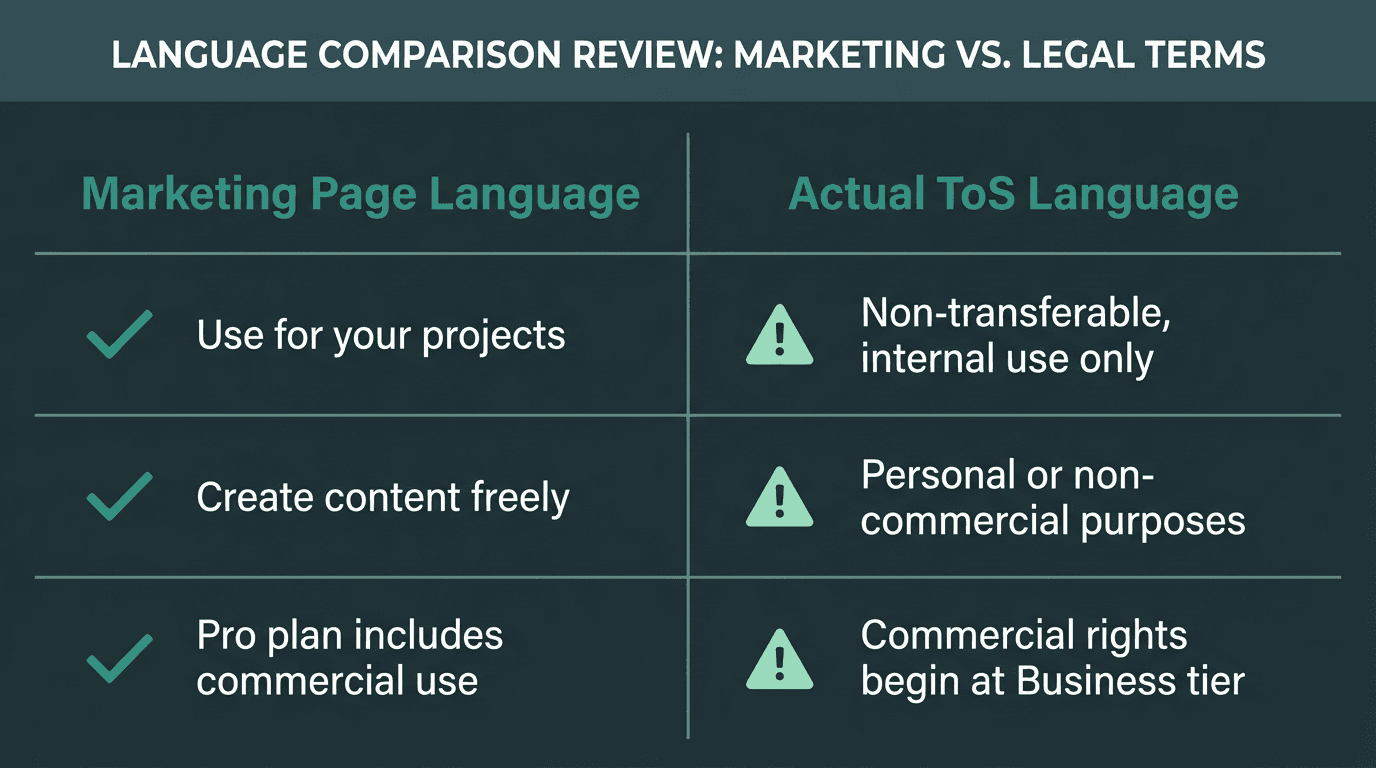
The gap between what pricing pages imply and what ToS documents actually permit is where most teams get caught.
The three traps that appear most often in our experience reviewing vendor agreements:
The tier trap. Commercial rights are gated behind a higher pricing tier, but the upgrade path is not obvious. Teams on a 'Pro' plan assume they have commercial rights because they are paying. The actual commercial license may only begin at 'Business' or 'Enterprise.' Always check the specific tier you are on, not the plan you think you are on.
The voice clone trap. A provider may offer broad commercial rights on their standard voice library but restrict cloned or custom voices to personal use. If your product's value proposition depends on a branded voice, this distinction is critical. Check the cloning-specific terms separately from the general commercial terms.
The silent update trap. ToS documents change. A vendor that permitted commercial use in 2024 may have updated their terms in 2025 to restrict it. If you do not have a process for monitoring ToS changes from your key vendors, you are exposed. Set a calendar reminder to review terms quarterly, or use a service that tracks ToS changes automatically.
Safe workflow for commercial TTS deployment
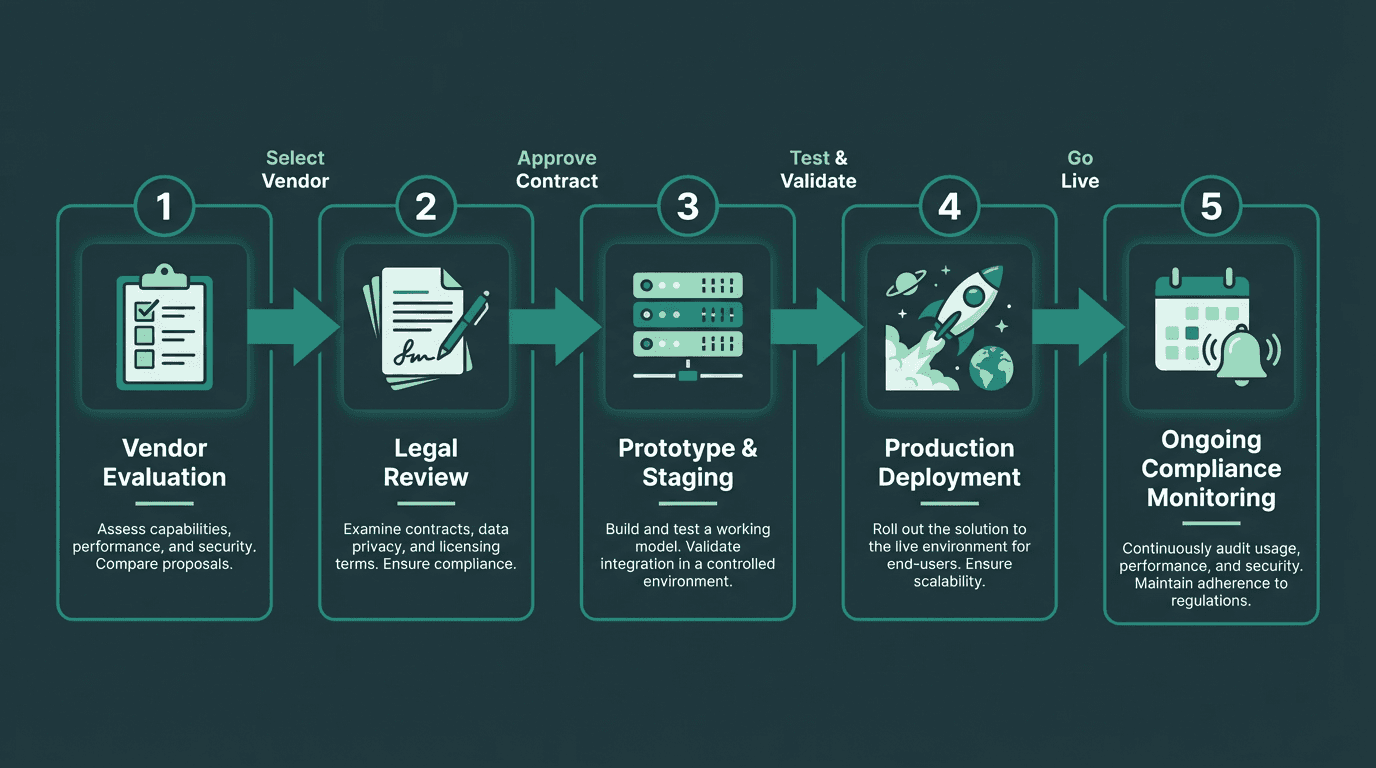
A five-stage workflow that keeps commercial TTS deployments legally sound from prototype to production.
A safe workflow is not bureaucracy. It is a repeatable process that prevents the kind of scramble that happens when legal flags a vendor agreement two weeks before launch. Here is how to structure it.
Stage 1: Vendor shortlisting with licensing as a filter
Start your evaluation by eliminating vendors whose terms do not fit your use case before you spend any time on audio quality testing. Pull the ToS for each candidate, run through the nine-question checklist above, and score each vendor on licensing fit. This takes two to three hours per vendor and saves weeks of rework later. The free-tier TTS space in particular requires careful scrutiny, since free tiers almost universally prohibit commercial use.
Stage 2: Legal sign-off before integration
Once you have a shortlist of two or three vendors that pass the licensing checklist, get your legal team or an IP attorney to review the specific terms for your use case. This is not optional for anything going into a revenue-generating product. The cost of a two-hour legal review is negligible compared to the cost of unwinding an integration after a cease-and-desist.
Stage 3: Staging environment with production-equivalent terms
Test in a staging environment using the same API tier and the same voice assets you intend to use in production. Do not prototype on a free tier and assume the commercial tier will behave identically. Some vendors apply different rate limits, voice availability, or output quality settings across tiers. Discovering this in staging is fine. Discovering it in production is not.
Stage 4 and 5: Deployment and ongoing monitoring
After launch, assign someone to monitor vendor communications and ToS update notifications. Many vendors send email notices of material changes, but these are easy to miss in a busy inbox. A lightweight process, such as a monthly five-minute ToS check and a shared Slack channel for vendor updates, is usually enough for most teams. For AI voice assistants in customer support workflows, where the voice is customer-facing and brand-critical, this monitoring step is especially important.
Advanced considerations: voice cloning, attribution, and data residency
For teams building at scale or in regulated industries, three additional dimensions come into play that standard licensing checklists rarely address.
Voice cloning consent and provenance. If your product uses a cloned voice, whether a brand voice or a public figure's likeness, you need documented consent from the original voice talent. The EU AI Act, which began its phased compliance period in February 2025 with prohibited AI practice provisions, and continues rolling out transparency obligations through 2026, includes specific provisions around synthetic voice generation and disclosure requirements for AI-generated audio in commercial contexts. In the United States, several states have passed or are actively considering voice likeness protection laws modeled on right-of-publicity statutes. Verify that your vendor's cloning pipeline includes consent verification, and keep your own records.
Data residency for input text. If your application generates audio from sensitive content (medical, legal, financial), you need to know where your input text is processed and stored. Some TTS providers process all requests through US-based infrastructure. Others offer EU or regional endpoints. For GDPR-covered organizations, this is a data processing agreement (DPA) question, not just a licensing question. Ask for the DPA before signing any commercial agreement.
Attribution requirements. A handful of providers require that generated audio include an audible or metadata-level disclosure that it was AI-generated. This is becoming more common as regulatory pressure increases. Even where it is not legally required, some brand contexts benefit from proactive disclosure. Build attribution handling into your workflow architecture from the start so it is not a retrofit problem later.
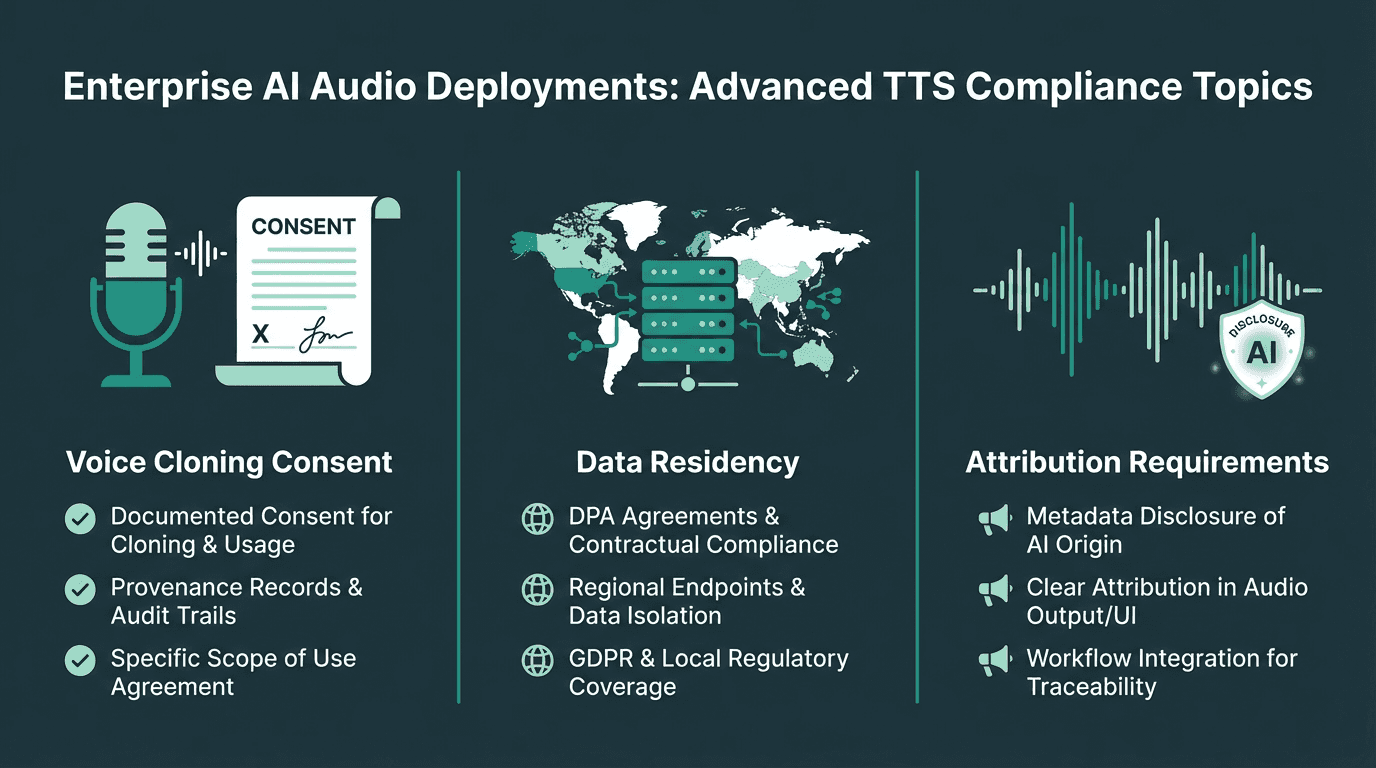
Three compliance dimensions that go beyond standard licensing checklists for enterprise and regulated deployments.
How Smallest.ai approaches commercial licensing
Most teams look for a combination of audio quality, API reliability, and clear commercial terms. Smallest.ai's Lightning TTS is built specifically for production environments where latency and licensing clarity both matter. The platform is designed for developers who need to move from prototype to commercial deployment without ambiguity about what they can and cannot do with the output.
Where many providers bury commercial rights in enterprise-only tiers, Smallest.ai structures its plans so that developers can verify their rights at the tier they are actually on, not the tier they would need to upgrade to. Commercial redistribution rights are included from the paid tier, with no enterprise contract required. You can confirm which tier applies to your use case on the Smallest.ai pricing page and review the full conditions in the Smallest.ai terms of service. For teams building voice-first products, this transparency is not a minor convenience. It is the difference between a clean launch and a legal scramble.
Start building with Smallest.ai and get commercial-ready voice AI without the licensing guesswork.
Key takeaways
What to carry forward from this guide:
Treat licensing as a filter, not an afterthought. Eliminate vendors that do not fit your commercial use case before testing audio quality.
Use the nine-question checklist for every vendor, including the one you are already using.
Watch for the three most common traps: tier ambiguity, voice clone restrictions, and silent ToS updates.
Get legal sign-off before integration, not after. A two-hour review now prevents weeks of rework later.
For regulated industries or large-scale deployments, add voice cloning consent, data residency, and attribution to your standard checklist.
Build a lightweight ongoing monitoring process so ToS changes do not catch you off guard post-launch.
Frequently asked questions
Do free TTS plans ever permit commercial use?
What is the difference between 'commercial use' and 'commercial redistribution'?
Can I use AI-generated voice for audiobooks and sell them on platforms like Audible?
How do I handle ToS changes after I have already deployed a commercial product?
Does the EU AI Act affect how I can use AI-generated voice in commercial products?