Contact Center Workforce Management Practical Guide and Tips

A detailed guide with practical tips on contact center workforce management, covering forecasting, intraday control, automation impact, and staffing stability.
Running a contact center rarely goes exactly as planned. Call volume rises without notice, agents run late, queues back up, and supervisors spend the day reacting instead of staying ahead. For teams managing growth, compliance, and service targets at the same time, contact center workforce management becomes less of a planning exercise and more of a daily pressure point.
Most leaders searching for contact center workforce management are not looking for theory. They want predictable staffing, stable service levels, and fewer surprises during peak hours. The urgency behind this search keeps growing. The global workforce management market is projected to reach USD 10.10 billion by 2033, reflecting how central workforce control has become for modern contact operations.
In this guide, we break down how workforce management works in real contact centers, where teams struggle without it, what to look for in a platform, and how Smallest.ai fits into workforce planning for voice-first operations.
Key Takeaways
Interval-Level Forecast Error Amplifies Under Load: As inbound volume and concurrency rise, small misses at the 15 or 30 minute interval level translate into queue buildup faster than supervisors can correct.
Intraday Control Determines Whether SLAs Hold: Live comparison of arrival rate and handle time against the plan is what prevents short spikes from turning into sustained backlog.
Escalation Timing Drives Staffing Risk: Workforce plans fail when call handoffs from automation arrive unpredictably, even if total call volume remains within forecast.
Language and Skill Queues Are Early Stress Points: Queues with limited skilled agents show service degradation first during regional surges or unexpected demand shifts.
Labor Cost Drift Signals Planning Gaps: Rising overtime and reactive hiring often indicate delayed detection of demand variance rather than true volume growth.
Why Contact Center Workforce Management Matters at Scale
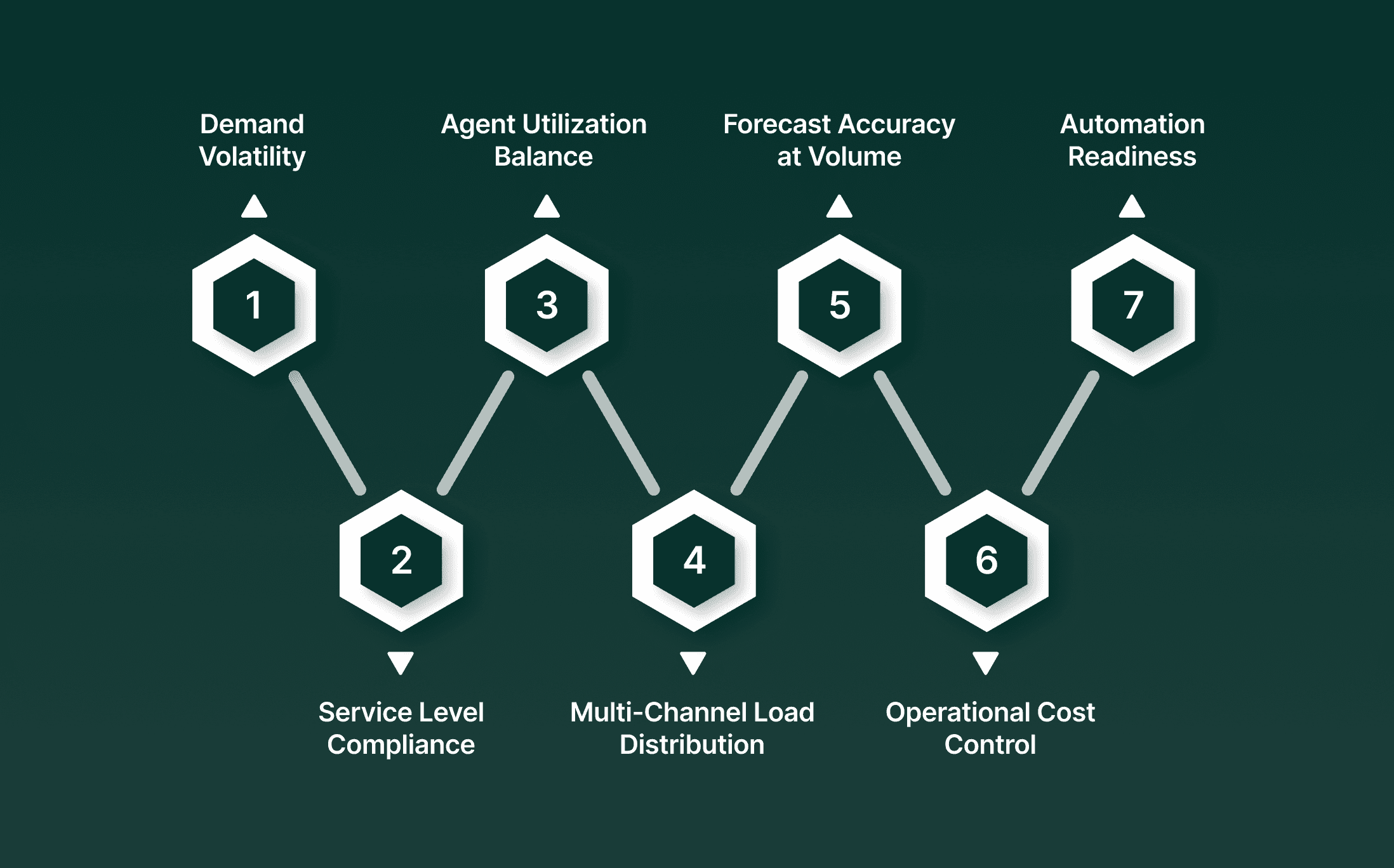
As contact centers move from small agent teams to multi-location, high-volume operations, workforce management stops being a scheduling task and becomes an operational control layer. At scale, small gaps in staffing, forecasting, or call handling ripple into higher wait times, missed SLAs, agent burnout, and direct revenue loss.
Demand Volatility: Daily and hourly call volumes fluctuate due to campaigns, billing cycles, outages, and regional factors. Without structured workforce management, staffing rarely matches real demand.
Service Level Compliance: Enterprise contact centers operate under strict response-time and abandonment thresholds. Workforce planning directly affects answer rates, queue times, and regulatory commitments.
Agent Utilization Balance: Overstaffing inflates cost per contact. Understaffing pushes agents into sustained overload, driving attrition and training overhead.
Multi-Channel Load Distribution: Voice, callbacks, chat, and automated calls compete for the same agent pool. Workforce management governs how capacity shifts across channels without degrading voice performance.
Forecast Accuracy at Volume: Manual forecasting breaks down once call volumes cross tens of thousands per day. Errors compound quickly, leading to missed coverage windows.
Operational Cost Control: Labor represents the largest cost center in contact operations. Workforce planning determines hiring cadence, shift structures, and overtime exposure.
Automation Readiness: Voice agents and assisted automation only deliver value when human staffing models account for call deflection, escalation rates, and peak overlap periods.
In practice, workforce management functions as a tight feedback system. Its quality determines whether service levels stay stable during pressure or collapse after volume shifts.
To see how voice automation shapes staffing outcomes and language coverage in real operations, continue with Top 10 AI Voice Agents with Multilingual Capabilities 2025
How Contact Center Workforce Management Functions in Real Operations
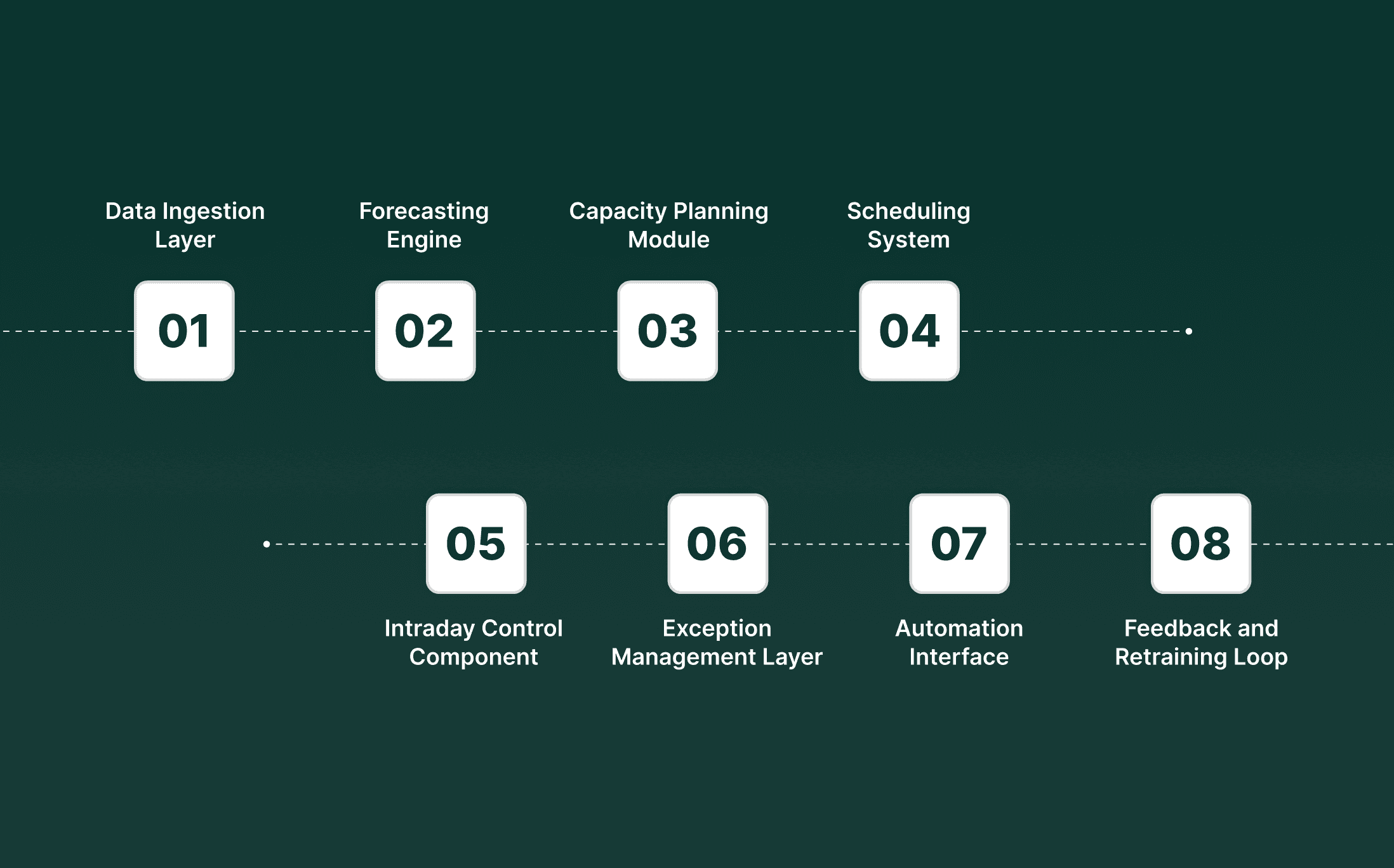
In production contact centers, workforce management is made up of interdependent system components that operate on shared data. Each component feeds the next, and weak accuracy in one layer spreads downstream into staffing gaps, SLA misses, or idle capacity.
Data Ingestion Layer: Pulls historical call records, queue metrics, average handle time, abandonment rates, and shrinkage factors from telephony and CRM systems. Data granularity typically sits at 15-minute intervals to support intraday control.
Forecasting Engine: Models expected call arrival rates by queue, language, and region. Adjustments account for seasonality, billing cycles, campaigns, and known external events that alter inbound patterns.
Capacity Planning Module: Converts forecasted demand into required staffing using service level targets, queue thresholds, and concurrency limits. This layer exposes headcount shortfalls before shifts are published.
Scheduling System: Maps required coverage into agent shifts based on labor rules, skills, break constraints, and contractual limits. Skill-based routing assumptions are locked at this stage.
Intraday Control Component: Monitors live queue depth, arrival rate, and handle time against the plan. Triggers actions such as reassigning agents, delaying non-critical activities, or routing overflow.
Exception Management Layer: Detects abnormal patterns like mass retries, outage-driven spikes, or region-specific surges. Flags queues where forecast confidence has broken down.
Automation Interface: Tracks how AI voice agents absorb volume and where escalations occur. Updates human staffing requirements based on deflection and transfer rates.
Feedback and Retraining Loop: Feeds actual outcomes back into the forecasting system. Repeated variance signals demand model drift rather than execution issues.
This component chain explains why workforce management works only when every layer remains accurate and synchronized under live conditions.
Practical Tips for Improving Contact Center Workforce Management
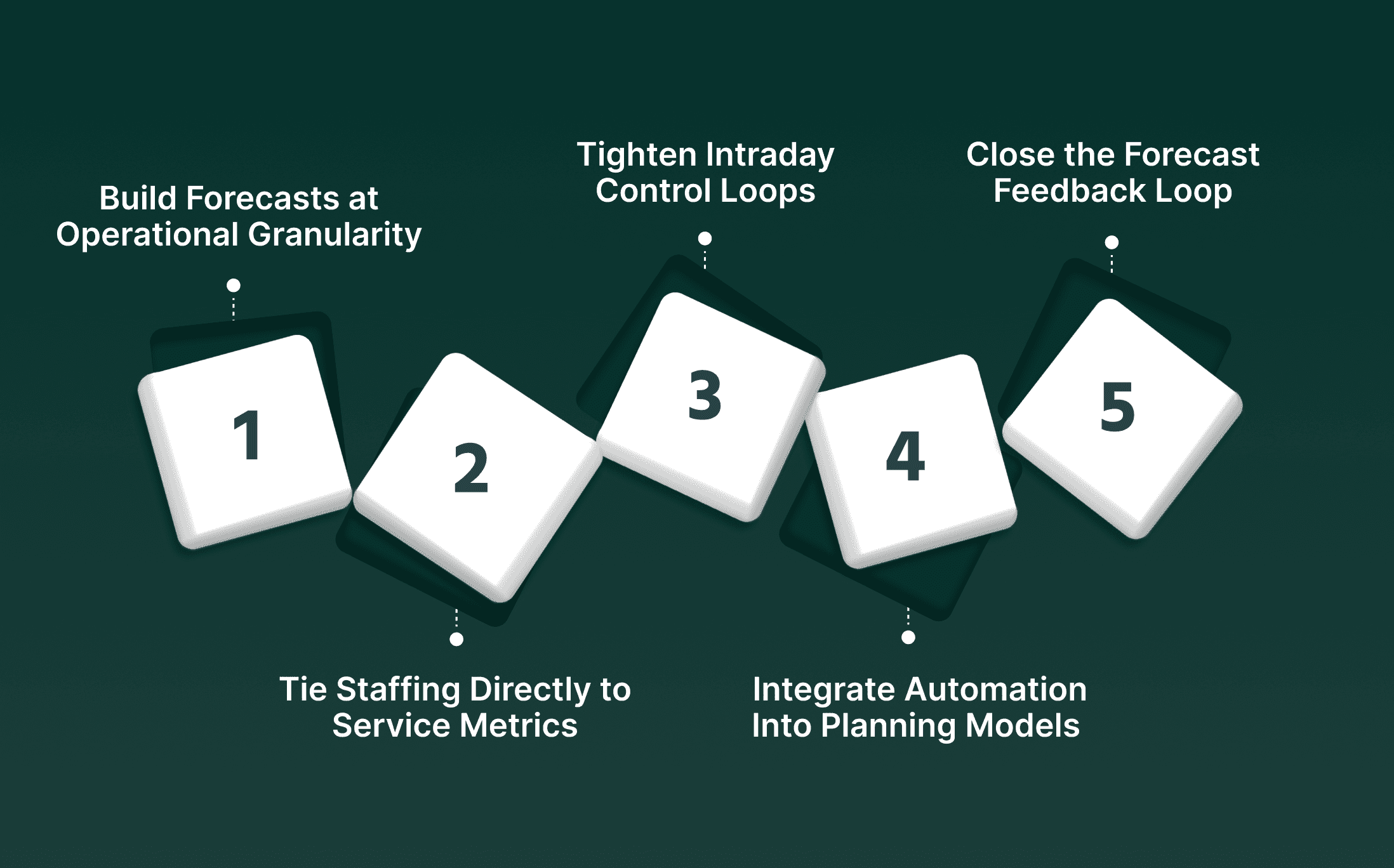
Improving workforce management requires tightening core operational practices rather than adding new layers of reporting. These steps focus on forecasting accuracy, intraday control, and how people and automation share load under real call conditions.
Step 1: Build Forecasts at Operational Granularity
High-level forecasts hide the patterns that break service levels during the day. Workforce plans must reflect how volume actually arrives.
Interval Planning: Forecast at 15 or 30-minute intervals so short spikes do not roll into later queues.
Queue Separation: Model each queue, language, and region independently instead of blending demand.
Event Adjustment: Apply known drivers like billing cycles, campaigns, or regional holidays before schedules lock.
Step 2: Tie Staffing Directly to Service Metrics
Schedules should reflect math tied to response targets, not static headcount ratios.
AHT Sensitivity: Recalculate staffing when handle time shifts by even small margins since impact scales fast.
Concurrency Limits: Respect how many calls agents handle concurrently rather than assuming uniform capacity.
SLA Visibility: Show how each staffing decision affects wait time and abandonment risk in real terms.
Step 3: Tighten Intraday Control Loops
The workday rarely follows the plan. Correction speed matters more than forecast perfection.
Live Variance Tracking: Compare actual arrivals and handle time against the plan every few minutes.
Predefined Actions: Set clear triggers for moving breaks, reassigning agents, or activating overflow.
Queue Priority Rules: Shift agents toward revenue, compliance, or escalation queues before backlog forms.
Step 4: Integrate Automation Into Planning Models
Voice agents change volume patterns. Workforce plans must reflect that interaction.
Deflection Accounting: Track which call types automation absorbs and at what success rates.
Escalation Timing: Model when handoffs happen so human agents stay available at those windows.
Load Testing: Validate plans during peak overlap between automated and human traffic.
Step 5: Close the Forecast Feedback Loop
Repeat variance signals system issues, not agent performance.
Pattern Review: Flag hours or regions where forecasts miss consistently.
Model Updates: Adjust demand assumptions rather than adding buffer staffing.
Decision Traceability: Store plan versions and intraday changes to review results accurately.
Consistent gains in workforce management come from disciplined execution across these steps, not from one-time schedule changes or added reporting layers.
To see how real-time voice agents and controlled escalation are shifting how enterprises handle live call volume, continue with 9 Ways Contact Center AI Is Changing Customer Calls Forever
What to Look For in a Contact Center Workforce Management Platform
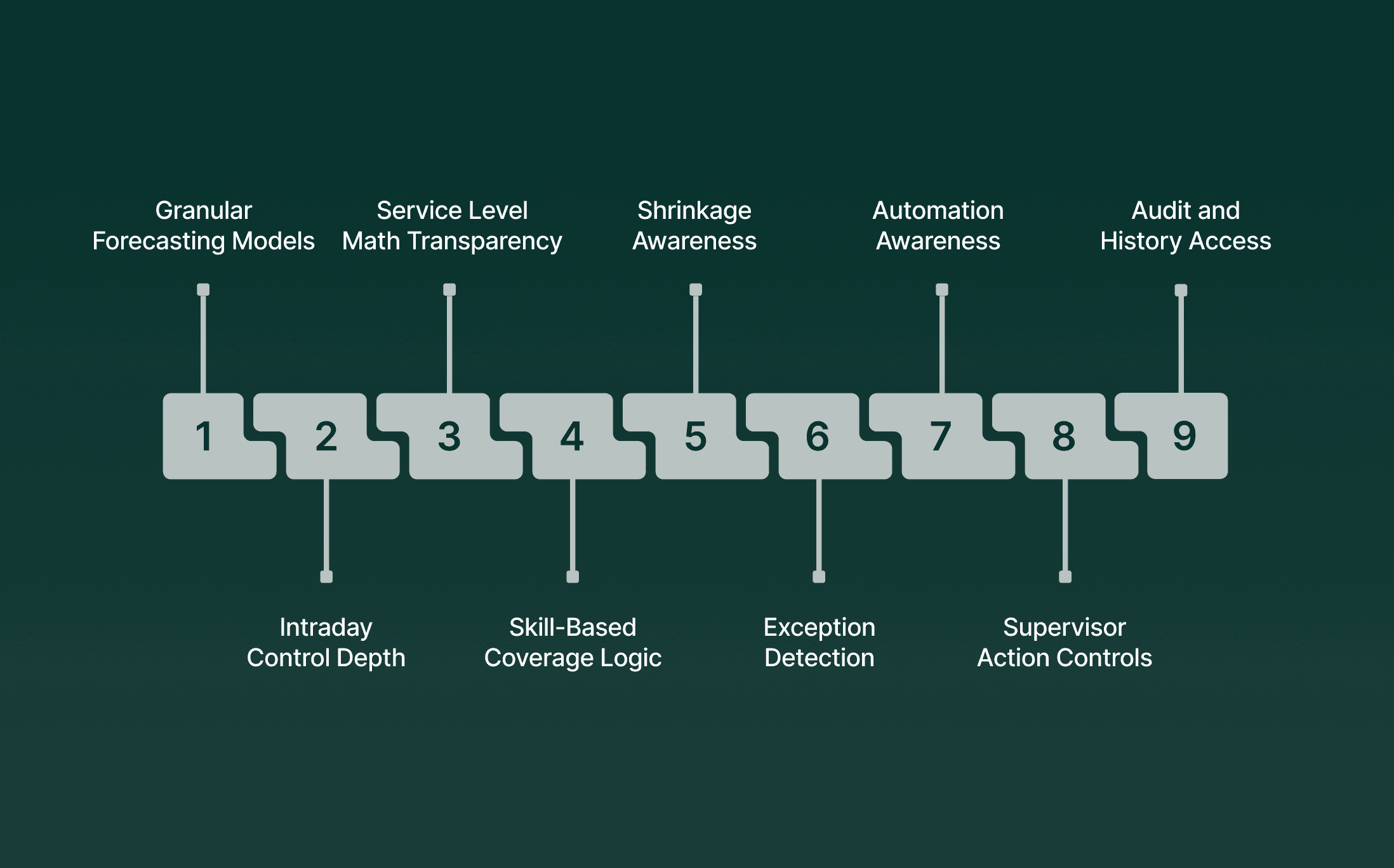
A workforce management platform must operate as a real-time control system, not a reporting layer. At scale, its value depends on how accurately it models demand, how fast it reacts to live variance, and how well it coordinates with human and automated handling.
Granular Forecasting Models: Supports 15 or 30 minute interval forecasting by queue, language, and region rather than daily or blended averages.
Intraday Control Depth: Tracks live arrival rates, handle time shifts, and queue backlog against the plan with the ability to act during the day, not after metrics close.
Service Level Math Transparency: Exposes how staffing levels tie to answer time, abandon rate, and concurrency assumptions instead of hiding logic behind scorecards.
Skill-Based Coverage Logic: Models agent skills at the queue level so multi-skill agents cover priority traffic first rather than spreading thin across all queues.
Shrinkage Awareness: Accounts for meetings, training, leave, system downtime, and attrition at planning time rather than treating shrinkage as a fixed percentage.
Exception Detection: Flags abnormal patterns like retry loops, outage-driven spikes, or regional surges where forecast confidence drops below safe limits.
Automation Awareness: Includes clear visibility into how voice agents deflect calls, when escalations occur, and how that changes human staffing needs.
Supervisor Action Controls: Allows real operational actions such as break movement, queue reassignment, and activity changes without manual workarounds.
Audit and History Access: Retains forecast versions, intraday changes, and outcomes so teams can trace why coverage failed or held up.
A platform that lacks these characteristics shifts risk to supervisors and agents. One that supports them keeps service levels steady while load and call mix change throughout the day.
How Smallest.ai Supports Contact Center Workforce Management
Smallest.ai supports workforce management through its real-time voice infrastructure and production-grade AI agents as defined on its official service pages. The value comes from predictable call handling behavior, low response latency, and system-level control over how and when human agents become involved.
Real-Time Voice Agents for Calls: Atoms provides AI agents that handle live phone calls in real time. These agents answer, converse, and resolve defined call types without holding calls in the queue, reducing inbound load during peak intervals.
Low-Latency Speech Generation: Waves delivers real-time text-to-speech with sub-100 ms latency. Fast responses reduce dead air and unnecessary call extensions, keeping average handle time closer to planned values.
Natural Language Understanding in Calls: Atoms uses natural language processing to capture caller intent during live conversations. This allows accurate routing decisions early in the call, limiting incorrect transfers to human agents.
Multi-Language Voice Support: Waves supports more than 30 languages and accents. This allows automated handling of language-specific queues where agent availability is often limited, stabilizing regional staffing pressure.
Scalable Concurrent Call Handling: Atoms is built to manage large volumes of simultaneous calls. Workforce teams can plan human coverage knowing automated capacity will not bottleneck during traffic spikes.
Defined Escalation Paths: AI agents escalate calls only when required, based on intent or failure to resolve. This creates a more consistent escalation pattern that workforce plans can account for.
Always-On Availability: Atoms operates around the clock. After-hours and overnight call traffic is handled without staffing human agents for full coverage, reducing backlog before the next shift starts.
API-Based System Connectivity: Smallest.ai provides APIs for integration into existing contact center stacks. This allows voice automation to operate alongside routing, CRM, and monitoring systems already used for workforce planning.
Smallest.ai works alongside workforce management platforms by reshaping live call demand using real-time voice handling and scalable AI agents, based strictly on its documented service capabilities.
Final Thoughts!
Operating a growing contact center puts steady pressure on staffing models that were built for calmer conditions. When volume patterns shift faster than schedules can adjust, contact center workforce management becomes the control point that determines whether service levels hold or start to erode quietly across the day.
As voice traffic scales, the role of contact center workforce management extends beyond planning headcount. It shapes how predictable demand remains, how escalation patterns form, and how much intraday correction supervisors need to apply to keep queues stable. Voice automation plays a direct role here by absorbing repeatable calls and passing only defined cases to human agents.
If you want to see how real-time voice agents can support contact center workforce management in high-volume operations, explore Smallest.ai’s platform and request a demo today.
FAQs About Contact Center Workforce Management
1. How does workforce management call center planning change once voice agents handle live calls?
When voice agents resolve a defined share of inbound calls, staffing forecasts shift from total volume to escalation-driven volume. Workforce teams begin planning around transfer timing, failure rates, and language-specific escalations rather than raw call counts.
2. What makes contact center WFM harder to manage in multilingual operations
Language-based demand rarely follows uniform patterns. Contact center WFM becomes more complex because staffing must account for uneven regional peaks, limited skilled agents, and a higher risk of backlog during localized surges.
3. Why do call center workforce management tools struggle during short traffic spikes
Many call center workforce management tools smooth data over longer intervals, which hides brief but damaging spikes. Without interval-level control, supervisors react after queues are already overloaded rather than during the initial surge.
4. Is contact centre workforce management useful in overnight or low-staff periods
Yes, contact centre workforce management plays a larger role during low coverage windows. Small forecast misses overnight create larger relative delays the next morning, especially when backlog carries into peak hours.
5. How does contact center workforce planning change when automation escalates calls selectively
Contact center workforce models must adjust for selective escalation, where only certain intents or failure cases reach humans. Planning shifts toward managing variability in escalation volume rather than steady call flow.