Best AI Voice Agents for Dental Practices in 2026: Features, Benefits, and Top Solutions

Compare AI voice agents for dental practices on scheduling accuracy, PMS integrations, latency, escalation logic, and HIPAA safeguards for 2026 deployments.
Missed calls are not merely an inconvenience for dental practices. They mean untreated emergencies, unfilled chair time, and patients who quietly book with someone else. Missed calls can represent significant revenue opportunities for dental practices, especially when potential patients cannot reach the office during busy periods. The actual impact varies depending on practice size, location, patient value, and conversion rates. AI voice agents for dental practices address this gap by answering, scheduling, routing, and documenting calls without requiring front-desk staff to manage every interaction.
This practical review is written for dentists, practice managers, administrators, and technical buyers. It moves through the technology in order, from basic call handling to solution selection, implementation, and healthcare safeguards. The goal is a realistic evaluation framework, not a promise that automation can replace an experienced dental team.
Dental voice AI basics and contents
Article contents
Section | Practical focus |
|---|---|
Dental voice AI basics and contents | How calls are understood and completed |
Dental workflows that produce measurable value | Booking, inquiries, reminders, routing, and after-hours calls |
Best voice AI solution paths for 2026 | Platforms and infrastructure compared |
How to evaluate and deploy a dental voice agent | Testing, integrations, metrics, and rollout |
Advanced reliability, security, and compliance | Healthcare safeguards and difficult edge cases |
Frequently asked questions | Five common purchasing and operational questions |
Key takeaways and next steps | A concise selection plan |
A dental AI phone assistant listens through speech-to-text, determines the caller's intent, applies practice rules, and generates a spoken response. A complete agent also reads appointment availability, writes approved changes to the practice management system, sends confirmations, and transfers calls with context. Readers unfamiliar with the components can first review what an AI voice agent is.
What most buyers get wrong: A pleasant synthetic voice is not proof of operational readiness. The harder test is whether the system accurately handles names, tooth numbers, insurance terminology, interruptions, background noise, and scheduling rules without inventing an answer.
Dental workflows that produce measurable value
Booking and schedule management
Automated appointment scheduling for dentists needs to enforce provider, operatory, procedure, duration, age, and location rules. A new patient requesting a cleaning should not land in a limited emergency slot. Strong dental appointment booking automation confirms contact details, explains approved preparation instructions, writes the appointment, and sends a confirmation while the caller is still on the line.
Questions, routing, and after-hours support
A well-scoped virtual dental receptionist can manage:
Routine inquiries: hours, directions, accepted payment methods, parking, and approved service information.
Call routing: transfer implant, orthodontic, billing, and clinical calls to the correct queue, including the transcript and stated reason.
After-hours support: collect symptoms, apply practice-approved escalation rules, and contact the on-call person when defined triggers occur.
Reminders and recalls: confirm, cancel, or request rescheduling, then create a staff task when no suitable time is available.
Outbound follow-up: contact patients about unscheduled treatment or overdue hygiene visits using approved scripts and consent rules.
An AI answering service for dentists should never diagnose pain or promise treatment outcomes. Consider a caller reporting facial swelling and difficulty breathing: the agent must stop routine booking, deliver the practice's approved emergency direction, and escalate immediately. A chipped tooth without severe symptoms, by contrast, can be captured as an urgent appointment request using predefined questions.
Adoption is moving quickly but remains uneven. Recent industry surveys indicate that dental practices are increasingly exploring AI for administrative and operational tasks, although adoption rates vary across regions and practice sizes. Industry reports suggest growing interest in AI and automation among dental practices, particularly for administrative workflows such as scheduling and communication. Adoption levels differ significantly by region, with many practices still evaluating AI primarily for administrative workflows. That gap points toward a sensible approach: start with repetitive, low-risk dental practice automation before expanding scope.
Best voice AI solution paths for 2026
1. Smallest.ai
Smallest.ai presents speech models, APIs, and agent-building capabilities.
Smallest.ai provides a modular stack covering voice and agent development components: Atoms supports voice and text agents, Lightning provides text-to-speech, Pulse handles speech-to-text, Hydra supports speech-to-speech, and Electron supplies a conversational small language model. That modularity suits groups that want an AI receptionist for dentists today but anticipate building custom scheduling, multilingual, or outbound workflows later.
Best fit: Practices or dental service organizations working with an implementation partner and seeking control over the speech and agent stack. Evaluate production latency, integration effort, data handling, and availability of a suitable business associate agreement for the exact deployment. The healthcare voice AI compliance overview provides useful planning questions.
2. ElevenLabs
ElevenLabs emphasizes expressive speech and conversational voice experiences.
ElevenLabs is worth evaluating when voice naturalness, language coverage, and brand-consistent speech carry substantial weight. Buyers should distinguish voice generation from a complete AI dental receptionist, which also requires telephony, orchestration, scheduling connectors, monitoring, and escalation logic. Review current packaging on the ElevenLabs pricing page, then model total call costs rather than comparing voice prices alone.
3. Deepgram
Deepgram is an infrastructure-oriented option for real-time voice applications.
Deepgram appeals to developers prioritizing streaming speech recognition and low-latency voice infrastructure. It is better understood as a component or developer platform than as ready-made dental patient communication software. A practice still needs workflow logic, telephony, integration development, and healthcare governance on top. Technical teams comparing architectures can review guidance on choosing the right voice agent stack.
4. AssemblyAI
AssemblyAI focuses on speech recognition and audio intelligence APIs.
AssemblyAI is most relevant when transcription quality, streaming recognition, or post-call intelligence is the primary requirement. It is not, by itself, a virtual receptionist. Engineering teams can use the AssemblyAI developer documentation to assess streaming behavior, supported models, and implementation details before building the remaining call workflow.
5. OpenAI
OpenAI provides conversational models that developers can incorporate into voice systems.
OpenAI offers a flexible route for teams building complex conversational behavior and tool calling. That flexibility also increases implementation responsibility. Dental buyers need firm controls around tool permissions, knowledge sources, retention, escalation, and model responses. A general-purpose model should never receive unrestricted authority to modify schedules or state clinical advice.
6. Cartesia
Cartesia targets responsive speech generation and real-time voice applications.
Cartesia belongs on a shortlist where fast, natural speech generation is central to the desired experience. As with other infrastructure-led options, verify what must be supplied separately. Telephony, practice-specific logic, audit trails, and integrations are what separate a polished demonstration from reliable voice AI for dental offices.
Solution comparison
Option | Primary strength | Deployment fit | Dental buyer caution |
|---|---|---|---|
Smallest.ai | Integrated speech and agent stack | Custom or partner-led agents | Validate healthcare terms and PMS integration |
ElevenLabs | Natural voice generation | Voice-led patient experiences | Account for full orchestration costs |
Deepgram | Real-time speech infrastructure | Developer-built systems | Requires workflow and integration layers |
AssemblyAI | Transcription and audio intelligence | Speech component selection | Not a complete receptionist |
OpenAI | Flexible conversational reasoning | Complex custom workflows | Apply strict permissions and response controls |
Cartesia | Responsive speech generation | Latency-sensitive builds | Confirm surrounding platform requirements |
How to evaluate and deploy a dental voice agent
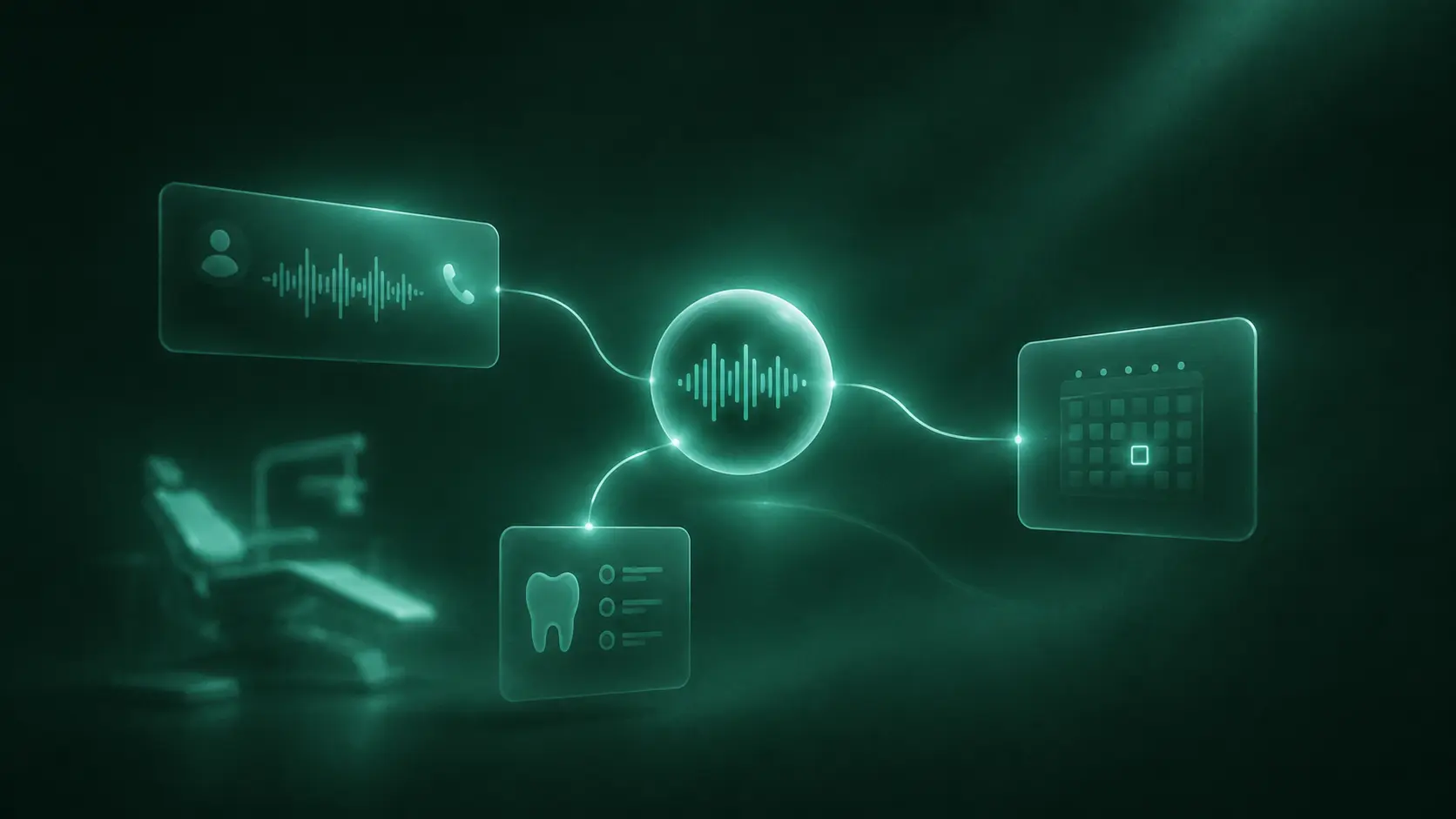
A controlled pilot exposes workflow problems before the agent handles every call.
1. Score real calls, not scripted demonstrations
Build a test set from de-identified call patterns: accented speech, noisy mobile calls, children speaking for parents, similar patient names, mid-sentence corrections, insurance terminology, and silence. Measure transcription accuracy, task completion, incorrect actions, transfer success, and response latency. Longer response delays can make conversations feel unnatural, so teams should evaluate complete end-to-end latency and interruption handling during testing.
2. Prove the integration before expanding
Require a live demonstration of the proposed workflow:
Read only the appointment types and slots the caller is allowed to book.
Write a booking once, then verify the returned appointment identifier.
Prevent duplicate patient records through deterministic matching rules.
Pass summaries and recordings into approved systems with role-based access.
Fail safely when Dentrix, Eaglesoft, or another practice system is unavailable.
3. Pilot one bounded use case
Start with after-hours answering or overflow scheduling for one location. Compare booking conversion, abandonment, transfer accuracy, average handling time, no-show rates, and staff rework against a baseline. A 2026 buyer overview of AI costs, tools, ROI, and HIPAA considerations for dentists also highlights the importance of practice-management-system compatibility. Expand only when errors are visible, reversible, and consistently reviewed.
Advanced reliability, security, and compliance
A HIPAA compliant AI voice assistant is a configured service and operating process, not a label attached to a model. US practices need to determine whether protected health information enters recordings, transcripts, prompts, analytics, support systems, or backups. Every relevant vendor and subcontractor requires appropriate contractual and technical review, including a business associate agreement where applicable.
Production controls that deserve written answers
Risk | Required control | Dental example |
|---|---|---|
Clinical overreach | Approved scripts and immediate escalation | Swelling, bleeding, trauma, medication questions |
Wrong schedule action | Tool permissions, confirmation, and idempotency | Agent repeats a booking after a timeout |
Privacy exposure | Encryption, retention limits, access logs, and deletion | Transcript contains treatment and insurance details |
Service outage | Fallback routing and status monitoring | PMS or speech service becomes unavailable |
Identity mismatch | Proportionate verification before disclosure | Caller requests another family member's appointment |
Operational rule: Preserve a fast path to a person. The AI call handling for dental clinics that works best recognizes uncertainty early, explains the transfer, and gives staff the collected context rather than forcing the patient to repeat everything.
Key takeaways and next steps
The strongest AI voice agents for dental practices combine accurate speech, low conversational latency, dependable scheduling integrations, visible audit trails, safe escalation, and healthcare-appropriate data controls. Natural voice quality matters, but completed and correct patient actions matter more.
A practical next-step plan:
Choose one high-volume, low-risk workflow and document every rule and exception.
Shortlist platforms by complete capability, not voice quality alone.
Confirm integrations, security responsibilities, contracts, retention, and escalation paths in writing.
Run de-identified tests followed by a limited pilot with daily staff review.
Expand only after patient experience, safety, reliability, and economics meet agreed thresholds.
Used this way, a virtual dental receptionist augments the team instead of obscuring problems behind automation. Practices comparing broader deployment models can also review business solutions for AI voice assistants before selecting a build, partner, or managed-service path.
Frequently asked questions
Can an AI dental receptionist replace front-desk employees?
Can a voice agent book directly into dental software?
How fast should a dental voice agent respond?
What calls should remain with people?
How should a practice calculate ROI?