AI Voice Assistant: Best Business Solutions in 2026

AI voice assistant platform comparison for 2026: Smallest.ai, ElevenLabs, AssemblyAI, Cartesia, and OpenAI ranked on latency, accuracy, pricing, and scale.
This comparison looks at several widely used AI voice assistant platforms and how they approach speech generation, speech recognition, voice agents, deployment, and platform scope. If you want the broader context first, the AI voice assistants guide lays out the fundamentals.
This comparison focuses on the factors businesses typically evaluate when selecting an AI voice assistant platform, including latency, speech recognition, platform scope, pricing structure, integration requirements, and operational complexity.
Smallest.ai: Built for Speed and Real-Time Voice
Smallest.ai is designed around a simple constraint: if the system is not fast, it does not feel conversational. Lightning TTS targets sub-100ms latency for real-time voice applications. Pulse provides speech-to-text capabilities for voice assistant deployments. Hydra links the two into real-time speech-to-speech pipelines for agent scenarios. Atoms is the layer that turns those primitives into something you can actually deploy without asking your team to become ML specialists.
A notable aspect of the platform is how much of that stack you can reach through one door. The Waves API exposes Lightning and the surrounding speech capabilities in a single integration, which reduces the usual multi-vendor juggling act. If you are mapping this to voice assistants for customer support, Pulse and Atoms can be used together in those workflows.
Current pricing and usage tiers are available on the Smallest.ai pricing page. Teams should evaluate pricing against expected usage volume, deployment requirements, and operational goals. The Smallest.ai pricing plans show current tiers, but the intent is straightforward: start with a pilot, then scale without the bill spiking for the wrong reasons. Voice cloning is available through the TTS API, enabling branded voices without negotiating a separate contract. Smallest.ai supports both developer workflows and no-code deployment through Atoms, allowing teams to choose the level of customization that fits their requirements.
ElevenLabs: Voice Generation Platform
ElevenLabs offers a platform for speech synthesis, speech-to-text, voice cloning, and conversational AI. Its products are used for voice applications, automated agents, and audio content creation workflows. The platform includes features for creating custom voices and integrating with external knowledge bases to inform agent responses. It also provides tools for managing conversational turn-taking and detecting the language being spoken to enable multilingual interactions.
AssemblyAI: Speech Intelligence and Transcription
AssemblyAI provides APIs for speech recognition, speaker diarization, summarization, sentiment analysis, and entity detection. The platform primarily focuses on transcribing and analyzing audio data. Its models can be used for both pre-recorded audio files and real-time streaming audio. Beyond core transcription, the platform offers features to identify key topics, redact personally identifiable information (PII), and automatically segment audio into chapters.
The company’s offerings are designed for use cases such as call analytics, content moderation, and the development of voice agents. Teams building complete voice assistants typically integrate its transcription services with separate components for voice generation and agent logic.
Cartesia: Real-Time Speech Infrastructure
Cartesia provides infrastructure for real-time speech applications. Its products include text-to-speech (Sonic), speech-to-text (Ink), and a platform for building voice agents (Line). The models are designed for bidirectional streaming to reduce latency and are accessible through a single API. The platform is built on state-space models (SSMs), an architecture well-suited for real-time processing and handling long sequences of input.
The platform is designed for applications where low-latency voice interaction is a primary requirement, such as interactive agents and customer support automation. Users can deploy the models through a cloud API, on-premises, or on-device.
OpenAI: Voice Capabilities Within a Broader AI Platform
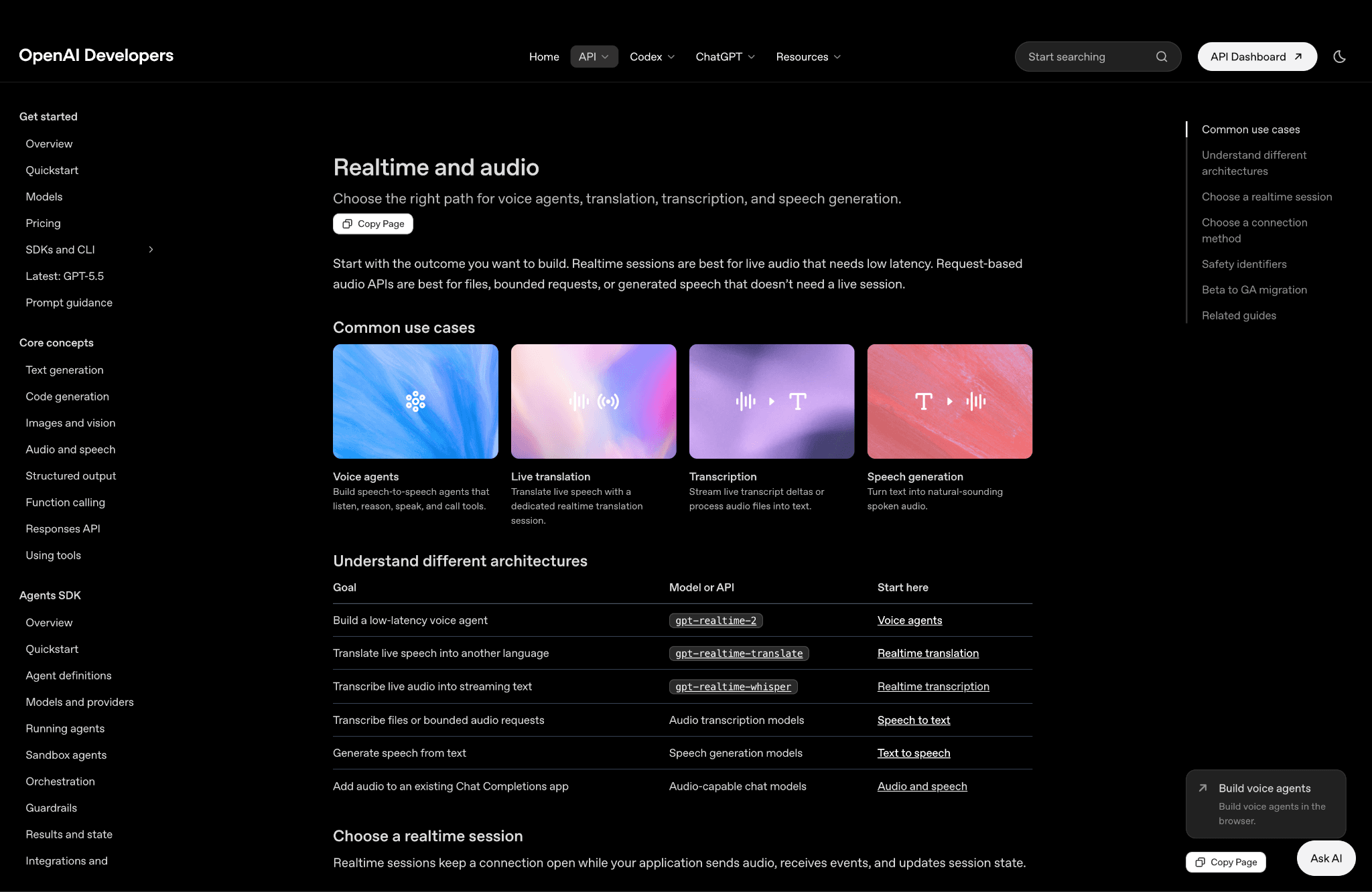
OpenAI provides voice capabilities as part of its larger suite of AI models. Its offerings include text-to-speech, speech-to-text, and real-time voice models designed for conversational applications. The text-to-speech models offer multiple preset voices and support for various audio formats. Some models also allow developers to guide the speech style, tone, and pacing through text-based instructions.
These voice features are integrated with its language models, allowing developers to build applications that can understand and respond with spoken language. Use cases include real-time translation, voice-controlled agents, and content narration.
Head-to-Head: AI Voice Assistant Comparison Table
Side-by-side comparison of the top AI voice assistant platforms for business in 2026.
Platform | Primary Focus | STT | TTS | Voice Capabilities | Common Use Cases |
|---|---|---|---|---|---|
Smallest.ai | End-to-end voice infrastructure | Pulse | Lightning | Atoms | Voice assistants, customer support, business automation |
ElevenLabs | Speech and conversational AI | Available | Available | Voice agents and conversational AI | Voice applications, conversational AI, audio experiences |
AssemblyAI | Speech intelligence | Available | Not primary focus | Speech analytics and transcription | Transcription, analytics, compliance |
Cartesia | Real-time speech infrastructure | Available | Available | Voice infrastructure and agents | Real-time voice systems |
OpenAI | General-purpose AI platform | Available | Available | Realtime voice capabilities | AI assistants, conversational applications |
Verdict: Which AI Voice Assistant Is Right for Your Business?
Different platforms prioritize different aspects of the voice stack. Some focus on speech generation, some on transcription and speech intelligence, and others provide broader conversational infrastructure. Teams should evaluate platform scope, integration complexity, deployment requirements, and operational goals before selecting a platform.
The right platform also depends on what you are trying to automate. The constraints for appointment booking and reminders differ from those in an enterprise contact center, and the tooling looks different again when evaluating top no-code voice AI solutions. If you are planning for a large-scale deployment, the enterprise voice AI assistant guide is a solid reference point.
The Problem Most Businesses Face, and Why Platform Choice Solves It
Most voice AI projects do not fail because the model is “bad.” They fail because the system is stitched together from too many moving parts, owned by too many vendors, all changing on their own schedules. Latency creeps up. Accuracy drops at the handoffs. When something breaks, support gets bounced between providers. The teams that ship successfully tend to standardize on platforms built to operate as one system rather than a pile of APIs.
Smallest.ai is designed to reduce the operational complexity that can come from managing multiple voice infrastructure components. Lightning covers sub-100ms synthesis. Pulse handles recognition. Hydra connects both sides in real-time speech-to-speech flows. Atoms provides a unified deployment layer for teams building voice assistants on the Smallest.ai stack. For an industry example, the AI enhancements in hotel customer service case studies show what these systems look like when they are tied to real operations. And if you need the numbers first, the Smallest.ai pricing plans spell out what it costs at different scales.
Frequently asked questions
What is an AI voice assistant, and what does it do for businesses?
How should I choose an AI voice assistant platform for my business?
What latency is realistic for an AI voice assistant on live calls?
Can AI voice assistants support multiple languages for global businesses?
What ROI can businesses expect from deploying an AI voice assistant?