How AI Transforms Customer Service for Enhanced Engagement: A Guide


Explore how AI in customer service automation is revolutionizing engagement. Learn how businesses can enhance efficiency, support, and drive satisfaction.
For businesses, especially those in e-commerce, healthcare, and finance, the challenge of delivering fast, personalized customer support at scale is overwhelming. Your teams are under constant pressure to keep up with high-volume requests while maintaining a high standard of service.
This is where AI in customer service automation comes in. Gartner predicts that by 2029, 80% of common customer service issues will be solved autonomously by AI. But AI isn’t about replacing human agents; it’s about supporting them. By automating routine queries and offering emotionally intelligent interactions, AI enables businesses to scale customer support without sacrificing the personal touch.
This blog will explore how AI is changing customer service. We’ll cover strategies to drive better engagement, improve response times, and ultimately reduce operational costs. Let’s jump in.
Quick Recap
AI Boosts Efficiency: Automates routine tasks, reducing response times and enhancing customer satisfaction.
Personalized Interactions: AI voice agents deliver real-time, emotion-aware responses while maintaining the human touch.
Optimized Workflows: Streamlines ticket routing, AI summaries, and pre‑written responses to increase agent productivity.
Data-Driven Insights: AI identifies patterns to refine strategies and improve service quality over time.
Scalable Solutions: Choose AI tools that integrate easily, scale with growth, and ensure strong security compliance.
What is AI in Customer Service?
AI in customer service refers to the use of advanced artificial intelligence technologies to improve customer interactions. It involves AI agents that can handle various customer inquiries, both simple and complex, and provide immediate, accurate responses. These agents use Natural Language Processing (NLP) to understand the customer’s intent and sentiment, enabling them to provide context-driven assistance.
The AI systems are designed to automate key aspects of customer support, such as ticket management, response generation, and case routing. They can analyze customer data and suggest solutions, and when necessary, escalate more intricate issues to human agents for resolution.
Now that we understand the basics, let’s explore practical ways AI can enhance customer service across different areas.
8 Ways to Utilize AI in Customer Service
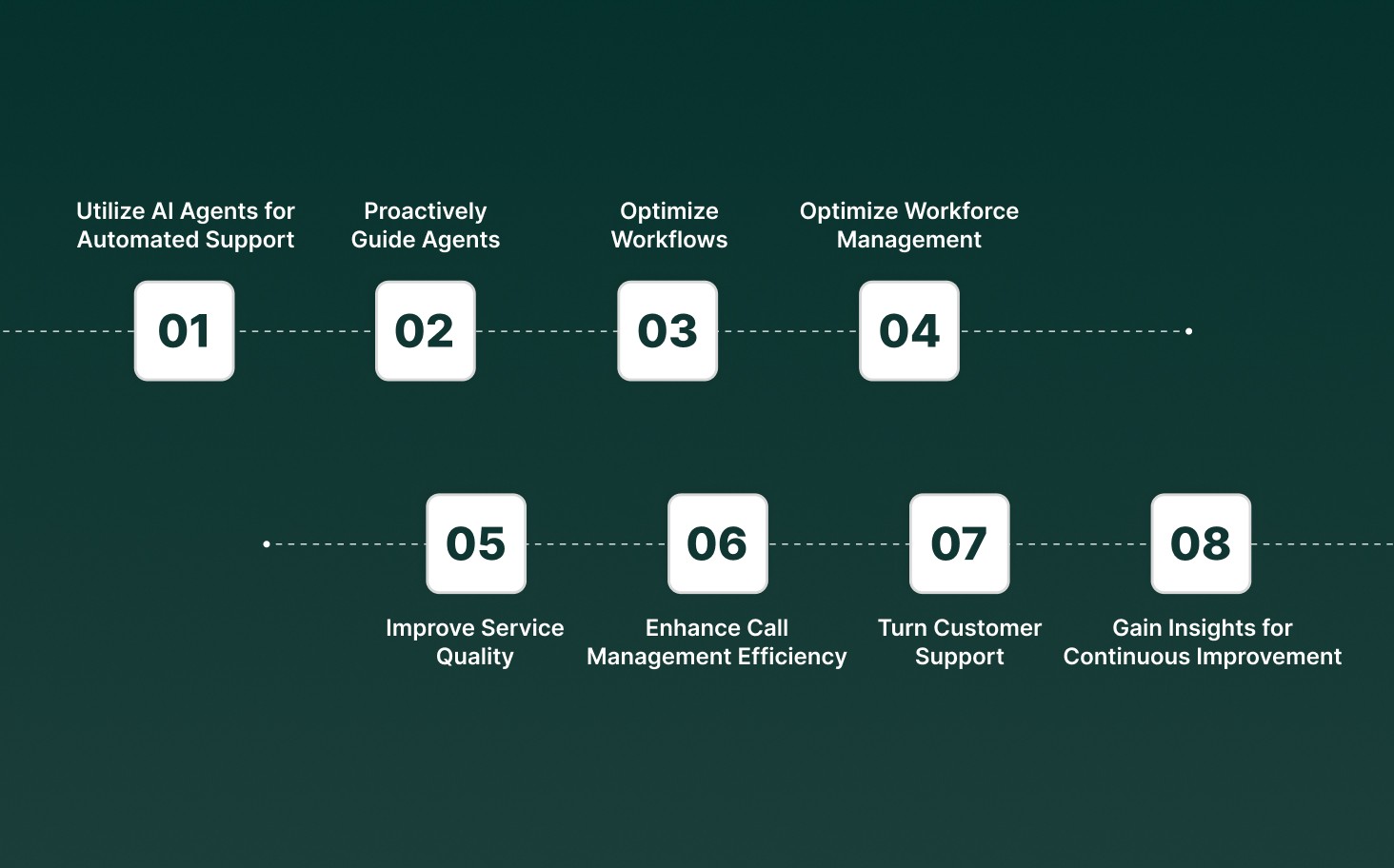
While AI in customer service has been around for a while, many companies are still finding its best use cases. Here’s how you can use customer service AI to drive efficiency and improve customer engagement:
1. Utilize AI Agents for Automated Support
AI agents, or advanced bots, are trained on real customer interactions, enabling them to handle complex questions with ease. These agents can resolve issues from start to finish, allowing your human agents to focus on more intricate problems.
2. Proactively Guide Agents with AI Assistance
AI-powered tools can assist human agents by suggesting relevant responses and guiding them through every customer interaction. For example, Smallest.ai's Conversational AI powers real-time voice agents for industries like e-commerce, healthcare, and logistics, with customizable voices and multilingual support, enhancing both agent efficiency and customer engagement.
3. Automate and Optimize Workflows
AI can streamline workflows, making it easier for agents to manage customer requests and increasing overall productivity.
Intelligent Routing: Automatically directs tickets to the most appropriate agent based on intent, language, or urgency.
AI Summaries: Quickly summarizes customer tickets, saving agents time on case history review.
Pre‑written Responses: AI can suggest automated responses to common queries.
4. Optimize Workforce Management with AI
AI helps by analyzing historical data and predicting staffing requirements based on seasons, time of day, or upcoming campaigns. It can also automate scheduling and personalize shift allocations, improving team efficiency and minimizing idle time.
5. Improve Service Quality Through AI-Powered QA
AI can enhance quality assurance (QA) by automatically reviewing conversations across agents and identifying key trends, performance gaps, or training needs. AI analyzes tone, language, and response accuracy, providing instant feedback to agents on their performance.
6. Enhance Call Management Efficiency
Handling phone interactions can be resource-intensive. AI in call centers can automate after-call summaries, reducing the wrap-up time for agents.
AI can also transcribe calls, helping agents with training and insights on past interactions.
7. Turn Customer Support into a Revenue-Generating Channel
AI doesn’t just improve efficiency; it can also drive sales. By integrating with your CRM and e-commerce platforms, AI can make personalized upsell and cross-sell recommendations during support interactions.
8. Gain Insights for Continuous Improvement
AI’s ability to analyze large volumes of customer data means it can identify patterns that might be missed by human agents. This analysis helps businesses pinpoint recurring issues and customer pain points.
Actionable insights from AI can guide your decision-making, whether it’s refining support processes, automating new tasks, or proactively addressing customer concerns.
Also Read: AI Tools In Customer Support: Top 10 Ways To Use Them
Before jumping into implementation, it’s important to consider key factors that will ensure a smooth and effective rollout.
What to Consider When Implementing AI-Powered Customer Service
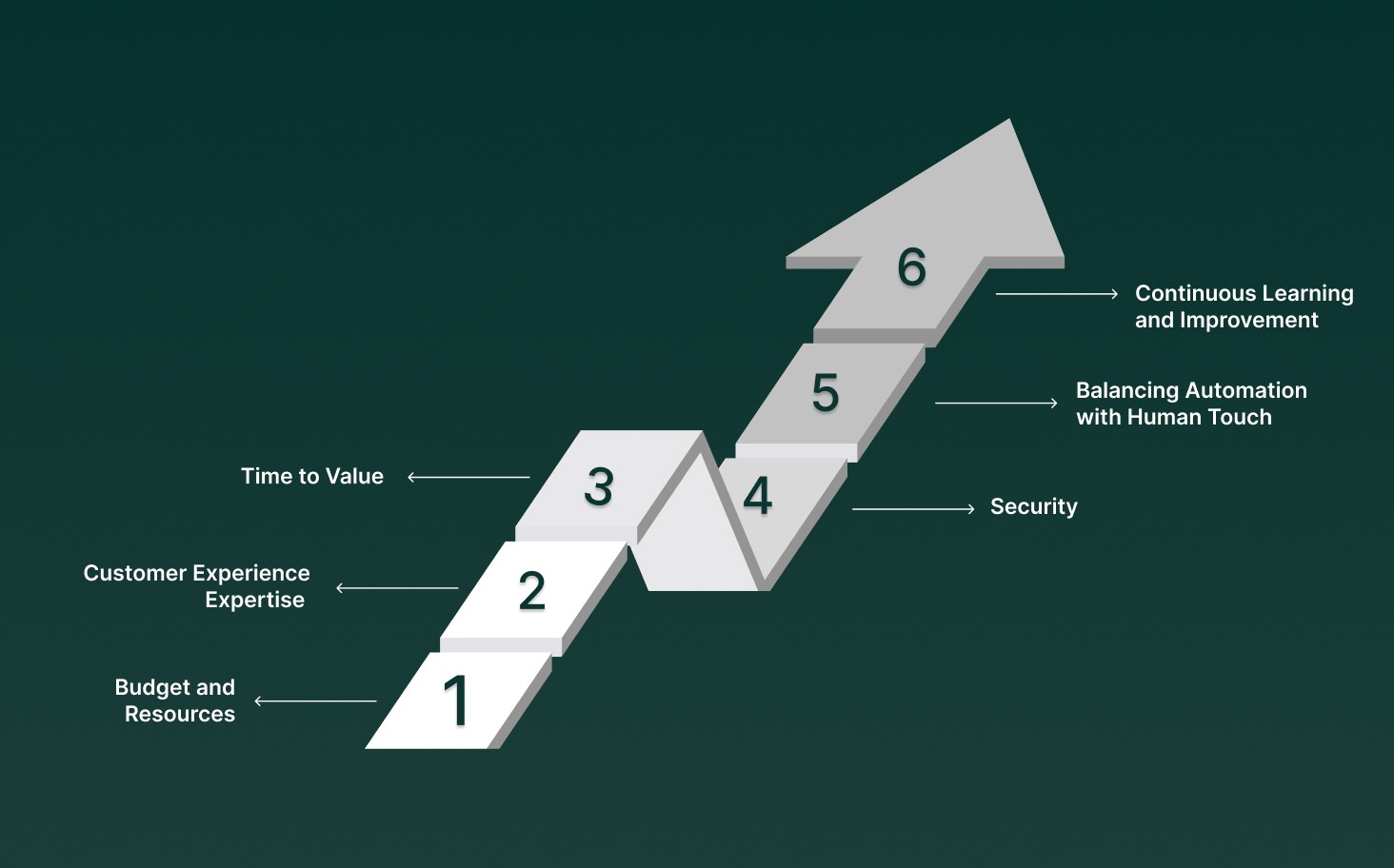
When implementing AI in customer service, it’s crucial to evaluate several key factors to ensure the solution fits your business needs.
1. Budget and Resources
Deploying AI for customer service can be costly, especially when manual training and technical expertise are required. However, there are AI platforms that enable businesses to deploy solutions with minimal IT resources and without large development budgets. This approach makes it easier for businesses to achieve high ROI without sacrificing quality.
2. Customer Experience Expertise
AI’s ability to understand customer needs accurately is one of its main advantages. Choose a solution that’s built on real-world customer service data. AI systems trained on extensive customer interactions can analyze sentiment, identify intent, and resolve support issues from the start.
3. Time to Value
Long lead times can delay the value your business gains from the technology. Choose AI systems that simplify planning, testing, and refinement. Efficient solutions can allow businesses to deploy and start benefiting from AI-powered customer service almost immediately.
4. Security
With the increased use of AI comes the need to protect sensitive customer data. Prioritize platforms that offer transparent privacy policies and comply with relevant standards to safeguard your data. Choose AI solutions that ensure advanced data protection to keep customer information secure. This is essential for building trust and ensuring customer data privacy.
5. Balancing Automation with Human Touch
AI should be used to handle routine tasks efficiently, while more complex or sensitive issues should be escalated to human agents. A smooth transition between AI and human agents is crucial for maintaining a positive customer experience.
6. Continuous Learning and Improvement
AI models should advance with real-world data and feedback. Ongoing monitoring and adjustments will help keep your AI system effective and relevant, ensuring consistent quality over time.
Considering these factors when implementing AI helps businesses create a seamless, efficient customer service experience that scales with customer expectations while maintaining data security and improving overall support quality.
See how Smallest.ai’s conversational AI powers real-time voice agents to automate support, deliver personalized experiences, and ensure seamless human handoffs, all while maintaining compliance and security.
Also Read: Engaging Text-to-Speech Bots for Better Customer Interaction
With the right considerations in place, here’s how you can effectively integrate AI into your customer service operations.
Effective Strategies for Implementing AI in Customer Service
Successfully integrating AI into customer service requires thoughtful planning and a focus on enhancing rather than replacing human support. Here’s how to approach the process:
1. Start with Clear Objectives
Before introducing AI, define the specific goals you want to achieve. Are you looking to reduce response times, scale support, or improve personalization? These goals will guide the implementation and help you measure success.
2. Maintain the Human Touch
AI excels at handling routine queries, but for complex or emotionally sensitive issues, human interaction is crucial. Use AI to automate repetitive tasks, while keeping human agents for high-stakes conversations where empathy and understanding matter.
3. Assess Your Business Needs
Analyze which aspects of your customer service operations could benefit most from AI. Look at your current workflows, customer pain points, and areas where agents face challenges. This assessment helps you focus on the tasks where AI can deliver real value.
4. Choose the Right AI Tools
Once you’ve identified your needs, research different AI tools to find the best fit for your business. Consider tools that offer features that enhance your customer interactions and support your operational goals
For example, Smallest.ai provides an advanced voice cloning tool that lets you clone your voice in just 10 seconds. Maintain brand consistency with a voice that mirrors your own or choose from a wide selection of lifelike voices to enhance your content creation, while ensuring your data remains secure with top-tier enterprise compliance.
5. Develop a Solid Plan
Set realistic timelines, define budget allocations, and determine resource needs. Think about the steps involved in integrating AI into your systems, including data migration, system configuration, and potential disruptions to your current operations.
6. Integrate AI with Existing Solutions
AI tools should seamlessly integrate with your current customer service software. This might require API integrations or syncing data across platforms. Conduct pilot tests to ensure a smooth integration and identify issues early.
7. Focus on Personalization
AI’s true power lies in its ability to personalize interactions. Use customer data to create meaningful, tailored experiences. Customers appreciate being recognized and receiving responses that are relevant to their needs, rather than generic replies.
8. Train Your Team
Ensure customer service representatives are equipped to work effectively with AI tools. Provide clear instructions for using the system and collaborate with AI to improve customer interactions.
9. Practice Ethical and Responsible AI Use
Ensure your AI solutions respect data privacy laws and uphold transparency. Avoid reinforcing biases or assumptions in AI models, as this can negatively impact both your customers and brand reputation. Regularly monitor interactions for errors or biases.
10. Design for Scalability and Flexibility
As your business grows, so should your AI systems. Ensure that the AI tools you implement are scalable and adaptable to changes in customer volume or changing service strategies. A system that’s flexible will be able to handle future demands without significant reengineering.
11. Measure and Optimize Performance
Regularly track AI’s performance using KPIs such as first contact resolution rates, customer satisfaction scores (CSAT), and escalation rates. Use these insights to continually refine and optimize your AI strategies, ensuring the best possible outcomes for customers and the business.
Following these strategies helps businesses ensure that AI enhances customer service experiences, boosts operational efficiency, and ultimately drives better engagement.
Also Read: Building Efficient AI Voice Bots with Smallest AI
Looking ahead, the future of customer service lies in the partnership between AI and human agents, driving smarter, more personalized interactions. Here’s a glance.
The Future of AI in Customer Service
The future of customer service lies in a collaborative partnership between AI and humans, working together to improve the customer experience. Here’s what we can expect:
Predictive AI for Proactive Service: With predictive AI, businesses can anticipate customer needs before they arise, offering tailored solutions and proactive service to prevent issues from escalating.
AI-Driven Self-Service Options: As AI becomes more intuitive, self-service portals will advance to offer customers even more advanced tools. These will allow customers to resolve issues independently, with the same accuracy and empathy a live agent would provide.
Integration with IoT for Real-Time Issue Resolution: AI will integrate with the Internet of Things (IoT) devices, enabling real-time problem-solving. For example, if a customer’s smart thermostat malfunctions, AI could automatically identify the issue and offer a solution without customer intervention.
By combining AI's speed and scalability with human empathy and judgment, customer service will become more personalized, efficient, and proactive than before.
Ready to enhance your customer service? Let’s look at how Smallest.ai can help simplify your processes and improve engagement.
Enhance Your Customer Service with Smallest.ai
If you're looking to enhance customer engagement and streamline your support operations, Smallest.ai's conversational AI and voice agents offer real-time solutions.
Multilingual Support: Connect with global customers in 16+ languages, expanding international reach.
Speech-to-Text for Sentiment & Speaker Diarization: Convert speech to text in real-time to analyze customer sentiment and emotions. Speaker diarization separates speakers, making it easier to track conversations and tailor responses for improved service.
Customization Options: Modify AI voice agents to match your brand’s tone, accent, and style for a truly personalized experience.
Enterprise Scalability: Smallest.ai’s platform supports small businesses and large enterprises alike, handling thousands of calls with ease.
Data Security: Fully compliant with SOC 2 Type II, HIPAA, and PCI standards, ensuring reliable data protection.
Professional Voice Cloning: Clone your voice in just 10 seconds for seamless voiceovers, podcasts, and more, with studio-grade precision.
Real-Time AI Agents: Boost customer service with highly responsive, emotion-aware voice agents.
Seamless Integration: Easily integrate with your current systems, whether it’s your CRM or help desk, for a smooth operational flow.
Smallest.ai enables you to handle thousands of customer interactions daily using real-time voice agents, without sacrificing personalization or compliance.
Wrapping up!
AI in customer service is a powerful tool that can change how businesses interact with their customers today. By automating routine tasks, personalizing experiences, and enabling faster responses, AI transforms customer service into a more efficient, scalable, and engaging operation.
Smallest.ai's voice agents are designed to seamlessly integrate with your systems, enhance the overall customer experience, and maintain the human touch in complex interactions.
Ready to enhance your customer service with AI-driven voice solutions? Talk to our experts and learn how our voice agents can simplify your operations, improve engagement, and scale your support.
How do I use AI to automate customer service?
What is the 30% rule in AI?
What is an example of AI in customer service?
What is the 10-20-70 rule for AI?