Which AI Tools Offer Multilingual Support for Enterprise Voice Operations?

Which AI tools offer multilingual support for enterprise voice operations? Compare real-time voice AI platforms built for scale, latency, and compliance.

Wasim Madha
Updated on
January 20, 2026 at 2:27 PM
Expanding into new regions sounds exciting until the first customer call stalls because of a language gap. Support queues grow, resolution slows, and teams scramble to bridge conversations that should have felt natural. That moment is usually what triggers the search for which AI tools offer multilingual support, especially for voice-heavy, high-volume operations.
For enterprise leaders, this search is not academic. It is driven by scale, cost pressure, and customer expectations that do not change by geography. The global multilingual AI market is projected to reach USD 15.0 billion by 2035, reflecting how central language-capable AI has become to contact centers and voice automation strategies. As demand grows, the question of which AI tools offer multilingual support shifts from feature comparison to operational fit.
In this guide, we break down what multilingual support really means for enterprise AI, how different tools approach it, and how to evaluate options that work reliably at scale.
Key Takeaways
Multilingual support is an execution problem, not a translation feature: Enterprise-grade multilingual AI must run full voice workflows in real time, not convert text after the fact.
Voice introduces constraints that most multilingual tools fail to handle: Latency, turn-taking, accents, interruptions, and numeracy make live voice far harder than chat or email.
Generic translation layers break in production voice environments: Common failures include delayed responses, lost context, incorrect numbers, and risky human fallbacks.
Multilingual AI tools differ fundamentally in architecture and intent: some translate conversations for humans, while others run conversations end-to-end as voice-native systems.
The right choice depends on whether AI is expected to assist or operate: Enterprises should evaluate tools based on live voice performance, deployment control, and compliance readiness, not language count alone.
What “Multilingual Support” Means in Enterprise AI Systems
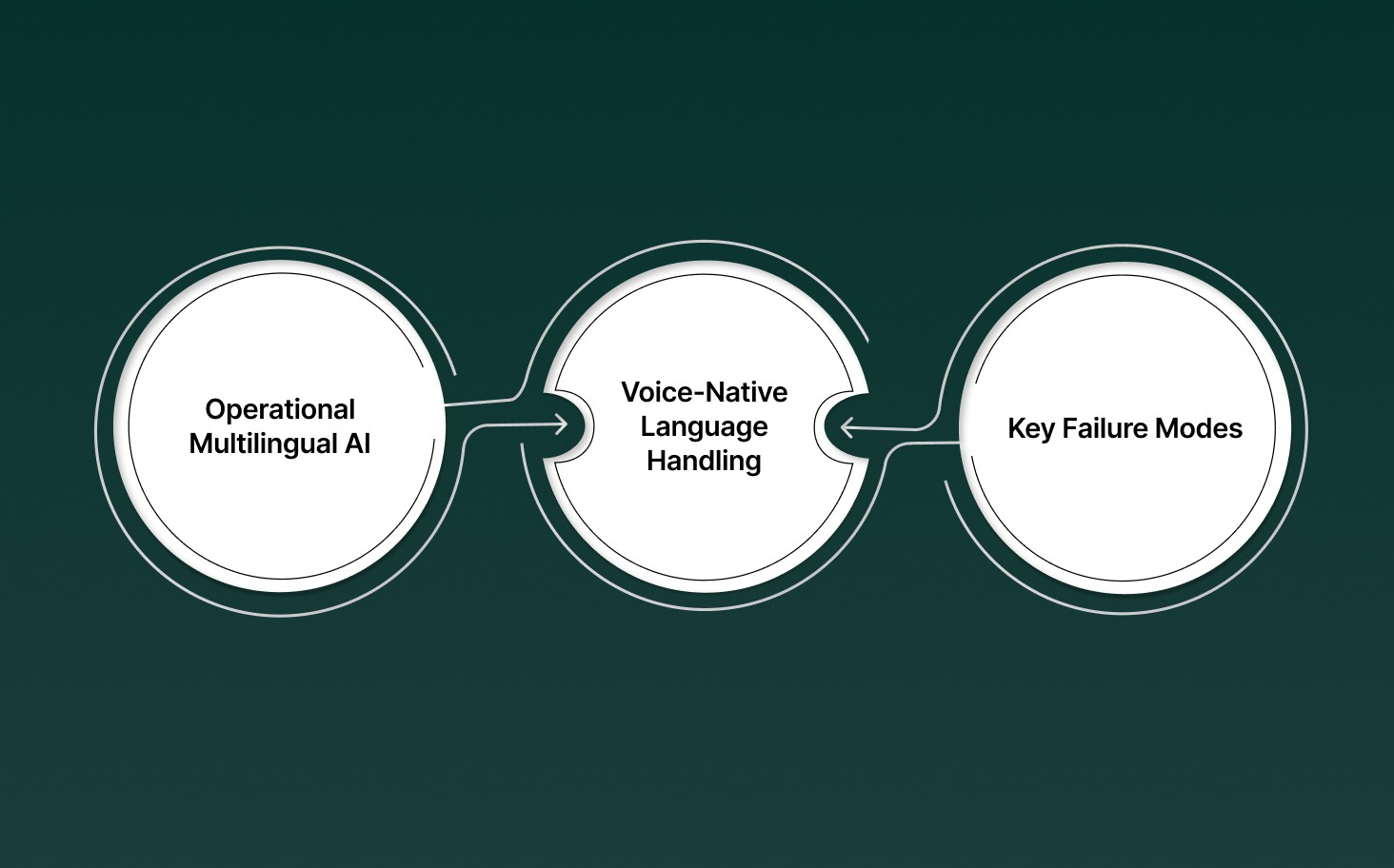
Multilingual support in enterprise AI does not mean converting words from one language to another. It refers to an AI system’s ability to operate end-to-end business workflows across languages, channels, and regions without breaking accuracy, latency, or compliance.
For enterprises running voice-heavy operations such as contact centers, collections, healthcare outreach, or sales calling, multilingual capability must function under real production constraints.
1. Difference Between Basic Translation and Operational Multilingual AI
Basic translation tools focus on text conversion. They translate sentences in isolation, often after the interaction has already occurred. This approach works for documents or asynchronous chat, but it fails in operational settings.
Operational multilingual AI is different.
It must:
Detect the spoken language instantly, without user input.
Preserve intent, tone, and context across multi-turn conversations.
Handle numbers, dates, identifiers, and regulated information correctly.
Maintain conversation state even when languages switch mid-call.
Execute actions, not only generate responses.
In short, translation outputs text. Operational multilingual AI runs the conversation.
2. Why Enterprise Workloads Demand Real-Time, Voice-Native Language Handling
Enterprise voice workflows operate under constraints that text systems never face.
Voice interactions are:
Time-sensitive, with strict latency limits.
Sequential, where pauses and interruptions matter.
Numerically dense, involving account numbers, payments, dates, and amounts.
Emotionally loaded, especially in support, healthcare, and collections.
A delay of even a few hundred milliseconds changes how a caller perceives the interaction. Flat or robotic speech breaks trust. Mispronounced names or poorly paced numbers introduce risk.
This is why enterprises require voice-native multilingual systems that process speech as speech, not as text routed through multiple layers.
Real-time speech recognition, real-time reasoning, and real-time speech generation must work together as a single pipeline.
3. Key Failure Modes of Generic Multilingual Tools in Live Conversations
Most tools that claim multilingual support are built for text or post-call analysis. When placed into live voice environments, predictable failures appear.
Common breakdowns include:
High latency caused by chained translation and synthesis steps.
Incorrect handling of numbers, acronyms, and identifiers.
Loss of context across turns, leading to irrelevant responses.
Inability to manage interruptions or overlapping speech.
Forced handoffs to humans without preserving language context.
These failures increase call duration, raise human fallback rates, and introduce compliance exposure.
Enterprise multilingual AI systems must be designed for live execution, not retroactive translation. Voice quality, timing, and correctness become operational requirements, not cosmetic features.
This distinction defines whether multilingual AI remains a demo capability or becomes production infrastructure.
Explore how enterprise teams deliver consistent, multilingual support across voice and chat by reading Multilingual Customer Support: Definition, Tips and Strategies
Which AI Tools Offer Multilingual Support Today?
Enterprises evaluating multilingual AI face a wide range of approaches, from voice-native systems built for live execution to translation layers added onto existing agent workflows. The differences lie in latency, control, deployment flexibility, and the extent to which multilingual capability is embedded in core operations. Understanding these distinctions is critical for selecting tools that work reliably at scale.
At a Glance:
Platform | Multilingual Approach | Voice Capability | Deployment Model | Pricing Transparency | Best Fit |
Voice-native, real-time execution | Real-time speech-to-speech across 16+ languages | Cloud, VPC, On-prem | High (public tiers) | Enterprises needing low-latency, compliant, multilingual voice infrastructure | |
Cresta | Live translation layered into agent assist | Translation during human-led calls | Cloud | Low (sales-led) | Contact centers augmenting human agents with live translation |
Observe AI | Governed AI agents with multilingual support | Voice + chat agents with policy controls | Cloud | Low (module-based) | Regulated enterprises prioritizing QA, compliance, and oversight |
Decagon | Omnichannel AI agents across languages | Voice + digital channels | Cloud | Low (custom) | Digital-first enterprises focused on deflection and automation |
Sierra | Brand-aligned multilingual AI agents | Real-time voice and chat | Cloud | Low (outcome-based) | Large consumer brands delivering empathetic CX at scale |
1. Smallest.ai
Smallest.ai provides enterprise-ready, real-time voice AI agents built for high-volume, multilingual contact center operations. The platform focuses on voice-native execution, low-latency performance, and deployment flexibility for regulated, global environments.
Real-Time Multilingual Voice Processing: Handles live conversations across 16+ languages with native pacing, accent handling, and natural turn-taking for production voice workflows.
Voice-Native AI Agents: Agents reason, respond, and act directly on speech, avoiding text-only translation chains that introduce delay and context loss.
High-Concurrency Call Handling: Supports thousands of parallel inbound and outbound calls daily without degradation in latency or speech quality.
Flawless Numeracy and Identifier Handling: Accurately speaks and understands card numbers, phone numbers, dates, and amounts with correct cadence and pronunciation.
On-Premise and Private Deployment: Runs on customer-owned infrastructure, allowing full control over inference, data residency, and compliance requirements.
Enterprise Integrations and SDKs: Python, Node.js, and REST APIs allow tight integration with telephony systems, CRMs, analytics stacks, and internal workflows.
Best for: Large enterprises and contact centers that require real-time, multilingual voice AI with strict latency, compliance, and deployment control.
Smallest.ai Pricing Highlights
Free plan for evaluation and prototyping
Personal ($49/month) for individual developers and early teams
Business ($1,999/month) for production voice AI workloads
Enterprise (Custom) for regulated, high-volume, or on-prem deployments
Talk to a voice expert to see how Smallest.ai runs multilingual voice agents at enterprise scale.
2. Cresta
Cresta delivers real-time translation as part of its Agent Assist and Agent Operations Center, helping enterprise contact centers support multilingual conversations by translating live speech during agent–customer interactions.
Real-Time Speech Translation: Automatically detects spoken language and translates conversations live, allowing agents and customers to communicate across languages during active calls.
Agent Assist–Embedded Workflow: Translation is embedded directly into Agent Assist, reducing the need for agents to switch tools or manage separate translation systems mid-call.
Speech-to-Text and Translation Pipeline: Captures spoken dialogue, converts it to text, and translates it in real time to maintain conversational continuity across languages.
Workforce Flexibility Across Regions: Allows contact centers to staff agents without strict language-based team separation, expanding coverage without rebuilding org structures.
Best for: Large contact centers that rely on human agents and want real-time language translation integrated into existing agent-assist workflows.
Cresta Pricing Highlights
Custom enterprise pricing based on the number of agent seats and features such as real-time translation, Agent Assist, and conversation intelligence.
Pricing is typically structured per agent per month with additional costs for advanced modules and integrations.
Enterprise engagements often involve annual commitments and implementation fees.
No publicly published per-seat or tiered pricing; buyers must contact sales for a customized quote.
3. Observe AI
Observe AI provides voice-first and chat AI agents designed to automate and augment customer experience workflows with strong governance, auditability, and execution controls. The platform emphasizes predictable behavior, compliance, and quality assurance across regulated enterprise environments.
VoiceAI and ChatAI Agents: Supports automated customer interactions across voice and digital channels, handling routine requests end-to-end or routing conversations intelligently.
Real-World Speech Handling: Built to manage overtalk, interruptions, background noise, and messy multi-turn conversations for accurate comprehension in live calls.
Deterministic Execution and Policy Controls: Uses policy gates, authentication checks, and process controls to enforce disclosures, approvals, and compliance-critical steps during conversations.
Continuous Evaluation and QA: Automatically evaluates 100% of AI and human interactions using LLM-based checks, human review, and structured QA scoring.
Best for: Enterprises in regulated industries such as healthcare, insurance, and financial services that need voice and chat AI agents with strong compliance, governance, and quality oversight.
Observe AI Pricing Highlights
Sales-led, module-based pricing requires buyers to contact sales.
Bundles include VoiceAI Agents, Real-Time AI (agent assist), and Post-Interaction AI (Auto QA and analytics).
Advanced enterprise tiers such as Enterprise Advanced and Enterprise Unlimited unlock features like call summarization and knowledge AI.
No published starting prices or self-serve tiers; pricing is negotiated based on agent count, features, and scale.
4. Decagon
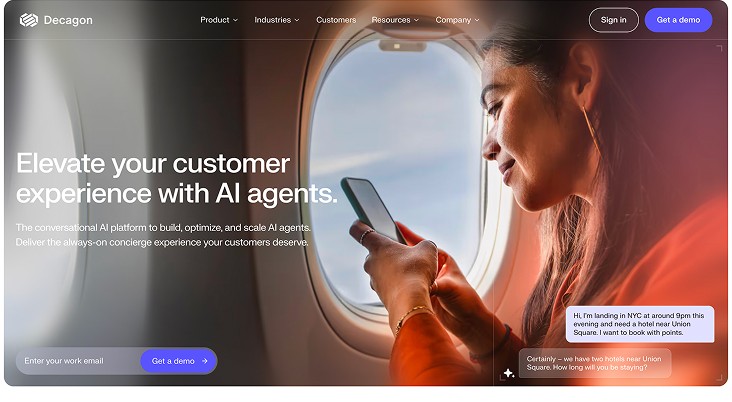
Decagon is a conversational AI platform designed to build, operate, and scale AI agents across voice and digital channels. It focuses on omnichannel resolution, operational control, and quick iteration for customer experience teams managing high interaction volumes across regions and languages.
Omnichannel AI Agents: Supports chat, email, voice, SMS, and custom API surfaces through a single centralized AI engine, allowing consistent behavior across channels.
Multilingual Resolution at Scale: AI agents operate across languages to resolve customer issues end-to-end, supporting global customer bases without channel or language fragmentation.
Agent Operating Procedures (AOPs): Uses natural language instructions that compile into executable logic, allowing CX teams to encode complex SOPs while maintaining predictable execution.
Cross-Channel Memory and Context: Maintains conversation context across channels and interactions, guaranteeing continuity when customers switch channels or return with follow-up questions.
Best for: Digital-first enterprises that need omnichannel, multilingual AI agents to deflect volume, improve resolution rates, and deliver concierge-style customer experiences.
Decagon Pricing Highlights
Custom enterprise pricing with no publicly disclosed tiers or list rates.
Pricing may be based on per-conversation or per-resolution models (e.g., flat rate per interaction or higher rate for successful issue resolution).
Costs typically include core AI agent access, omnichannel support, and enterprise integrations.
Buyers need to contact sales for quotes and volume-based terms (no official published pricing found).
5. Sierra AI
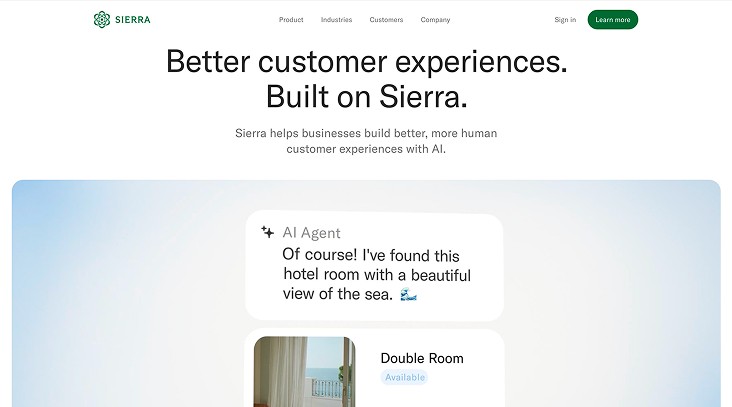
Sierra is an enterprise AI platform focused on building always-available, brand-aligned AI agents that support customers across voice and digital channels. The platform emphasizes empathetic conversations, real-time problem solving, and consistent execution across languages and channels.
Omnichannel AI Agent Platform: Deploys a single AI agent that operates across chat, voice, and digital channels, allowing enterprises to build once and run everywhere.
Multilingual Customer Support: Supports customer interactions in multiple languages, allowing global brands to deliver consistent service experiences regardless of geography.
Voice-Enabled AI Conversations: Provides real-time voice capabilities that allow AI agents to reason, respond, and take action during live phone calls.
Brand and Policy Grounding: Agents are grounded in company identity, tone, policies, and internal knowledge to maintain brand consistency across customer interactions.
Best for: Large consumer brands that need multilingual, omnichannel AI agents to deliver consistent, empathetic customer experiences at high volume.
Sierra AI Pricing Highlights
Outcome-based pricing structure with no published standard tiers or rates.
Likely involves custom enterprise contracts due to a focus on large consumer brands and deep integrations.
Pricing is not publicly available; enterprise buyers must engage with sales for customized quotes.
Positioning suggests pricing scales with usage, agents, or successful outcomes rather than fixed self-serve tiers.
Multilingual support varies widely across platforms, from real-time voice execution to assistive translation for human agents. Enterprises should prioritize systems that match their operational reality, compliance needs, and channel mix. The right choice depends on whether multilingual AI is expected to translate conversations or run them end-to-end.
See how voice and chat agents handle real multilingual workflows across systems and regions by reading How Multilingual Chatbots Drive Global Customer Connections
Key Use Cases of Multilingual AI for Contact Centers and Voice Agents
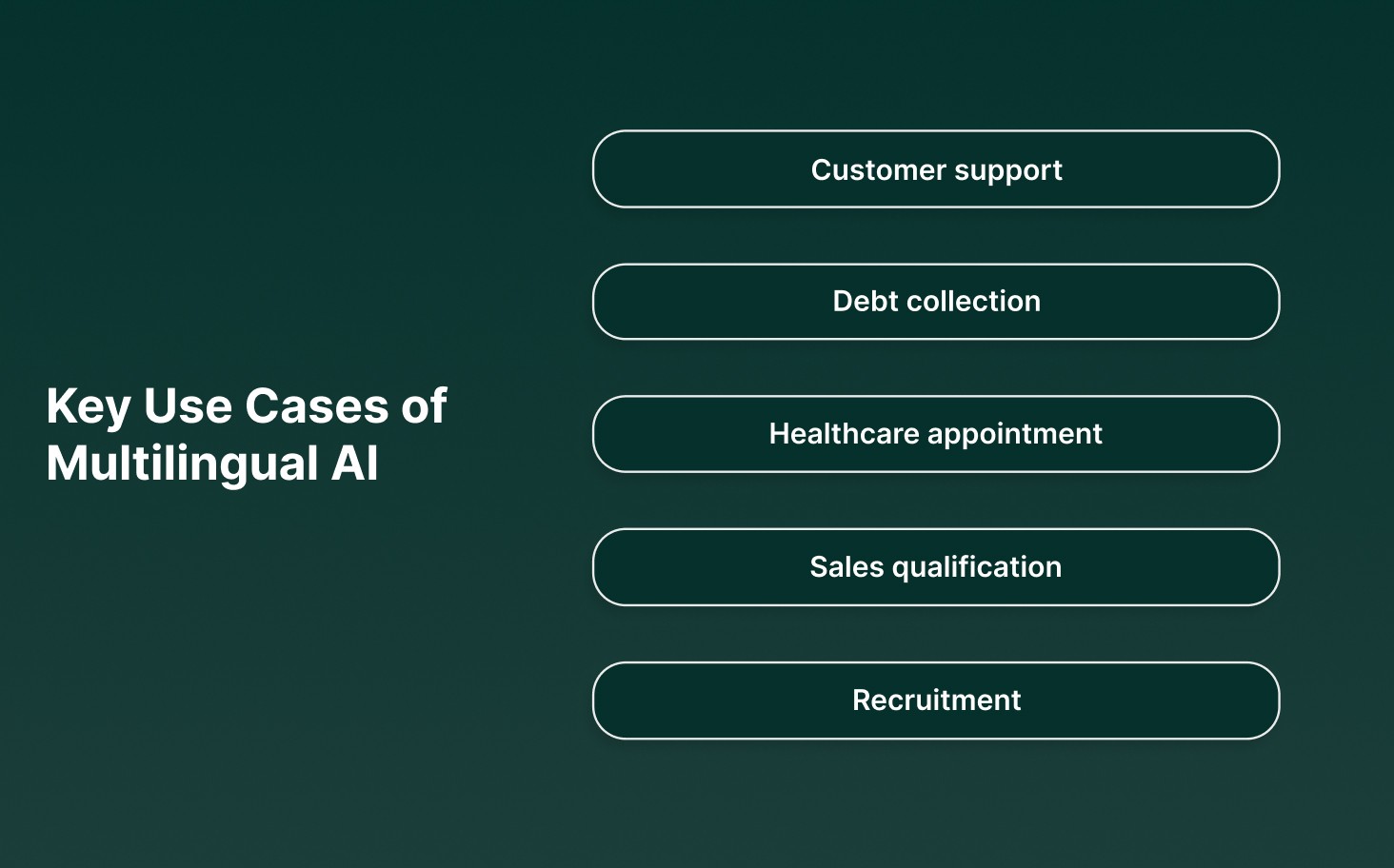
Multilingual voice AI is most effective in repeatable, high-volume interactions where language barriers slow resolution or increase cost.
Customer support and service hotlines: Handle inbound queries across regions without building separate language teams, improving resolution speed and consistency.
Debt collection and payment reminders: Reach customers in their preferred language while delivering accurate amounts, dates, and required disclosures.
Healthcare appointment and follow-ups: Confirm appointments, send reminders, and complete follow-ups clearly across languages, reducing no-shows.
Sales qualification and outbound calling: Qualify leads and route high-intent prospects globally without expanding regional sales teams.
Recruitment and interview screening: Run initial screenings and scheduling in multiple languages to accelerate hiring pipelines.
Multilingual voice AI delivers the most impact where scale, speed, and consistency are critical. It allows global operations without adding language-specific overhead.
Final Thoughts!
Multilingual AI decisions tend to fail when framed as language-coverage problems rather than execution problems. The real question is whether AI tools that offer multilingual support can operate under live voice conditions, regulatory pressure, and global scale without compromising experience or control. That distinction is what separates experimentation from infrastructure.
As enterprises narrow down which AI tools offer multilingual support, the evaluation increasingly comes down to voice latency, deployment flexibility, and how deeply multilingual capability is built into the system rather than added on. Tools that translate conversations are useful. Tools that run conversations define outcomes.
If you are assessing multilingual voice AI for real production workloads, Smallest.ai is built for that reality.
Talk to a voice expert to see how Smallest.ai runs multilingual voice agents at enterprise scale.
FAQs
1. Do multilingual AI tools handle language switching within the same voice call?
Most tools struggle when callers switch languages mid-conversation. Only voice-native systems maintain context, intent, and state without restarting or escalating the call.
2. Are multilingual AI tools equally reliable for voice and text channels?
No. Many platforms perform well in chat or email but introduce latency and errors in live calls. Voice requires real-time speech recognition, reasoning, and speech generation working together.
3. How do multilingual AI tools handle numbers, dates, and sensitive identifiers?
Generic translation systems often misread or rephrase numerically dense data. Enterprise-grade tools use deterministic handling to preserve cadence and accuracy for regulated information.
4. Does multilingual support increase compliance risk in contact centers?
Yes, if implemented incorrectly. Language processing can expose sensitive data through logging or third-party translation layers unless controls are enforced uniformly across languages.
5. Can multilingual AI tools be deployed on-premise for data residency needs?
Most cannot. Only a subset of platforms supports on-prem or private deployments, which is critical for enterprises with strict data, latency, or regulatory requirements.
Expanding into new regions sounds exciting until the first customer call stalls because of a language gap. Support queues grow, resolution slows, and teams scramble to bridge conversations that should have felt natural. That moment is usually what triggers the search for which AI tools offer multilingual support, especially for voice-heavy, high-volume operations.
For enterprise leaders, this search is not academic. It is driven by scale, cost pressure, and customer expectations that do not change by geography. The global multilingual AI market is projected to reach USD 15.0 billion by 2035, reflecting how central language-capable AI has become to contact centers and voice automation strategies. As demand grows, the question of which AI tools offer multilingual support shifts from feature comparison to operational fit.
In this guide, we break down what multilingual support really means for enterprise AI, how different tools approach it, and how to evaluate options that work reliably at scale.
Key Takeaways
Multilingual support is an execution problem, not a translation feature: Enterprise-grade multilingual AI must run full voice workflows in real time, not convert text after the fact.
Voice introduces constraints that most multilingual tools fail to handle: Latency, turn-taking, accents, interruptions, and numeracy make live voice far harder than chat or email.
Generic translation layers break in production voice environments: Common failures include delayed responses, lost context, incorrect numbers, and risky human fallbacks.
Multilingual AI tools differ fundamentally in architecture and intent: some translate conversations for humans, while others run conversations end-to-end as voice-native systems.
The right choice depends on whether AI is expected to assist or operate: Enterprises should evaluate tools based on live voice performance, deployment control, and compliance readiness, not language count alone.
What “Multilingual Support” Means in Enterprise AI Systems

Multilingual support in enterprise AI does not mean converting words from one language to another. It refers to an AI system’s ability to operate end-to-end business workflows across languages, channels, and regions without breaking accuracy, latency, or compliance.
For enterprises running voice-heavy operations such as contact centers, collections, healthcare outreach, or sales calling, multilingual capability must function under real production constraints.
1. Difference Between Basic Translation and Operational Multilingual AI
Basic translation tools focus on text conversion. They translate sentences in isolation, often after the interaction has already occurred. This approach works for documents or asynchronous chat, but it fails in operational settings.
Operational multilingual AI is different.
It must:
Detect the spoken language instantly, without user input.
Preserve intent, tone, and context across multi-turn conversations.
Handle numbers, dates, identifiers, and regulated information correctly.
Maintain conversation state even when languages switch mid-call.
Execute actions, not only generate responses.
In short, translation outputs text. Operational multilingual AI runs the conversation.
2. Why Enterprise Workloads Demand Real-Time, Voice-Native Language Handling
Enterprise voice workflows operate under constraints that text systems never face.
Voice interactions are:
Time-sensitive, with strict latency limits.
Sequential, where pauses and interruptions matter.
Numerically dense, involving account numbers, payments, dates, and amounts.
Emotionally loaded, especially in support, healthcare, and collections.
A delay of even a few hundred milliseconds changes how a caller perceives the interaction. Flat or robotic speech breaks trust. Mispronounced names or poorly paced numbers introduce risk.
This is why enterprises require voice-native multilingual systems that process speech as speech, not as text routed through multiple layers.
Real-time speech recognition, real-time reasoning, and real-time speech generation must work together as a single pipeline.
3. Key Failure Modes of Generic Multilingual Tools in Live Conversations
Most tools that claim multilingual support are built for text or post-call analysis. When placed into live voice environments, predictable failures appear.
Common breakdowns include:
High latency caused by chained translation and synthesis steps.
Incorrect handling of numbers, acronyms, and identifiers.
Loss of context across turns, leading to irrelevant responses.
Inability to manage interruptions or overlapping speech.
Forced handoffs to humans without preserving language context.
These failures increase call duration, raise human fallback rates, and introduce compliance exposure.
Enterprise multilingual AI systems must be designed for live execution, not retroactive translation. Voice quality, timing, and correctness become operational requirements, not cosmetic features.
This distinction defines whether multilingual AI remains a demo capability or becomes production infrastructure.
Explore how enterprise teams deliver consistent, multilingual support across voice and chat by reading Multilingual Customer Support: Definition, Tips and Strategies
Which AI Tools Offer Multilingual Support Today?
Enterprises evaluating multilingual AI face a wide range of approaches, from voice-native systems built for live execution to translation layers added onto existing agent workflows. The differences lie in latency, control, deployment flexibility, and the extent to which multilingual capability is embedded in core operations. Understanding these distinctions is critical for selecting tools that work reliably at scale.
At a Glance:
Platform | Multilingual Approach | Voice Capability | Deployment Model | Pricing Transparency | Best Fit |
Voice-native, real-time execution | Real-time speech-to-speech across 16+ languages | Cloud, VPC, On-prem | High (public tiers) | Enterprises needing low-latency, compliant, multilingual voice infrastructure | |
Cresta | Live translation layered into agent assist | Translation during human-led calls | Cloud | Low (sales-led) | Contact centers augmenting human agents with live translation |
Observe AI | Governed AI agents with multilingual support | Voice + chat agents with policy controls | Cloud | Low (module-based) | Regulated enterprises prioritizing QA, compliance, and oversight |
Decagon | Omnichannel AI agents across languages | Voice + digital channels | Cloud | Low (custom) | Digital-first enterprises focused on deflection and automation |
Sierra | Brand-aligned multilingual AI agents | Real-time voice and chat | Cloud | Low (outcome-based) | Large consumer brands delivering empathetic CX at scale |
1. Smallest.ai

Smallest.ai provides enterprise-ready, real-time voice AI agents built for high-volume, multilingual contact center operations. The platform focuses on voice-native execution, low-latency performance, and deployment flexibility for regulated, global environments.
Real-Time Multilingual Voice Processing: Handles live conversations across 16+ languages with native pacing, accent handling, and natural turn-taking for production voice workflows.
Voice-Native AI Agents: Agents reason, respond, and act directly on speech, avoiding text-only translation chains that introduce delay and context loss.
High-Concurrency Call Handling: Supports thousands of parallel inbound and outbound calls daily without degradation in latency or speech quality.
Flawless Numeracy and Identifier Handling: Accurately speaks and understands card numbers, phone numbers, dates, and amounts with correct cadence and pronunciation.
On-Premise and Private Deployment: Runs on customer-owned infrastructure, allowing full control over inference, data residency, and compliance requirements.
Enterprise Integrations and SDKs: Python, Node.js, and REST APIs allow tight integration with telephony systems, CRMs, analytics stacks, and internal workflows.
Best for: Large enterprises and contact centers that require real-time, multilingual voice AI with strict latency, compliance, and deployment control.
Smallest.ai Pricing Highlights
Free plan for evaluation and prototyping
Personal ($49/month) for individual developers and early teams
Business ($1,999/month) for production voice AI workloads
Enterprise (Custom) for regulated, high-volume, or on-prem deployments
Talk to a voice expert to see how Smallest.ai runs multilingual voice agents at enterprise scale.
2. Cresta

Cresta delivers real-time translation as part of its Agent Assist and Agent Operations Center, helping enterprise contact centers support multilingual conversations by translating live speech during agent–customer interactions.
Real-Time Speech Translation: Automatically detects spoken language and translates conversations live, allowing agents and customers to communicate across languages during active calls.
Agent Assist–Embedded Workflow: Translation is embedded directly into Agent Assist, reducing the need for agents to switch tools or manage separate translation systems mid-call.
Speech-to-Text and Translation Pipeline: Captures spoken dialogue, converts it to text, and translates it in real time to maintain conversational continuity across languages.
Workforce Flexibility Across Regions: Allows contact centers to staff agents without strict language-based team separation, expanding coverage without rebuilding org structures.
Best for: Large contact centers that rely on human agents and want real-time language translation integrated into existing agent-assist workflows.
Cresta Pricing Highlights
Custom enterprise pricing based on the number of agent seats and features such as real-time translation, Agent Assist, and conversation intelligence.
Pricing is typically structured per agent per month with additional costs for advanced modules and integrations.
Enterprise engagements often involve annual commitments and implementation fees.
No publicly published per-seat or tiered pricing; buyers must contact sales for a customized quote.
3. Observe AI

Observe AI provides voice-first and chat AI agents designed to automate and augment customer experience workflows with strong governance, auditability, and execution controls. The platform emphasizes predictable behavior, compliance, and quality assurance across regulated enterprise environments.
VoiceAI and ChatAI Agents: Supports automated customer interactions across voice and digital channels, handling routine requests end-to-end or routing conversations intelligently.
Real-World Speech Handling: Built to manage overtalk, interruptions, background noise, and messy multi-turn conversations for accurate comprehension in live calls.
Deterministic Execution and Policy Controls: Uses policy gates, authentication checks, and process controls to enforce disclosures, approvals, and compliance-critical steps during conversations.
Continuous Evaluation and QA: Automatically evaluates 100% of AI and human interactions using LLM-based checks, human review, and structured QA scoring.
Best for: Enterprises in regulated industries such as healthcare, insurance, and financial services that need voice and chat AI agents with strong compliance, governance, and quality oversight.
Observe AI Pricing Highlights
Sales-led, module-based pricing requires buyers to contact sales.
Bundles include VoiceAI Agents, Real-Time AI (agent assist), and Post-Interaction AI (Auto QA and analytics).
Advanced enterprise tiers such as Enterprise Advanced and Enterprise Unlimited unlock features like call summarization and knowledge AI.
No published starting prices or self-serve tiers; pricing is negotiated based on agent count, features, and scale.
4. Decagon

Decagon is a conversational AI platform designed to build, operate, and scale AI agents across voice and digital channels. It focuses on omnichannel resolution, operational control, and quick iteration for customer experience teams managing high interaction volumes across regions and languages.
Omnichannel AI Agents: Supports chat, email, voice, SMS, and custom API surfaces through a single centralized AI engine, allowing consistent behavior across channels.
Multilingual Resolution at Scale: AI agents operate across languages to resolve customer issues end-to-end, supporting global customer bases without channel or language fragmentation.
Agent Operating Procedures (AOPs): Uses natural language instructions that compile into executable logic, allowing CX teams to encode complex SOPs while maintaining predictable execution.
Cross-Channel Memory and Context: Maintains conversation context across channels and interactions, guaranteeing continuity when customers switch channels or return with follow-up questions.
Best for: Digital-first enterprises that need omnichannel, multilingual AI agents to deflect volume, improve resolution rates, and deliver concierge-style customer experiences.
Decagon Pricing Highlights
Custom enterprise pricing with no publicly disclosed tiers or list rates.
Pricing may be based on per-conversation or per-resolution models (e.g., flat rate per interaction or higher rate for successful issue resolution).
Costs typically include core AI agent access, omnichannel support, and enterprise integrations.
Buyers need to contact sales for quotes and volume-based terms (no official published pricing found).
5. Sierra AI

Sierra is an enterprise AI platform focused on building always-available, brand-aligned AI agents that support customers across voice and digital channels. The platform emphasizes empathetic conversations, real-time problem solving, and consistent execution across languages and channels.
Omnichannel AI Agent Platform: Deploys a single AI agent that operates across chat, voice, and digital channels, allowing enterprises to build once and run everywhere.
Multilingual Customer Support: Supports customer interactions in multiple languages, allowing global brands to deliver consistent service experiences regardless of geography.
Voice-Enabled AI Conversations: Provides real-time voice capabilities that allow AI agents to reason, respond, and take action during live phone calls.
Brand and Policy Grounding: Agents are grounded in company identity, tone, policies, and internal knowledge to maintain brand consistency across customer interactions.
Best for: Large consumer brands that need multilingual, omnichannel AI agents to deliver consistent, empathetic customer experiences at high volume.
Sierra AI Pricing Highlights
Outcome-based pricing structure with no published standard tiers or rates.
Likely involves custom enterprise contracts due to a focus on large consumer brands and deep integrations.
Pricing is not publicly available; enterprise buyers must engage with sales for customized quotes.
Positioning suggests pricing scales with usage, agents, or successful outcomes rather than fixed self-serve tiers.
Multilingual support varies widely across platforms, from real-time voice execution to assistive translation for human agents. Enterprises should prioritize systems that match their operational reality, compliance needs, and channel mix. The right choice depends on whether multilingual AI is expected to translate conversations or run them end-to-end.
See how voice and chat agents handle real multilingual workflows across systems and regions by reading How Multilingual Chatbots Drive Global Customer Connections
Key Use Cases of Multilingual AI for Contact Centers and Voice Agents

Multilingual voice AI is most effective in repeatable, high-volume interactions where language barriers slow resolution or increase cost.
Customer support and service hotlines: Handle inbound queries across regions without building separate language teams, improving resolution speed and consistency.
Debt collection and payment reminders: Reach customers in their preferred language while delivering accurate amounts, dates, and required disclosures.
Healthcare appointment and follow-ups: Confirm appointments, send reminders, and complete follow-ups clearly across languages, reducing no-shows.
Sales qualification and outbound calling: Qualify leads and route high-intent prospects globally without expanding regional sales teams.
Recruitment and interview screening: Run initial screenings and scheduling in multiple languages to accelerate hiring pipelines.
Multilingual voice AI delivers the most impact where scale, speed, and consistency are critical. It allows global operations without adding language-specific overhead.
Final Thoughts!
Multilingual AI decisions tend to fail when framed as language-coverage problems rather than execution problems. The real question is whether AI tools that offer multilingual support can operate under live voice conditions, regulatory pressure, and global scale without compromising experience or control. That distinction is what separates experimentation from infrastructure.
As enterprises narrow down which AI tools offer multilingual support, the evaluation increasingly comes down to voice latency, deployment flexibility, and how deeply multilingual capability is built into the system rather than added on. Tools that translate conversations are useful. Tools that run conversations define outcomes.
If you are assessing multilingual voice AI for real production workloads, Smallest.ai is built for that reality.
Talk to a voice expert to see how Smallest.ai runs multilingual voice agents at enterprise scale.
FAQs
1. Do multilingual AI tools handle language switching within the same voice call?
Most tools struggle when callers switch languages mid-conversation. Only voice-native systems maintain context, intent, and state without restarting or escalating the call.
2. Are multilingual AI tools equally reliable for voice and text channels?
No. Many platforms perform well in chat or email but introduce latency and errors in live calls. Voice requires real-time speech recognition, reasoning, and speech generation working together.
3. How do multilingual AI tools handle numbers, dates, and sensitive identifiers?
Generic translation systems often misread or rephrase numerically dense data. Enterprise-grade tools use deterministic handling to preserve cadence and accuracy for regulated information.
4. Does multilingual support increase compliance risk in contact centers?
Yes, if implemented incorrectly. Language processing can expose sensitive data through logging or third-party translation layers unless controls are enforced uniformly across languages.
5. Can multilingual AI tools be deployed on-premise for data residency needs?
Most cannot. Only a subset of platforms supports on-prem or private deployments, which is critical for enterprises with strict data, latency, or regulatory requirements.
Related Blogs
The Real Applications Driving AI Voice Recognition Adoption
Jan 20, 2026
What is Call Center Quality Monitoring? Use Cases and Benefits
Jan 20, 2026
Contact Center Workforce Management Practical Guide and Tips
Jan 20, 2026
Which AI Tools Offer Multilingual Support for Enterprise Voice Operations?
Jan 20, 2026
Top 7 Free Voice-to-Text Software to Evaluate in 2026
Jan 20, 2026